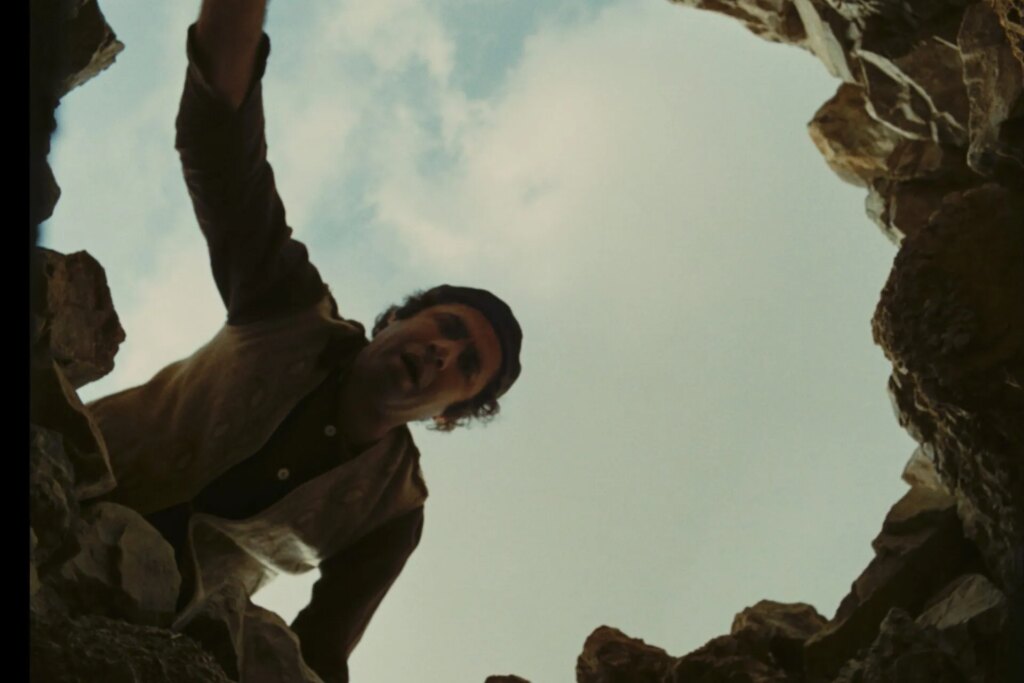

For the better part of half a century, much of the films produced by the Golestan Film Studio have been limited to rarely-circulated, often-damaged prints. So named for its iconoclastic, affluent founder, Ebrahim Golestan, the studio predated the Iranian New Wave by nearly a decade, bringing together poets and journalists across a series of documentary shorts and narrative features. This boxset, the first time the entire studio’s output has been assembled on home video, should therefore be treated as a seismic moment in preservation and archiving. Fortunately, the films are all bangers too.
Split across three discs, Treasures from the Golestan Film Studio covers two strands of shorts (one focused on Golestan’s documentaries, the other on his collaborator and muse, celebrated modernist poet Forough Farrokhzad) and Golestan’s only two narrative features: Brick and Mirror (1966) and Secrets of the Jinn Valley Treasure (1974). What persists across the entire catalogue is a strange fusion of poetry and political polemic, wherein reality is both abstracted and critiqued in the same motion. This pairing, a joining of Golestan and Farrokhzad’s sensibilities, is driven by the belief that society betrays its working class at every turn.
Those inclinations immediately clash with the financing behind Wave, Coral and Rock (1961) and A Fire (1961), which were both produced for the National Iranian Oil Company. And yet despite retaining some markers from that corporate steering, particularly a somewhat hand-holding narration, the images rightly pierce through any bluster. In Wave, Coral and Rock, mass metallic infrastructures and the hard manual labour that sustains them are pushed up against the mystic oceanic world beneath, Golestan deeply engaged with silt and sediment and the texture of the environment being plundered. Meanwhile, in A Fire an enormous fire erupts as a direct response from nature to the man-made oil drilling, its towering rippling flames and billowing smoke in stark contrast to the cool lines of man’s constructions. A duel, as Golestan puts it.
Golestan’s work hinges on these types of confrontations. In The Hills of Marlik (1964) and The Crown Jewels of Iran (1965) he pores over man-made relics and treasures, presented in black fabric voids. In the former, he muses about time’s endless passing, questioning how we can interact with historical finds, gently brushed clean of any dirt and painstakingly reassembled, when they’re so divorced from their context, present and yet wholly apart from us. In the latter, he presents a rapid-fire succession of the Iranian crown jewels in their vault, followed by a similarly fast montage of poor labourers working the fields. By pushing luxury up against images of the proletariat, Golestan makes a blunt force point about how distant from labour these trinkets are. Pleasing to the eye, but dead and of no actual worth. You can’t eat ‘em!
The most famous and well regarded of the works here, The House is Black (1963), is also one of the few not directed by Golestan. Forough Farrokhzad, in what would be her only film as director, takes cues from Golestan’s style. But she is far more focused on people themselves than their creations, taking in the entirety of an Iranian leper colony with an open-hearted lens. The perspective is educational yet empathetic, trying to reckon with a disease where care is the main cure, and poverty is the main affliction. It’s a cruel society that shuns its most needy.
The two features take the fierce social critique that defines the early Golestan documentary shorts, but translates them into narrative form. Brick and Mirror (1966) takes a more recognisable social realist shape, following the plight of a taxi driver, Hashem (Zakaria Hashemi), who finds a baby left in the back seat of his cab. But Golestan refuses to take the easy path in the odyssey that follows, whether it’s in a surreal encounter Hashem has with a cryptic female mystic in a ruined building, or the documentary-like footage of an orphanage that drives the final emotive point home. “Whose baby is this? “Bad luck’s.”
By contrast, Secrets of the Jinn Valley Treasure (1974) is a camper and more farcical affair—though no less incisive. When a poor farmer stumbles upon a hidden burial chamber of jewels and gold statues, the falling dominos that follow are perhaps inevitable. Perhaps as a result of Golestan’s own wealth (interestingly, he spent the latter part of his life living in a huge manor in Sussex), the film is particularly preoccupied with the ease with which such a windfall corrupts an entire community, turning people from all walks of life from their previous callings. In the end, the origins of the wealth matters less than in whose hands it ends up. In the case of Golestan, it’s left to the audience to decide if the ends justify the means.
Special Features
- Outtake from Brick and Mirror (3 mins)
- Introduction by curator and the Golestan restoration project collaborator Ehsan Khoshbakht (2026, 14 mins)
- A Tree Called Golestan – a visual essay on Ebrahim Golestan by Ehsan Khoshbakht (2026, 8 mins)
- Introductions to each programme by Ehsan Khoshbakht (2026, 10 mins and 18 mins)
- Introduction by Ehsan Khoshbakht (2026, 12 mins)
- New interview with actor Parviz Sayyad (2026, 6 mins)
- See You Friday, Robinson – Mitra Farahani’s award-winning documentary (2022, 101 mins)
- Newly translated optional English subtitles
- Reversible sleeve featuring newly commissioned artwork by Filippo Di Battista
- Booklet featuring archival writing by Ehsan Khoshbakht
- Limited edition of 3000 copies, presented in full-height Scanavo packaging with removable OBI strip leaving packaging free of certificates and markings
Treasures from the Golestan Film Studio is available in the UK now courtesy of Radiance.