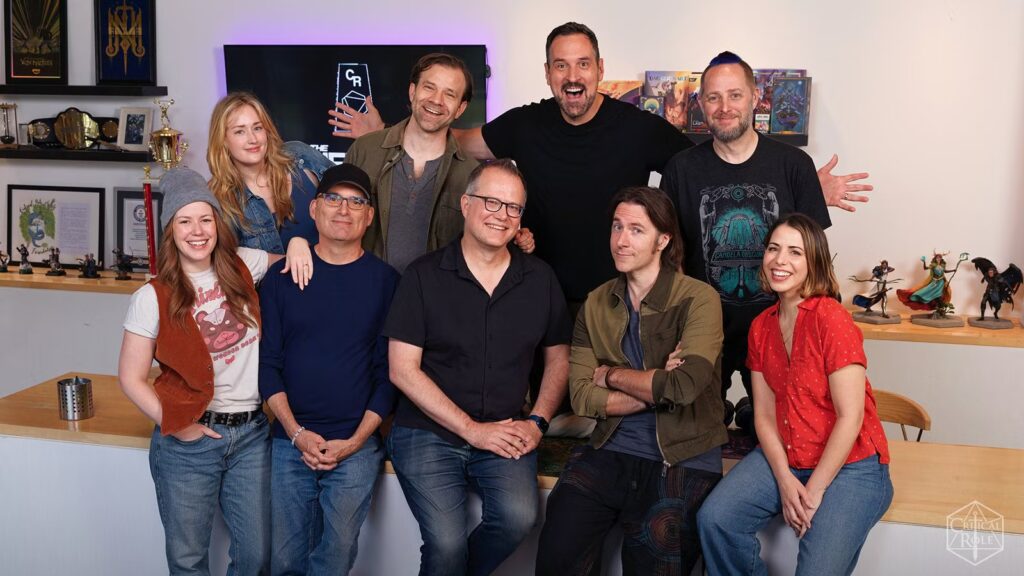

Chris Perkins and Jeremy Crawford are responsible for a lot of what Dungeons & Dragons looks like today. As two of the lead designers for the 5th edition of the game, they, along with Mike Mearls and many others, shaped much of D&D’s modern look, work that later carried on into the game’s 5.5 edition.
The two worked not only on the core rulebooks for both 5e and 5.5e, but also authored some of the most iconic and successful adventures published in the past decade, including Curse of Strahd, the best-selling D&D adventure of all time.
I can only imagine, then, how challenging it must have been for Perkins and Crawford to step into uncharted territory when, in 2025, they both joined Critical Role’s publishing arm, Darrington Press, to work on Daggerheart, a game whose rules they didn’t design.
Chris Perkins and Jeremy Crawford discuss leaving D&D for Daggerheart

“For me, it was super easy,” Perkins says in a video interview with Polygon. “Even working on D&D, we were building on the work of previous editions and the labors of the people who made those additions. It’s not like we were creating a game out of nothing.”
“For me, it’s actually been a delight,” Crawford adds. “Daggerheart is such a fun system to not only play in, but to work on. It has enough flexible parts to take and use to build new things, but it is also a new enough system that there’s actually a lot of design space that we’re exploring for future products.”
Just like how every edition of D&D builds on previous iterations of the game, Daggerheart has been influenced by many other TTRPGs, D&D included. For example, many of Daggerheart’s rules resemble D&D house rules that evolved organically over the years — for example, the Syndicate Rogue feature called “Well-Connected” is essentially the “I know a guy” house rule.
“There is continuity, but it is far larger than just those two games,” Crawford says. “So many different RPGs inspired the Daggerheart design team. The broader RPG community is constantly exploring — no matter what they’re playing — different ways to play and to build worlds. One of the amazing things that the Daggerheart design team did is that they managed to capture the lightning in a bottle of the things that many different design teams and groups have been exploring, and they synthesized it into this game.”
Collaborative storytelling is in Daggerheart’s DNA

“Collaborative storytelling” is how many people describe and play TTRPGs, including D&D. It refers to how the Game or Dungeon Master and the players work together to build a story as it develops at the table. The GM may have a path in mind for the adventure or campaign, but they let players’ choices shape how it all unfolds. In D&D’s case, this particular approach is not inherently baked into the rules. But it’s widely regarded as the most enriching experience for everyone at the table. Simply put, it’s how good DMs run their games. Daggerheart takes this further by making it part of the game’s DNA, and both Perkins and Crawford are fully on board with this design approach.
“That goes back to the philosophy of Daggerheart,” Crawford says, “to take many of these things that groups have been doing for years, embracing them, and making them an official part of the game.” This philosophy goes beyond the game’s rules and extends to how products such as adventures and campaign frames are designed.
“In the Daggerheart campaign frames, there are points where the player is addressed directly, or the GM is told to basically go to the players and have them add something to the setting,” Perkins adds. “As we create more adventures for Daggerheart, we’re finding ways to bake that into the adventure design, so there are points in every adventure where the players are actually steering the ship. This is a fun shift for me as someone who has spent a literal lifetime working on adventure content. It’s a fundamental shift.”
I couldn’t agree more. D&D adventures are tools for the Dungeon Master, who guides players through them. Of course, DMs will add their own spins and make changes, and a good DM always involves their players in the storytelling process, but providing tools to actively shape the adventure as it develops is a monumental design change. Likely, some adventures from independent publishers have already experimented with this idea, but Daggerheart can do it at such a high level that it could change the industry forever.
Daggerheart is set to revolutionize the TTRPG industry
Perkins, who is working on a massive anthology of over 100 Daggerheart adventures, must feel a little like Gary Gygax and his colleagues did in the late 1970s when they were crafting the classic adventures that went on to define D&D for decades.
“It’s exciting to think about just what a Daggerheart adventure is,” Perkins says. “We literally only have one or two adventures out there in the universe. It’s a delightful thought exercise, and one I’ve never been part of, because D&D adventures are kind of established and codified. Here, we’re starting right at the outset with carte blanche, and we are going to take some chances, experiment a little, and see what lands.”

Crawford, on the other hand, is already working on a “spooky” campaign setting, but details are still kept under wraps. “All I can say right now is that it is scary but also a realm of dark fantasy where even people who might not normally be into horror are going to find something that will entice them,” Crawford says. “We already teased that the Blood Hunter and Summoner classes are part of the setting. I can add that there were also pieces of the setting teased during the Age of Umbra: Sallowlands series that Matt Mercer ran recently.”
The first year of Daggerheart might have been a quiet one, but things are going to change soon. With the planned two tentpole releases per year, Daggerheart is in position to become D&D’s first real competitor in a long time. But this is more than a competition between two games or fandoms.
“In the vast community of RPG players, we’re all in this together, experimenting with how we can move this art form forward,” Crawford says. “Sure, there are individual systems, but the older I get, the more I get concerned about just the art form as a whole. The art form of role-playing games is so precious and such a unique way for people to connect with each other and entertain each other that I am excited when I see the art form moving forward in any way in any game.”