
For guitar players, an element that is essential to recording as well as writing a song is choosing the right guitar for the job. I love a lot of different guitars – all guitars, really! – but especially Gibson guitars fitted with P-90 “soapbar” pickups.
For those unfamiliar, a P-90 is a large single-coil pickup that was standard issue on Gibson electric guitars prior to 1957, when the double-coil humbucker pickup replaced the P-90 on most of their instruments. I love the sound of P-90s! They’re loud and clear and have more top-end than a humbucking pickup.
When choosing a specific guitar for its tonal qualities, for me it will often happen when I’m writing the song. The riff itself will “decide” whether it needs to be played with a single coil pickup, a humbucker or something else entirely. There are Blackberry Smoke songs played on Gretsch and Rickenbacker guitars. So it’s all over the map!
Latest Videos FromGuitar World
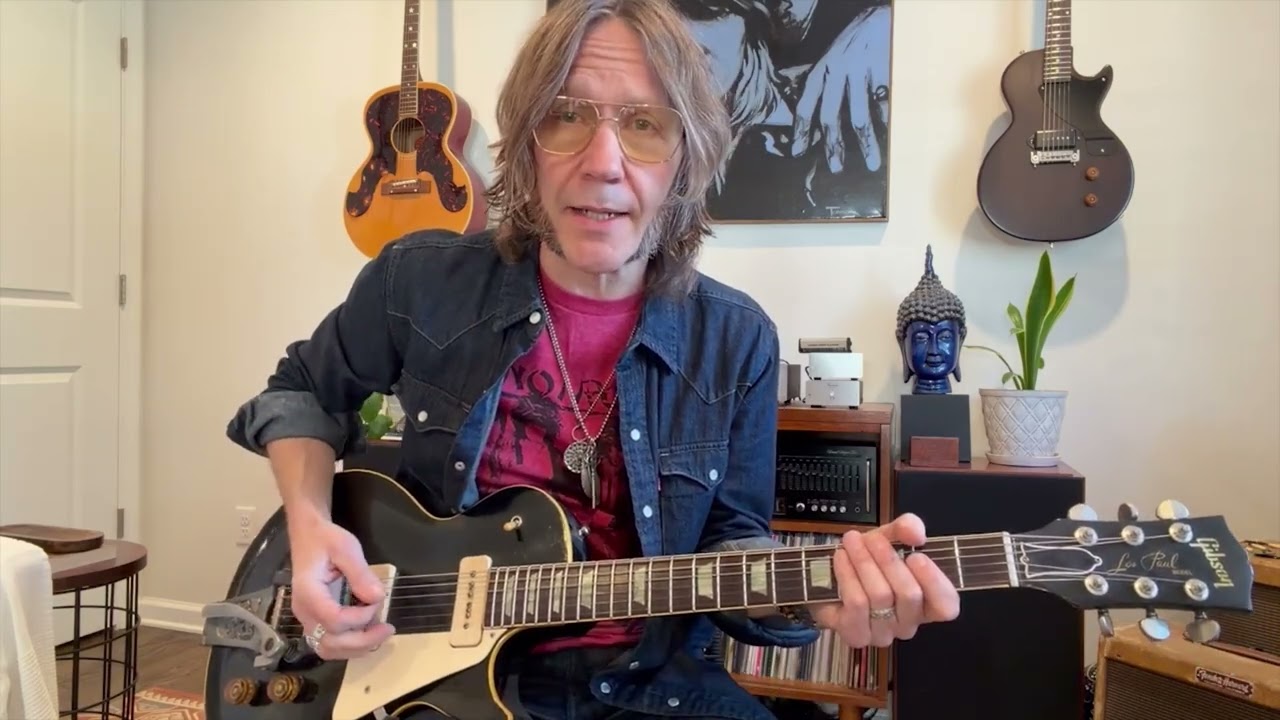
When I sat down to write Workin’ for a Workin’ Man, recorded for our 2016 album, Like an Arrow, the guitar that brought the song to life was a 1953 Gibson Les Paul Standard, fitted with P-90s and a Bibsby vibrato tailpiece. The “honk” of the bridge-position P-90, with its accentuated midrange, was perfect for a hard-driving riff like this.
Figure 1 illustrates the song’s primary riff, which for me felt so “at home” on a P-90 guitar set on the bridge pickup. I begin with an A5 power chord and then play two-note voicings on the D and G strings against the open A string, making brief reference to G/A and D/A. Bar 2 incorporates the A minor blues scale (A, C, D, Eb, E, G). In bar 3, the two-note voicings move over to the A and D strings.
Figure 2 shows the song’s pre-chorus, which is built around two-note 6th intervals, fretted on the A and G strings, which are played against an open low E pedal tone. In bar 1, I begin in 9th position and then slide down to 6th position. In bar 2, I begin in 9th position and slide up to 11th position. Be sure to allow your open low E string to ring out while playing the two-note 6ths on the other strings.

About midway through the song, we hit a breakdown section that features the riff shown in Figure 3, which is primarily a single-note riff based on the A blues scale. Here, I utilize double-stops along with D5 and C5 power chords.

At the guitar solo section, shown in Figure 4, I switch from the bridge to the neck pickup. Bars 1-2 are based on the E major pentatonic scale (E, F#, G#, B, C#). Bar 3, played over a G chord, is based on G major pentatonic (G, A, B, D, E), and bar 4, which is played over an A chord, is based on A minor pentatonic (A, C, D, E, G).

After this, it’s back to the bridge pickup for a recap of the main riff for the final verse. To me, this song is a prime example of how the right guitar, in this case a 1953 Les Paul Standard, serves every aspect of the song perfectly.