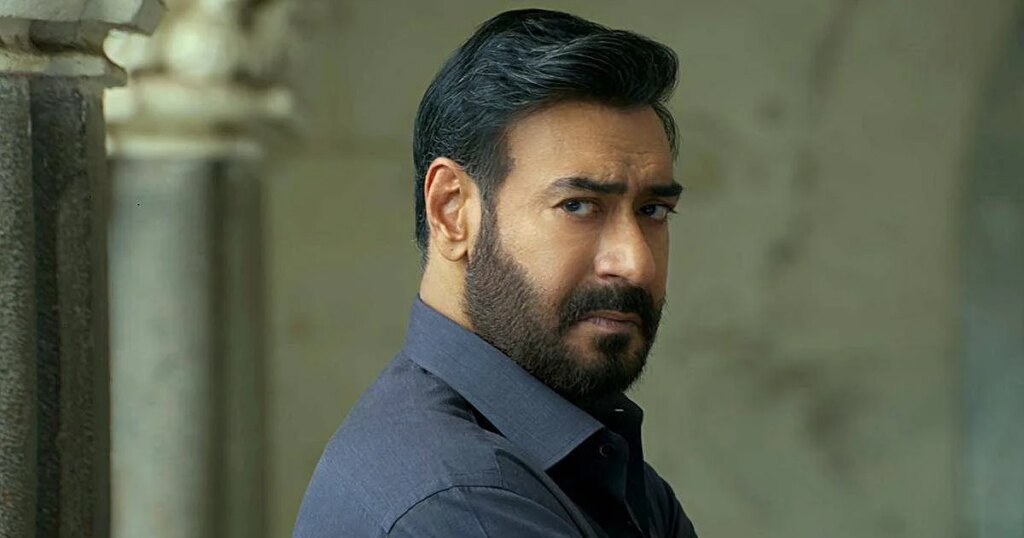

From Hera Pheri to Krrish and Drishyam, these Bollywood franchises took their sequels in wildly different directions from the films that inspired them.

IMAGE: Ajay Devgn in Drishyam: The Conclusion.
Key Points
- Drishyam: The Conclusion will be the first film in the Hindi franchise to tell an original story, breaking away from its Malayalam source material.
- Several other Bollywood franchises, including Hera Pheri, Bhool Bhulaiyaa and Singham, have successfully created their own narratives in sequels, moving beyond their initial inspirations.
- The Krrish series, starting with Koi… Mil Gaya, evolved from a sci-fi family entertainer into a full-blown superhero saga, achieving massive box office success.
Drishyam: The Conclusion, hitting theatres on October 2, is touted as the final chapter of the Hindi Drishyam franchise. Directed by Abhishek Pathak, the threequel brings back Ajay Devgn, Shriya Saran, Tabu, Rajat Kapoor, Ishita Dutta, Mrunal Jadhav, Kamlesh Sawant from the previous two outings, while adding two new heavy-hitters to the mix: Prakash Raj and Jaideep Ahlawat.
As you might be aware, the first two movies in the Hindi franchise owe their plotlines and twists to Jeethu Joseph’s Mohanlal-starrer Malayalam blockbuster, Drishyam (2013) and its 2021 sequel.
But Drishyam: The Conclusion is taking a fascinating turn. The supposedly concluding part is officially breaking away from the Malayalam franchise by telling its own original story. Both the makers and the trailer have firmly confirmed this.
The timing makes that decision even more intriguing. The Malayalam Drishyam 3, which came out earlier this year, was met with mixed reviews. More importantly, it ended with a promise for a fourth chapter, which is presently in the works.
Viewers familiar with both franchises will naturally be curious to see if Abhishek Pathak can step out of the massive shadow of the Malayalam franchise, which faltered with its third film, and craft a Drishyam movie that takes the story in a more satisfying direction and a natural conclusion as they keep promising.
Sreeju Sudhakaran looks at seven Bollywood franchises that broke away from their original inspirations, either by taking their sequels in a different direction or by abandoning the path their source material had taken.
Hera Pheri/Phir Hera Pheri

IMAGE: Akshay Kumar, Paresh Rawal and Suniel Shetty in Phir Hera Pheri.
Priyadarshan handed Bollywood one of its most iconic comedies when he remade Siddique-Lal’s Malayalam classic Ramji Rao Speaking (1989). That original film eventually spawned a sequel called Mannar Mathai Speaking (1995), which brought back the protagonists and dropped them into a brand-new comic mystery.
The Hindi franchise, however, took a different route. Phir Hera Pheri (2006) was not a remake of Mannar Mathai Speaking. Instead, it was a loose adaptation of Guy Ritchie’s British crime comedy Lock, Stock and Two Smoking Barrels (1998).
The sequel brought back Akshay Kumar as Raju, Suniel Shetty as Shyam, and Paresh Rawal as Baburao Ganpatrao Apte, but it was directed by Neeraj Vora rather than Priyadarshan.
Interestingly, Priyadarshan did eventually try to remake Mannar Mathai Speaking in Hindi, albeit as a completely different film: Bhagam Bhag (2006). That film also starred Akshay Kumar and Paresh Rawal, alongside other Phir Hera Pheri alumni like Rajpal Yadav, Manoj Joshi, and Sharat Saxena.
Bhool Bhulaiyaa Movies

IMAGE: Rajpal Yadav and Kartik Aaryan in Bhool Bhulaiyaa 2.
Priyadarshan’s Bhool Bhulaiyaa (2007) was one of his most successful imports from Malayalam cinema, adapting the evergreen psychological thriller Manichitrathazhu (1993).
Starring Akshay Kumar, it was a faithful adaptation. But when it was turned as a franchise with Bhool Bhulaiyaa 2 (2022), the sequel took a different route. It was much more of a requel, a reboot and a sequel, replacing the lead actor with Kartik Aaryan and handing directorial duties to Anees Bazmee.
The film dropped the psychological aspect of the first movie and wholeheartedly embraced full-blown supernatural themes, a trend happily repeated in Bhool Bhulaiyaa 3 (2024). Both movies emerged as huge blockbusters.
Yet, Bhool Bhulaiyaa 2 inadvertently circled back to the Malayalam franchise it was trying to leave behind. Priyadarshan had earlier taken over from his mentor Fazil to direct Geethanjali (2013), a spin-off of Manichitrathazhu bringing back Mohanlal and marking Keerthy Suresh’s lead debut.
What Geethanjali and Bhool Bhulaiyaa 2 share is that both owe their core supernatural twists heavily to the 2007 Thai film Alone, which also inspired the 2015 Hindi film Alone starring Bipasha Basu and Karan Singh Grover.
Singham Trilogy

IMAGE: Ajay Devgn in Singham Returns.
With apologies to our Tamil readers, while I thoroughly enjoyed Suriya’s performance in Hari’s 2010 entertainer Singam, I felt what Rohit Shetty did with the Hindi remake, Singham (2011) was far more enthralling.
A huge reason for that is the wildly rambunctious climax that makes the best use of Prakash Raj’s brilliant comic timing.
Singham was a big hit. But when it came to the more successful but less enjoyable sequel,Singham Returns (2014) took zero inspiration from the Tamil sequel released a year prior. Instead, it was loosely based on the 1993 Malayalam film Ekalavyan, with Ajay Devgn’s DCP Bajirao Singham taking on a powerful godman.
The franchise took an even bigger detour with Singham Again (2024), and had nothing in common with the critically reviled third part of the Tamil franchise. Instead, Shetty looked directly to the Ramayana for inspiration for his Avengers-ensemble of his Cop Universe, albeit that wasn’t enough to entice the fans enough.
Koi… Mil Gaya/Krrish Series

IMAGE: Hrithik Roshan in Krrish.
Rakesh Roshan’s superhit sci-fi family entertainer Koi… Mil Gaya (2003) owes its core storyline to Steven Spielberg’s beloved classic E.T. the Extra-Terrestrial (1982), while Hrithik Roshan’s character was reportedly based on Tom Hanks’ Forrest Gump (1994). E.T. never spawned a sequel, though Spielberg did briefly toy with plans for a much darker follow-up that never materialised.
Roshan Sr, however, took his story in a completely different direction and genre. He turned Krrish (2006) into a full-blown superhero origin story and continued that approach with Krrish 3 (2013), the latter, undeniably, borrowed heavy elements from the X-Men franchise.
The genre pivot definitely worked wonders for the Roshans, as both Krrish and Krrish 3 became massive blockbusters. Though the wait for Krrish 4, now slated to be directed by Hrithik himself, is getting excruciatingly long.
Dhamaal Movies

IMAGE: Jaaved Jaaferi, Riteish Deshmukh, Arshad Warsi and Aashish Chaudhary in Double Dhamaal.
Indra Kumar’s Dhamaal (2007) is almost a scene-by-scene adaptation of the 1963 American comedy It’s a Mad, Mad, Mad, Mad World. For those who had not watched the original, Dhamaal proved to be a highly entertaining film packed with fun performances.
The Hollywood original never had any sequels (though there were two Hong Kong-based spiritual successors), but Dhamaal did.
Double Dhamaal (2011) dropped the treasure hunt aspect and morphed into a con comedy, bringing back the core protagonists to continue their story. The movie was poorly received.
So when Indra Kumar returned with Total Dhamaal (2019), he essentially made a requel. He retained some of the main cast but rebooted their storylines, bringing back the treasure hunt element of the original film, a lucrative tradition that continued in the recent Dhamaal 4 (2025).
Both the movies were hits, so expect him to continue sticking to having his characters seek treasures they never get their hands on in future Dhamaal movies.
Awara Paagal Deewana/Deewane Huye Paagal

IMAGE: Suniel Shetty, Rimi Sen, Paresh Rawal and Akshay Kumar in Deewane Huye Paagal.
Okay, Deewane Huye Paagal (2005) is not technically a direct sequel to Awara Paagal Deewana (2002), but was set up as a spiritual follow-up.
It retained the same director (Vikram Bhatt), producer (Firoz Nadiadwala), and dialogue writer (Neeraj Vora), alongside core cast members like Akshay Kumar, Paresh Rawal, Suniel Shetty, Johnny Lever, Om Puri, and Supriya Pilgaonkar. Aftab Shivdasani even dropped in for a cameo.
The comedy shared the exact same flair, and even the title fonts were strikingly similar. But the film’s inspiration came from elsewhere.
Awara Paagal Deewana was a faithful remake of the 2000 American comedy The Whole Nine Yards, starring Bruce Willis and Matthew Perry. That film did have a far less popular sequel, The Whole Ten Yards (2004).
But Deewane Huye Paagal ignored that, taking its inspiration instead from a totally different R-rated comedy: The 1998 Farrelly brothers hit There’s Something About Mary.
Sarkar Saga

IMAGE: Amitabh Bachchan and Abhishek Bachchan in Sarkar Raj.
Ram Gopal Varma’s political crime drama Sarkar (2005) is heavily indebted to Francis Ford Coppola’s all-time masterpiece The Godfather (1972) in terms of plot, characterisation, and even specific scenes, particularly the climax.
But Varma made a few significant changes. Amitabh Bachchan’s Subhash Nagre survives the first film, unlike Marlon Brando’s Don Corleone, who passes away right before the third act of The Godfather. More importantly, Bachchan’s character continues to lead the Sarkar sequels, whereas Don Corleone’s son Michael (Al Pacino) takes over in The Godfather Part II (1974), which also gives us the Don’s backstory via Robert De Niro, and Part III (1990).
Sarkar Raj (2008) took the franchise even further away from The Godfather template. Despite directly continuing the story, it offers no backstory.
Abhishek Bachchan’s character, who serves as the Michael Corleone of the Sarkar saga, is shockingly killed before the climax, prompting his furious father to go on a brutal revenge spree.
By the time Sarkar 3 (2017) arrived, the franchise had strayed astronomically far from The Godfather saga, shifting its focus entirely to Subhash Nagre’s grandson (Amit Sadh) and earning the absolute worst reviews of the franchise.
Photographs curated by Satish Bodas/Rediff