
WHAT ARE MY THOUGHTS ON VERITY?
“Maybe you should switch to romance.” In director Michael Showalter’s Verity, Dakota Johnson’s author Lowen Ashleigh hears these words after she expresses difficulty with her own, much darker writing genre. One could naturally view this as an inside joke about the fact that Colleen Hoover, the author on whose book this film is based, is primarily known for writing love stories that are often about as much harmless yet melodramatic fluff as your average Nicholas Sparks novel. But in a sense, it’s the movie’s own way of crying out for help, as the filmmakers and indeed Hoover’s own story are both reaching far beyond their means with subject matter and overall tones that they’re perhaps not so qualified for.
With Verity, there is a sense that director Showalter and screenwriter Nick Antosca aren’t sure what to make of the material that Hoover has provided. Their adaptation feels strangely detached in how it tackles ideas and themes that none of them, not even Hoover, knows how to properly handle, making for something that aims for overblown campiness but never justifies such an exaggerated and often ridiculous narrative.
To give you an example of how over-the-top that narrative is, one of the first things that happens is Johnson’s Lowen, a struggling writer, being suddenly sprayed with the blood of a slain cyclist that’s been hit by a car. As if that wasn’t insane enough, this moment also serves as the film’s meet-cute between the traumatised Lowen and Jeremy Crawford (Josh Hartnett), the husband of celebrated author Verity Crawford (Anne Hathaway) who happens to be passing by and lends her his shirt to replace her blood-soaked one. Incidentally, they’re both headed to the same meeting, where Jeremy invites Lowen to ghost-write the final few books in Verity’s best-selling series of dark crime novels, which Verity cannot complete herself due to a recent car accident leaving her in a catatonic state.
Lowen soon heads to the Crawfords’ lakeside home to gather notes and piece together the stories, where she not only begins to develop a closer connection with Jeremy – who’s also mourning the tragic death of his daughter – but also learns, via a secret autobiographical manuscript, that Verity had a much more morose view of her life as a wife and especially as a mother. So much so, in fact, that Lowen becomes immensely disturbed by Verity’s increasingly questionable confessions, evem having visions of the seemingly catatonic Verity in the background like she’s some kind of Michael Myers-like boogeyman.
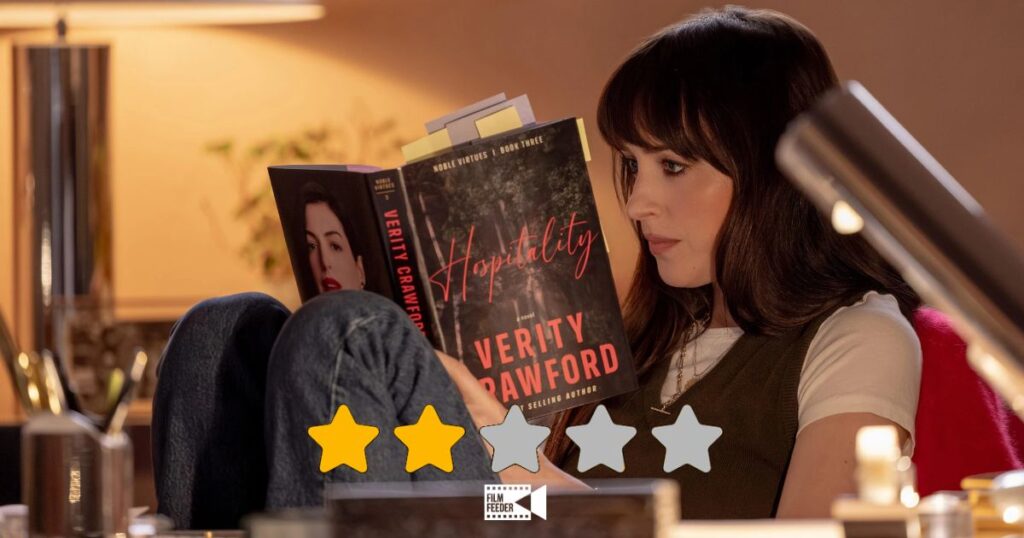
In case it wasn’t already apparent in that plot summary, the biggest issue with Verity is its own narrative. It’s clearly aiming for the kind of dark psychological thriller storytelling previously put to much better (and certainly more entertaining) use in the likes of Gone Girl and The Housemaid, but here it never feels as though things are progressing to anything quite as wild or even as unpredictable as those stories. A lot of the narrative is very stagnant, as Johnson’s Lowen spends most of the movie sitting around and reading the grim manuscript that Verity has left behind, sullying much of the tension as it meanders aimlessly before suddenly unloading plot twist after plot twist that makes increasingly little sense before an overblown climax (complete with outrageous thunder effects) and a final rug-pull that it doesn’t quite earn.
Strangely, the filmmaker can only match the airlessness of the narrative without actually improving on it. Showalter’s direction is noticeably flat as it moves from scene to scene competently but never interestingly, with only a series of bland visuals and a fruitless sense of eroticism carrying it, to a point where it almost starts to feel like it exists within the cinematic universe of the Fifty Shades trilogy (though how one could explain two Dakota Johnsons walking about is one for the experts). Sadly, the performances are also reflective of the strange lack of passion surrounding this material, as good actors like Johnson, Hartnett, and even Hathaway who spends most of the movie in a supposed state of catatonia, are directed with little conviction while Antosca’s script barely expands upon Hoover’s original story, leaving the actors without much material to work with on their own.
Much of it just screams as though neither Hoover nor the filmmakers adapting her work truly knew how to work within this kind of dark, vaguely campy subject matter. Showalter relies on stale thriller conventions to further exaggerate the mystery, such as inserting loud jump-scare music when the smallest insignificant thing happens, which only draws more attention to how overblown certain aspects of this story are than actually creating an unsettling atmosphere. While Antosca perhaps has more experience in this realm, having created and showran the true-crime miniseries The Act as well as Apple’s recent Cape Fear serial, he is once again saddled with source material that is already so drenched in its own nonsense that no adapting screenwriter can truly save it.
As for Hoover herself, with Verity she’s crafted a story that is as unsatisfying on the screen as it presumably is on the written page. Maybe, to quote this very movie, she should switch to romance.