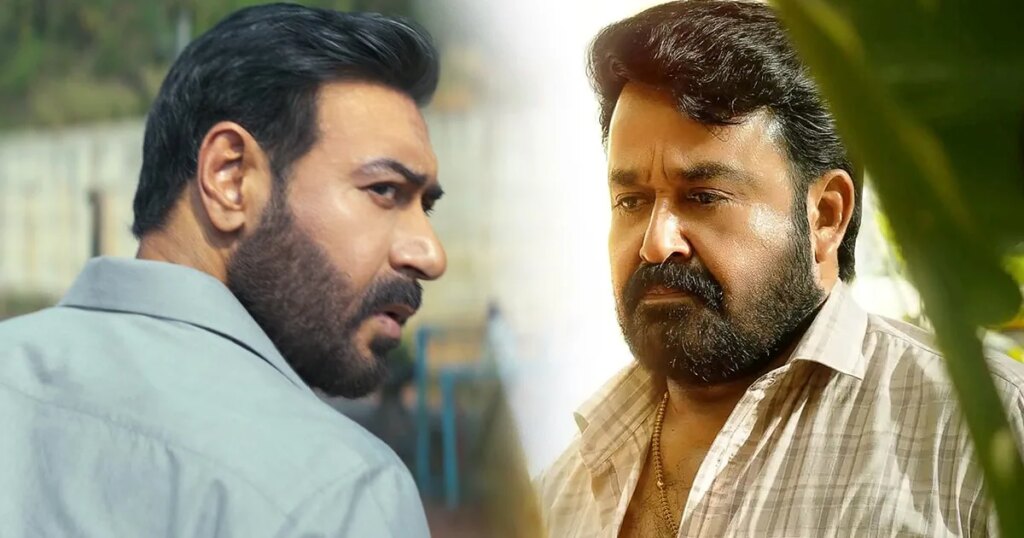

Drishyam: The Conclusion has remarkably outsmarted its Malayalam counterpart, Drishyam 3, by delivering a superior thriller that perfectly understands audience expectations for intricate plots and compelling twists.

IMAGE: Ajay Devgn in Drishyam: The Conclusion; Mohanlal in Drishyam 3.
Key Points
- Drishyam: The Conclusion succeeds because Director Abhishek Pathak understands that audiences come to the franchise for clever investigations, elaborate twists and Vijay Salgaonkar staying several steps ahead of his enemies.
- Unlike Drishyam 3, the Hindi film keeps its focus on procedural tension, uses its supporting characters more effectively and avoids excessive melodrama.
- By breaking away from Jeethu Joseph’s path while preserving the elements that made Drishyam popular, Abhishek Pathak turns the Hindi third instalment into the franchise’s strongest film.
What a shocking turnaround!
For an industry often criticised for being obsessed with remakes, and for a franchise that owes its very existence to adaptations, it came as a pleasant surprise that Drishyam: The Conclusion took an original approach instead of simply copying its Malayalam counterpart, and that did NOT suck!
The bigger question is whether whatever Abhishek Pathak cooked up with Drishyam: The Conclusion has turned out to be better than what Jeethu Joseph served in Drishyam 3.
The answer is simple: Yes.
But this is not simply a case of the Hindi film being different or ‘original’ and that made it better. This is more of the Hindi franchise understanding its strengths and weaknesses and also what works about it for the fans, and tailoring their film accordingly.
So, how did the Malayalam franchise, which proudly boasted of being the original and superior series, stumble so badly like the proverbial hare, while the ‘copycat’ Bollywood version suddenly won the race?
Sreeju Sudhakaran dissects both Drishyam 3 and Drishyam: The Conclusion and finds out how the latter trumped over the former.
Reason 1: The Twists Work Better

IMAGE: Ajay Devgn, Shriya Saran, Ishita Dutta, Mrunal Jadhav and Jaideep Ahlawat in Drishyam: The Conclusion.
I will always maintain that Malayalam Drishyam 2 was far superior to the Hindi remake (apart being the original film), a fact that ultimately became its Achilles heel.
Drishyam 2 in Malayalam ended by reminding you of the psychological prison Georgekutty had trapped himself in, one from which he could never escape. It was a genuinely powerful and bittersweet ending, that shows it is never a clean victory for the hero while giving us a glimpse of the protagonist’s lonely mental state.
The Hindi version was far more upbeat, proudly ending with Vijay Salgaonkar chilling with his family.
In Drishyam 3, therefore, Jeethu Joseph became increasingly interested in Georgekutty’s psychological paranoia and him dealing with the emotional consequences of his actions, sometimes at the expense of the very thriller mechanics that made the franchise so popular.
The second half collapsed as Georgekutty became reactionary while scrambling to save his family, and not the proactive mastermind we knew him to be. Therefore, the ludicrously-written twists sucked.
The Hindi film never forgot its franchise formula. The makers knew fans were there for mind-blowing twists. The buildup for those was sometimes predictable, but the revelations were not. For example, Vijay Salgaonkar, a Hindu, is introduced praying in a church, followed by a mention of a protest over church land encroachment. You instantly know these details will matter.
The same applies to Vijay’s seemingly innocuous phone calls with unseen people. You already know those conversations are going somewhere. You see the pawns he is going to play, you just don’t know when and how.
When those revelations arrive at the right moments in the second half, they exploded exactly the way the makers wanted them to be. It doesn’t mean all the twists made sense, and one of them even retcons the events of the previous film (in a way, it kinda makes sense), but as long as the audience’s mouths collectively drop, Mission Accomplished!
Reason 2: It Understood Its Protagonist Better

IMAGE: Ajay Devgn in Drishyam: The Conclusion.
There is a specific reason why Georgekutty and Vijay Salgaonkar appeal to fans so strongly as clever underdogs.
In one scene in Drishyam: The Conclusion, Meera (Tabu), Mahesh (Rajat Kapoor) and SP Rajveer Singh Tomar (Jaideep Ahlawat) meet public prosecutor Indrajith Shetty (Prakash Raj), who chuckles at the absurdity of highly educated, powerful people plotting together to bring down a fourth-standard-failed common man.
That is exactly what makes Vijay such an incredible protagonist. He stands against the might of the system, using that very system to protect his family despite lacking any formal education. All he truly has is his love for cinema and a brilliant sense of storytelling, not to mention, his fiercely protective nature.
The movie eventually has him reveal how he writes the screenplay of his own life, with his enemies merely playing the roles he has created for them. That is Vijay Salgaonkar’s pulpy genius, and it is something Abhishek Pathak clearly understood.
Georgekutty, meanwhile, made some glaring mistakes in Drishyam 3 that are difficult to reconcile with the supposedly meticulous strategist we know him to be. He never properly keeps tabs on disgraced ex-cop Sahadevan (who was his biggest nemesis in the first film), fails to investigate his daughter’s prospective husband and even produces a movie that appears to (insensitively) celebrate his victory over his enemies, who are, ultimately, grieving parents.
At least Vijay smartly drops that movie-making plan.
Reason 3: The Police Procedural Makes It More Taut And Thrilling

IMAGE: Jaideep Ahlawat in Drishyam: The Conclusion.
The basic thread in both the movies remains the same: the protagonist’s enemies trace his steps from the previous film to expose how he switched the mortal remains.
In the Malayalam film, the cops abandon their official investigation against Georgekutty, forcing Prabhakar to resort to underhanded methods with the help of Sahadevan. When that fails, they eventually concoct an elaborate (and dumb) plan to frame Anju for a fake murder.
Drishyam: The Conclusion is far more cohesive. It begins with Meera and Mahesh grieving before the latter teams up with Rajveer Tomar (Jaideep Ahlawat) to bring Vijay down. Tomar identifies the biggest threat against Vijay immediately: Finding Vijay’s DNA on the switched remains.
From there, the movie builds its case through a proper procedural investigation. Vijay almost becomes a supporting player in his own film. Pathak wisely keeps him restrained until the right moment, allowing Rajveer and later Shetty to gloat before eventually being forced to eat humble pie.
These procedural portions keep the film taut and focused while ensuring they provide adequate firepower for the courtroom drama portions that dominate the second half.
Reason 4: It Makes Better Use Of Its Supporting Characters (Mostly)

IMAGE: Prakash Raj in Drishyam: The Conclusion.
In the Malayalam film, Georgekutty receives most of the character development because the story focuses so heavily on his psychological apprehensions. Yet, even he makes rookie mistakes that I have mentioned earlier. Also, for a fiercely protective man desperate to save his family, intentionally and grievously injuring Anju to protect her was quite frankly laughable.
The treatment of the other characters is even more frustrating. Veena Nandakumar became the Internet’s favourite meme as the ‘bucket star’, but the real problem was how her character disappeared after being built up as a formidable foe.
Sahadevan’s much-anticipated return was reduced to that of a paid goon. Most frustrating was Prabhakar’s sudden transformation from the franchise’s most pragmatic character into an idiotic schemer. His unconditional love for his depression-suffering wife might explain reckless behaviour, but the film never properly develops this drastic change. It simply uses it as a cheap shock.
Coming to Drishyam: The Conclusion, fans were understandably disappointed when Akshaye Khanna dropped out just days before the shoot. Jaideep Ahlawat, however, proved to be a solid replacement (was there ever any doubt?), playing a completely new character with fewer moral grey areas.
He is simply a dedicated cop doing his duty, viewing Vijay as an arrogant criminal trying to outwit the system. His tense meeting with Vijay at the latter’s home is one of the standout scenes in Hindi cinema this year.
Ahlawat is slightly underused in the second half, but that gives Prakash Raj room to shine as the haughty public prosecutor. His overconfidence makes his eventual humiliation during the tape-recorded sequence all the more entertaining.
Even Shriya Saran gets a solid third-act moment.
Ajay Devgn is no Mohanlal, and the film smartly acknowledges that. It uses his famously deadpan expressions to hide what Vijay is actually thinking. When that mask finally slips, the impact is tremendous.
Even Kamlesh Sawant’s irksome Laxmikant Gaitonde is surprisingly entertaining this time, whose sarcastic dialogues include fun meta jokes about the franchise.
Where Drishyam: The Conclusion does disappoint is in underusing Meera and Mahesh, not giving Tabu and Rajat Kapoor much to do. The movie begins with establishing their trauma as supposedly their emotional drive, only to sideline them later as they watch Vijay outmanoeuvre them. Again.
Reason 5: It Did Not Resort To Melodrama

IMAGE: Shriya Saran and Ishita Dutta in Drishyam: The Conclusion.
A major reason why I disliked the Hindi Drishyam 2 was its insistence on cheap melodrama, particularly the return of violent police interrogation methods that the Malayalam film wisely avoided.
Ironically, the Malayalam Drishyam 3 became far more melodramatic. The focus on Anju’s marriage felt forced, especially since the film itself established that she was neither mentally nor psychologically ready for such a transition.
Her marriage also exposes the narrow-mindedness of Georgekutty as a father. He felt like a man trying to get rid of his daughter without properly investigating the family he is marrying her into.
The Hindi version touches upon the elder daughter’s marriage, but smartly uses it to lead into the intense faceoff between Tomar and Salgaonkar rather than allowing it to dominate the story.
The police procedural keeps the film moving and leaves little room for emotional wallowing. And this time, Drishyam: The Conclusion refuses to use unnecessary violence to artificially heighten the melodrama. Even better, there was no Kalyan Jewellers product placement.
Reason 6: It Wants To End On A High

IMAGE: Tabu and Rajat Kapoor in Drishyam: The Conclusion.
What annoyed me most about the Malayalam Drishyam 3 was its ending. The previous two films offered proper conclusions to their storylines, but Drishyam 3 leaves the door wide open for a cash-grab sequel while awkwardly trying to tie up its own messy plotlines.
Drishyam 4 is officially on the way, but the excitement is considerably lesser because even the die-hard fans can see that the makers are trying to squeeze more out of a golden goose. After all, Drishyam 3 did become one of the highest-grossing Malayalam films of all time despite the mixed reviews.
Au contraire, Ajay Devgn and Abhishek Pathak repeatedly insisted before release that they wanted to end the Hindi franchise on a high, hence the title Drishyam: The Conclusion. That is an admirable choice because it is difficult to keep inventing fresh twists once the creative well runs dry.
Whatever Pathak cooked up here properly concludes the story established in this film. That does not mean the franchise can never return, but what Drishyam: The Conclusion has is not a cheap open ending that cheats the audience out of a satisfying conclusion.
Reason 7: A Gamble That Paid Off

IMAGE: Ajay Devgn in Drishyam: The Conclusion.
A remake franchise does not have to blindly follow its original inspiration with every sequel. Just look at how Rohit Shetty’s Singham franchise diversified from the Tamil original.
The tricky part for Drishyam was that the first two Hindi films relied heavily on Jeethu Joseph’s writing (along with Ajay Devgn’s star appeal). Even though both were blockbusters, they were still adaptations. That lack of originality always made them feel inferior even when they had a major domination on the social media chatter.
When Abhishek Pathak, riding high on the success of Drishyam 2, kept claiming he was working with Jeethu Joseph on a simultaneous third film, those boasts lacked much basis, especially as Jeethu repeatedly denied that such a collaboration was possible. Also, we never really got to see Pathak’s ingenuity as a screenwriter.
Once both franchises chose different paths, it became a trial by fire for Pathak and his writers. They had to prove they understood a franchise whose foundations were laid by someone else.
Well, they aced the assignment. They knew exactly what made Vijay Salgaonkar work and what the audience wanted from him.
It recognises that the fans comes for the cheesy pleasure of watching an apparently ordinary man stay several steps ahead of a powerful system, for the elaborate investigation into how he could possibly get away with his crimes, and, most importantly, for those big twists that make you rethink everything you have just watched.
That understanding informs almost every major creative decision in Drishyam: The Conclusion. It is there in how Vijay Salgaonkar is written, how his enemies investigate him, how the supporting characters are used, how the film handles its emotional beats, and even how it chooses to end the story.
That gamble paid off, both critically and commercially. The Hindi franchise finally dared to diversify, and in doing so, it ended up being the better Drishyam.
Photographs curated by Satish Bodas/Rediff