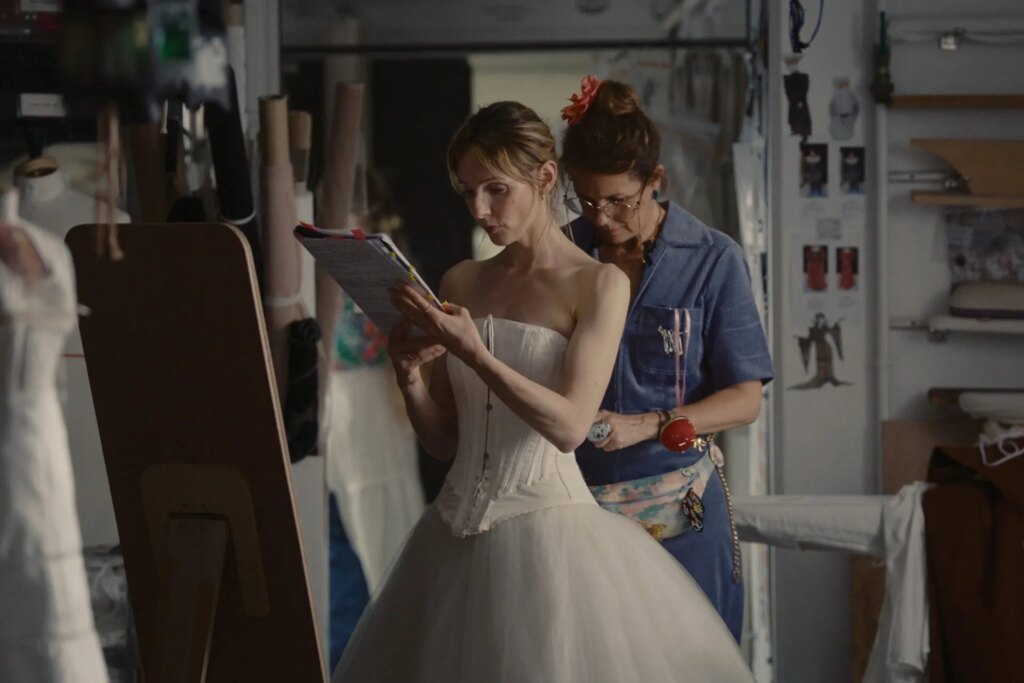

Comédie-Française (De la Comédie-Française) (2026), directed by Martin Darondeau and Bertrand Usclat, takes place inside one of France’s most revered arts institutions and the world’s oldest still-performing theatre company. At the Comédie-Française, there is one golden rule: the play is never cancelled. Unfortunately for Nina (Pauline Clément), everything begins to unravel just three hours before the premiere of her first ever production as the director, a retelling of Shakespeare’s Macbeth. With the clock ticking, Nina must somehow keep everything together long enough to get the show on stage.
Nina arrives at the theatre in a rush, nearly denied entry after thinking she has left her ID badge at home. From there, she races through the building with her bike, up staircases and backstage corridors, desperately trying to figure out where she needs to be. This frantic introduction sets the tone for the rest of the film. When she finally finds the members of her company, they remind her that the performance begins in only three hours. From there, Nina’s problems only multiply. Her lead actress is stuck on a train, forcing the company to find a last-minute replacement, stage equipment begins to fail, and tensions between the performers continue to rise. As Nina’s panic grows, so does her insecurity as a first-time director. Clément does a fantastic job portraying someone trying to maintain control while everyone looks to her for answers she doesn’t have. The camera often follows closely behind Nina as she moves through the bustling backstage corridors, creating a sense of constant movement that mirrors her increasingly frantic state of mind. Clément gives Nina a determination that makes her an easy protagonist to follow and makes the audience care about whether she can actually pull the production together.
The ensemble is equally great, with Laurent Stocker, Julien Frison, Marina Hands, Adeline D’Hermy, Danièle Lebrun, Christian Hecq and Sefa Yeboah each bringing distinct personalities to the company. The film takes time to show how these characters interact, including where their personalities and egos clash, and much of the comedy comes naturally from those relationships and in the increasingly absurd problems they have to overcome together. The constant stream of obstacles works in the film’s favour because the story itself is relatively simple. Rather than relying on a complicated plot, the film keeps moving by throwing new problems at Nina. This approach also allows Comédie-Française to capture the particular chaos of working behind the scenes at a theatre. The situations are exaggerated, but they remain grounded enough to feel recognisable. The mounting pressure also forces Nina to finally find her own voice. She begins the film as someone who struggles to make decisions, but as everything around her falls apart, she gradually becomes more assertive and confident in her role as a director.
When Nina finally breaks down in front of the company, Clément’s frustration feels genuine without being overdone, which makes the scene much more affecting. Unfortunately, the film then introduces one of its clumsiest moments when Nina has an encounter with Molière’s ghost, who reminds Nina of the theatre’s history in an attempt to convince her to go on. The scene feels unnecessarily on-the-nose, interrupting the emotional momentum that had been built naturally up until then. But Nina eventually comes to her own conclusion in a much more meaningful way, and because this moment works so well on its own, this addition feels unnecessary, even if the emotional payoff that follows still lands.
Despite this misstep, Comédie-Française is an enjoyable blend of comedy and lighthearted drama. Its final moments bring the company together on stage, with Nina at the centre as they embrace one another. It is a simple but genuinely beautiful image of everything she has spent the entire film trying to protect. The theatre may be chaotic, the performers may be unprepared, and almost everything that could have gone wrong, does go wrong, but once the curtain rises, the show must go on.
Comédie-Française is in cinemas from 9th October.