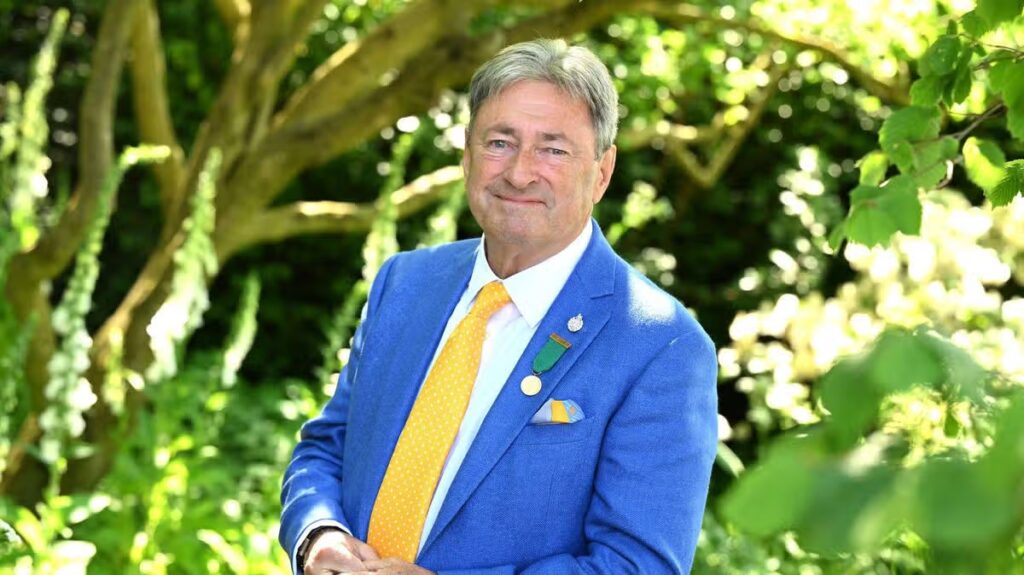

Gardening legend Alan Titchmarsh has named seven fragrant garden plants that he would never be without in his own garden, sharing expert tips on how to grow each one

Alan Titchmarsh has named seven scented plants he couldn’t be without(Image: Getty)
One of Britain’s most celebrated gardeners, Alan Titchmarsh, has revealed seven fragrant plants he considers essential in his own garden. The BBC Gardeners’ World legend and ITV’s Love Your Weekend presenter shared his selections in a comprehensive video on his YouTube channel, which launched earlier this year.
Throughout the video, he identified each plant, highlighted their most attractive characteristics, offered practical gardening advice, and described their distinctive scents. Helpfully, Alan also commented on which of the seven would survive the UK’s summer heatwaves. Counting down from seventh to his top choice, he meticulously examined each one before declaring his ultimate favourite.
7th: English Lavender
Securing seventh place on Alan’s list was English lavender, which he characterised as a “wonderful accompaniment” to roses. Offering advice on their maintenance, he explained: “Just as these are beginning to ripen in summer, you can go over with your shears, cut them all off, and make lavender bags out of them to stick among your smalls.
“But there is another reason why you do that, and that is by cutting lavender back quite lightly, but just beyond the flowers in late summer, you’re giving them enough time to produce new shoots from the base that will flower again next year.”
Subsequently, referencing the progressively warmer and drier summers Britain has experienced of late, Alan noted: “It’s really well adapted to cope with high temperatures and the kind of hot summers we’ve been having recently.”
6th: Choisya – Mexican Orange Blossom
Securing sixth place in Alan’s rankings was the renowned Choisya, commonly referred to as Mexican Orange Blossom, with Alan noting two varieties exist, both of which he displayed in the video.
He elaborated: “This is a double whammy of a shrub. In fact, there are two distinct kinds. There’s the plain green kind, and there’s the sort of lime green kind. I like both of them and I’m particularly fond of the ordinary plain green one. It has wonderful white blossom in May and again in September.”
Regarding the shrub’s distinctive scent, he was effusive in his praise, adding: “It’s wonderfully fragrant, that blossom. Even the foliage is aromatic. Crush it and you’ll get the aroma….It’s quite fruity.”
Alan also discussed his own use of the plant at home and the visual appeal it creates as a consequence. He remarked: “What I’ve done with Choisya is replace a lot of box hedging. It grows more vigorously but I’ve clipped it in this great rolling sea. The leaves are shiny. It’s pretty tough and in a really, really hard winter, right up north, it’s a really good doer of a shrub.”
5th: Perovskia – Russian Sage
Alan devoted less attention to Perovskia compared to other specimens on his list, though he remained enthusiastic about the plant’s qualities.
He highlighted how one of its advantages is the plant’s self-supporting nature until maturity, while also possessing a pleasant aroma. He explained: “The great thing about this is that it’s self-supporting, it doesn’t need a stake, until it gets older and heavier and then starts to go over.
“There are dwarfer forms now which are about half the size. The fragrance, which you’ll only get when you crush it, is a kind of hybrid between lavender and eucalyptus. If you feel a little bit bunged up, squeeze it.”
4th: Salvia – Royal Bumble
Narrowly missing a podium position was Salvia, also referred to as ‘Royal Bumble’, which Alan commended for offering a “good range of colours” and an “ability to flower form one end of the summer to the next”.
Regarding their scent, Alan noted: “Crush the foliage to the aroma, or if you don’t like it, don’t, but it’s really quite powerful and the fragrance, the aroma, does vary from species to species.”
Concerning planting advice, Alan outlined: “Again, another plant for a good British summer. Well drained soil, full sunshine. And you’ll find they make plants about one and a half to two feet tall. Good fillers these for borders in between all kinds of other plants.”
3rd: Phlox paniculata
Characterising these as border stalwarts, Alan described what he held as a herbaceous phlox. Regarding identification from other varieties, he confirmed it was a phlox paniculata “with a panicle”.
He clarified: “That’s the shape of the flower head.”
Alan also offered a cautionary note regarding phlox’s preferred conditions and how to maximise its potential: “This is not a plant for poor dry soil. It likes sunshine, but it likes a bit of beef at the roots.
“It’s very quick to wilt when the soil dries out. So, find it a spot where the soil can hold onto moisture, and then you’ll get these gorgeous heads of flower, which are delectably sweetly scented. Absolutely lovely. [Aromas] come straight out into the open air.”
2nd: Lonicera periclymenum – Honeysuckle
Claiming second place in Alan’s list was the well-loved honeysuckle. Despite its powerful fragrance, Alan was full of praise for the plant, noting it thrives equally well in shaded or sunny spots.
He said: “It can be quite an overpowering perfume after rain when the heat comes on it, filling the air. It’s not just, ‘Oh that’s nice’. It’s ‘Oh my goodness, smell that honeysuckle’.
“It really is quite powerful. Imagine a shed that’s been decorated with these glorious flowers. It’s a lovely plant for sun or dappled shade. It’s quite a good shade lover this.
“Sometimes they can be a bit tricky and decide they don’t like you and take a while to settle in. When they do settle in, they’ll fill the air with fragrance. I love it, a wonderfully modest plant.”
1st: Rosa ‘Duchess of Cornwall’
Topping the list by a considerable margin was the rose, particularly the Duchess of Cornwall Rose, which Alan described as a “special rose”. He said: “This one has a particularly glorious flower, shape, and colour. This is Duchess of Cornwall, named after the present Queen’s former title.
“The most powerful of fragrances. When you’re looking for a rose, choose one that has really good glossy leathery leaves as well because that way it will be capable of shrugging off mildew and black spot.
“With Duchess of Cornwall, good foliage, beautiful flowers, with a glorious fragrance that carry on right the way through the year. I’d give her a home in my garden.”
Alan’s remarks come as he makes his return to British television with Love Your Weekend with Alan Titchmarsh, broadcasting on ITV from 9.30am until 11.30am.