
Ask anyone who saw Teenage Sex and Death at Camp Miasma, Jane Schoenbrun’s breakout horror-romance-comedy, to name the big musical moment in the film, and they will instantly say “Counting Crows.” When the film’s fictional slasher villain Little Death arises from the lake, some familiar piano chords surface as well, and “A Long December” plays uninterrupted, every single drawled “na-na-nah” and “yeah” accounted for, as counselors fall to the ground screaming in fountains of corn-syrup blood and fake guts. It’s transcendent; it’s hilarious. During my first viewing, I cackled so loudly during this scene I worried one of my neighbors would report me.
If fewer viewers remember Alex G’s score, that’s a testament to his mindmeld with Schoenbrun. He has scored all their films, and by now his cues melt into the shadows of Schoenbrun’s work. The pair are kindred souls: They’re both critical darlings whose influences don’t enjoy critical-darling status. Alex G has reverently name-dropped Audioslave; Schoenbrun grew up loving nu-metal. Teenage Sex and Death is their complicated valentine to cruddy ’80s slasher franchises like Friday the 13th and Sleepaway Camp.
No score yet, be the first to add.
Alex G’s records are steeped in the ephemera of music making, and the mix overflows with little tactile cues that signify the creative process: impressions of warped vinyl, babbled and sampling voices that connote studio chatter, guitars quietly noodling away. His music is appealing on its surface, but the reason he haunts people, pulls them into his orbit, is that his music feels like it’s making itself, like he’s steeped in his own creation, at the moment you listen. This is kind of how Schoenbrun makes films—they are in thrall to the power that media can have over a psyche, and their movies are basically paeans to what happens when people gaze into screens and discover portals out of themselves.
Alex G and Schoenbrun are so attuned that their successes and misfires tend to line up—what works in the music is what works in the movie, and vice versa. The fingerpicked acoustic guitar and shimmering synthesizers that tag along after Hannah Einbinder’s wide-eyed ingénue on “DVD Rack” and “Dipping” telegraph that Miasma is largely redemptive. A few disturbing images aside, it is not a scary movie; it is a movie about feeling safe and loved and warm inside something designed to make you feel terrified and helpless and alone. The secret to slashers, which everyone figures out sooner or later, is that they’re not scary. They follow predictable patterns, and once you spot them, they almost instantly revert to comedies. “I feel like there’s going to be a jump scare right now,” Einbinder’s character giggles, nervously, after a charged pause.
What follows instead is Alex G’s mournful “Meeting Billy,” the introduction to Gillian Anderson’s faded-starlet character, Billy Presley. In Schoenbrun’s movies, no onscreen slaughter could terrify you nearly as much as what happens inside your body. The most upsetting piece of music in the score is called “Sex Talk,” and whenever Einbinder and Anderson discuss sex and pleasure, Alex G goes full late-Romantic, channeling a troubling lyricism somewhere between Samuel Barber and Arvo Pärt. “Sex Talk,” “Meeting Billy,” and “Kris’s Fantasy” fill the screen with dark, plangent orchestral synth pads and strings. This is not a tool set Alex G has been called upon to demonstrate, and it points to even wider canvases he might yet fill.
The music that feels imprecise or sketchy matches the half-formed moments in the film. The bustling “Your Agent – Art Studio” feels like a less-distinctive take on Trent Reznor and Atticus Ross’ score for The Social Network. It conjures the movie’s least convincing sequences, which involve Sarah Sherman’s agent character, who seems to have wandered over from a broader, sillier Netflix series.
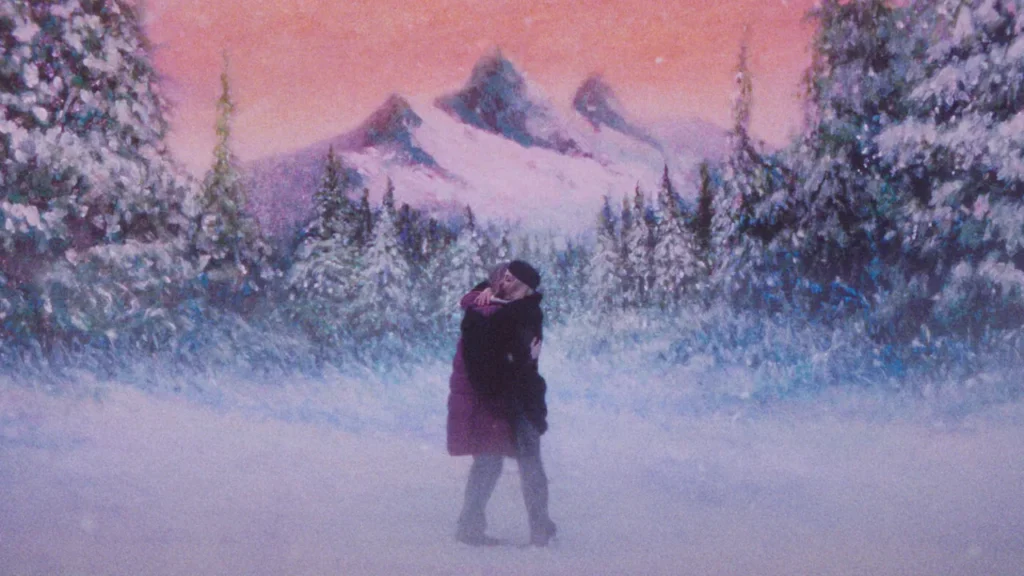
There is a fairy-dust feel to Alex’s score, a complement to the story of two people searching for what Anderson’s character calls “your own private alternate universe.” The pulsing harp and swirling vapor of “Welcome to Camp” summons memories of other ’80s VHS classics—Labyrinth, maybe, or any movie where the main character stumbles around a drab corner onto a personal wonderland. The spiraling tremolos on “Blizzard” lift the accompanying scene between Einbinder and Anderson heavenward, as slow-motion snowflakes swirl against a pink matte-painting backdrop. It’s the film’s most rhapsodic moment, and Alex G’s music helps take it there.