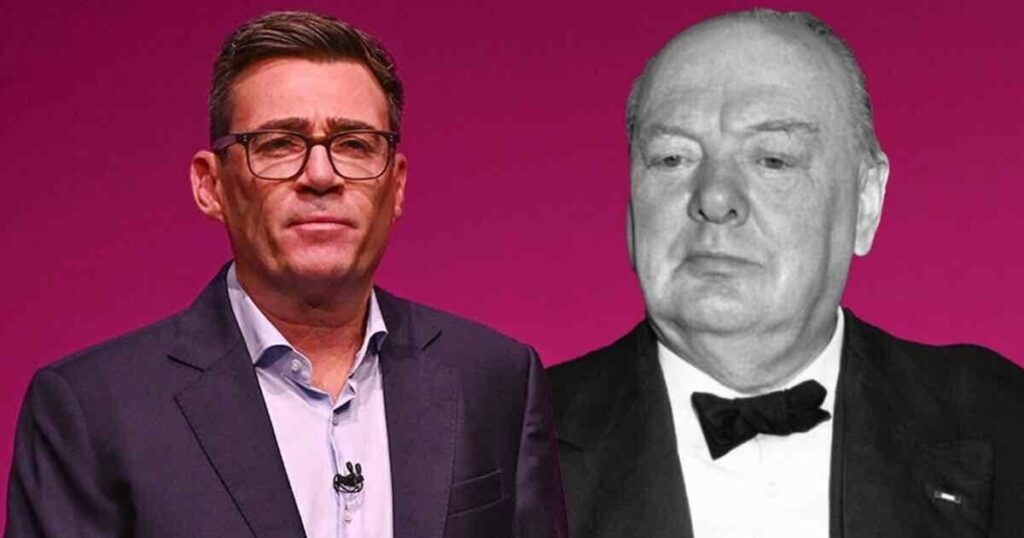


Britain needs another Winston Churchill, but we’ve got Andy Burnham… (Image: Getty)
In the wake of the Dunkirk evacuation in May and June of 1940, during which more than 338,000 men escaped death or capture, the atmosphere on the home front was, according to the historian Sir Max Hastings, somewhat febrile. It took a certain type of statesman, in this case Winston Churchill, to prick the bubble. “The British people were in a peculiarly self-congratulatory mood,” Hastings explains. “They were saying, ‘Gosh, haven’t we done well?’ And Churchill stood up in the House of Commons and told them: ‘Wars are not won by evacuations’. That was courageous – it was telling the British people something quite ugly.
“Can you imagine Andy Burnham in the same position? He’d say: ‘The war’s half won!’ And one major lesson from the Second World War is that, to be a true leader, you have to do – and say – some deeply unpopular things. But in recent years, we’ve had an endless procession of leaders who are not willing to be unpopular – who will not face up to our problems. We have to blame some of it on ourselves. We say we want serious leaders, but do we really?
“Andy Burnham’s the sort of bloke you’d be happy to leave the kids with for the afternoon. But is this the sort of person who ought to be running Britain?” The question is left hanging but there’s little doubt of Hastings’ view.

Men of the British Royal Ulster Rifles on the beach at Dunkirk in June 1940 (Image: The LIFE Picture Collection via Getty)
The new Prime Minister’s “tell”, according to our greatest living military historian, was his admission in the Commons that national security “can’t come at the expense of social security” when challenged over defence funding by Kemi Badenoch. As far as soundbites go, it’s likely to dog his premiership amid rising global threats and growing public understanding – perhaps for the first time in several decades – about just how vulnerable the nation is.
“That was the moment at which I, and millions of other Britons, decided Burnham was not a serious person,” continues Hastings. “The Labour Party is lagging behind the country. The British people are waking up to the threat while Labour are off in fairyland. The Tory record on defence was also shameful but I feared Andy Burnham would prove a hollow man.
“It’s pretty scary we’re led by a Prime Minister who doesn’t seem to have any understanding of – or wish to admit to – the serious issues, far less to address them.”
He pauses: “I think we’ve got some grim years ahead of us. We’ve never needed strong and convincing leadership more and it’s obvious we’re not going to get it from Burnham. To call him a lightweight is a mistake – he’s a featherweight. As Putin looks at what’s happening in Germany, France and Britain, he thinks Western Europe looks more and more like a soft touch. And there’s every reason to believe he’s right. I can’t think of a less suitable leader for Britain in 2026 than Andy Burnham.”
Hastings’ criticisms might be excoriating but few can argue that the veteran journalist and broadcaster, now 80, doesn’t know what he’s talking about. He covered the Vietnam War as a young reporter and yomped across the Falklands with British troops in 1982, becoming the first person to enter Port Stanley on the day of the Argentine surrender. Since then he served as a newspaper editor and heavyweight correspondent, pivoting to a prolific career as a historian with more than 20 acclaimed books to his name as well as several more volumes of memoir.
Frankly, if I was running No 10, I’d be inviting Sir Max in for a coffee.

Veteran journalist. broadcaster and military historian Sir Max Hastings (Image: Jim Stokes)
We’re talking today in the wake of his latest book, Plunder, a riveting new account of the final days of the Second World War and a remarkable new take on a period many underestimate – believing the war was all over bar Hitler’s suicide. Not so, explains Hastings. There was still plenty of killing to come. Indeed, between January and May 1945, around half a million German civilians died and more than a quarter of all Wehrmacht fatalities took place in the final year of the war.
While on the Allied side, although the Russians bore the lion’s share of casualties, British and American forces were losing tens of thousands of men a month in a series of bloody, bitterly-fought engagements. No one was ready to pack up and go home.
“A lot of societies when they know they’re collapsing – as I saw in Vietnam in 1975 – everybody packs up and the armies crumble before your eyes,” says Hastings. “That didn’t happen in 1945. A lot of the Germans went on fighting furiously to the bitter end. When I interviewed them, many officers told me, ‘As long as there was a ‘Heimat’, or ‘homeland’, we had to defend it.’
“Secondly, it was extraordinarily how efficient the Nazi terror machine remained. The Nazis were executing anybody they accused of defeatism to the bitter end. Of course, there were also quite a lot who’d done such unspeakable things – not only to Jews, but to prisoners and civilians – and knew that, even if they stayed alive, it was unlikely they were going to escape vengeance. They had nothing to lose.”
It’s a genuinely extraordinary story that begins on the banks of the Rhine in the spring of 1945 with several million Allied troops ranged on one side and, on the other, half a million Germans who, despite everything, remain largely loyal to the regime. Approaching from the East are the Russians but this book is largely about the Western Allies.
“There are people who say once they were across the Rhine, it became small stuff for everybody except the Russians and that’s true – but there was a huge amount of the small stuff. It was heartbreaking how many were killed in these last months and weeks, almost always in operations to capture a bridge.
“Some of the fighting in the towns was absolutely ferocious as these nutcases on the Nazi side fought to the bitter end. These were small battles, but boy, did the casualties stack up. What’s amazing is that so many on the Allied side were determined to do their duty. But they were pretty bitter at being expected to stick their necks out in these final weeks.”

Ludendorff Bridge, better known as Bridge at Remagen, was captured by US forces (Image: Bettmann Archive)
Hastings has a great gift for telling the strange, moving and sometimes downright bizarre personal stories of war, alongside the great leaders and big, strategic stuff. This time they include the German burgomaster (mayor), appointed by the Allies to run the city Aachen, who was criticised as pro-Nazi by the Americans and tarred as a collaborator by the Nazis – who dispatched a fanatical hit squad by parachute to assassinate him.
He also shines a light on the “barking mad” US General George S. Patton who, in a fit of untrammelled ego, dispatched an armoured column 50 miles behind enemy lines to rescue his son-in-law from enemy captivity.
“The whole thing’s a catastrophe, the armoured column’s cut to pieces, a lot of people are killed, his son-in-law’s badly wounded but what happens? In the British Army, he would have been disgraced. But at that stage of the war, Patton was an American hero. And everybody, from the Supreme Commander down, lied and lied to cover for him.”
Among the most moving examples is the story of Ian Liddell, a captain in the Coldstream Guards, who up until fairly late in the war had been detailed to protect King George VI.
“The King liked Ian Liddell,” says Hastings. “He said: ‘He’s the only one of my officers who doesn’t treat me like a king’. The King invited him to shoot. It’s a weird thing to be going on in the middle of a war, that in 1941 they were busy shooting hundreds of partridges at Sandringham, while around the world, everybody’s shooting each other!”
Having arrived on the front, Liddell won one of the “best-deserved” Victoria Crosses in the history of the medal when he helped take a key bridge under heavy fire armed only with a pair of wire cutters to stop the Germans blowing it up.
“He’d only been married three months and he’d had one week of married life with his 21-year-old wife. I can’t help wondering if he felt a bit of guilt that he’d had a pretty cushy time guarding the King,” explains Hastings.

Ian and Patricia Liddell on their wedding day in London in January 1945 (Image: Courtesy Max Hastings)
“All alone, Liddell climbs over the German barricade, drops his Tommy gun, runs with just his wire cutters and starts cutting all the wires. Cuts all the wires he can see, runs back to the barricade, and one of his officers shouts, ‘Ian, Ian! There’s more wires under the bridge, and more bombs!’ So he runs back and does the same thing again.
“And when a German puts his head up, he hasn’t got a gun, so he throws his wire cutters at him, the only thing he had to chuck.”
Liddell’s actions that day undoubtedly saved scores of lives. Yet just three weeks later – a week before the end of the war – a bullet comes from nowhere, hits another officer, and ricochets off him, killing Liddell.
“And he died without knowing he’d been recommended for one of the last Victoria Crosses of the war – which he was awarded posthumously,” Hastings sighs. “This was one of the last truly heroic episodes of the war in Europe.”
They are, clearly, the kind of sacrifices many of us, perhaps an overwhelming majority, would be hard put to make today.
“For many years Donald Trump has said Europe has had a free ride on defence at the expense of the Americans,” Hastings adds. “It’s about the only thing Trump has ever said that’s true. I’m fearful our people have become so soft and so accustomed to being able to please themselves – not just in Britain but in Germany and France too – that they seem determined to put welfare payments above national security.

Plunder, Max Hastings’ thrilling account of the end of WWII, is out now (Image: William Collins)
“The Russians are all the time testing our will to retaliate, and they’re finding there is no will to retaliate. Putin may only stop doing this if someone gives him cause to think he pays a price – and that means hitting back. How can we expect Putin to respect us if we simply allow him to continue escalating his grey zone war?”
Has he taken any precautions domestically, I wonder?
“If I were going to take any precautions, it would be for my grandchildren,” he says. “The old have too much of a voice in Britain. It’s the young one wishes would find more of a voice – because it’s the young who really matter.”
Next is a book on the sinking of the Bismarck. “That may well be the last one, because I’m about to be 81, and you have to stop sometime,” he adds. It’s the one time during our interview I don’t quite believe him.
Plunder: The Last of the War in Europe, 1945, by Max Hastings (William Collins, £25) is out now