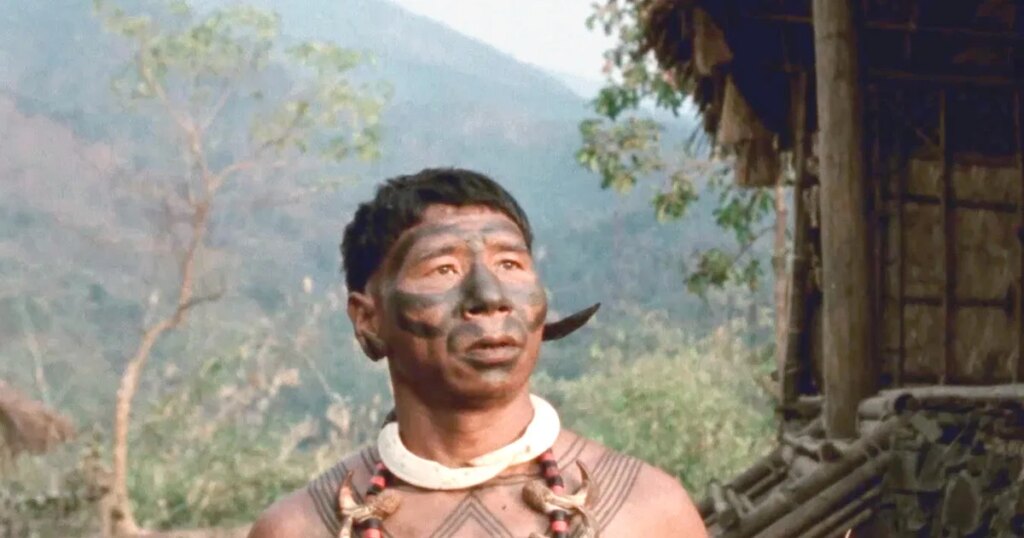

‘I like to make films where I am also conflicted. I don’t want to make films with themes that I am sure about because then it easily becomes agenda-driven.’

IMAGE: A scene from Angh.
Key Points
- ‘I was just trying to capture the characters in their rural setting. In that sense, the pacing of the film also mirrors the pacing of their lives.’
- ‘Obviously, it’s a choice to make a film that’s really observational, and to let the audiences take things in as well, without laying all the cards on the table.’
- ‘In Nagaland, there are two theatres in Dimapur, which is the biggest town. Kohima, the capital city, has none.’
A small film from Nagaland won the biggest prize at the Toronto International Film Festival. Angh, directed by 31-year-old Theja Rio won the Platform Prize in the only competition section at TIFF.
Because of a change in the rules by the Academy of Motion Picture Arts and Sciences, Angh has directly entered into the race for the Best International Film Oscar.
India now has two films that will compete for the international film Oscar, Angh and the country’s official submission Gondhal.
Set in the early 1960s, Angh is the story about a village chief in Nagaland. The chief and his son remain the last people in their village to convert to Christianity.
An American missionary (Douglas Henshall) arrives in the village and there are social pressures on the father and son that they try to resist. The father desperately wants to preserve the ancient culture that is being replaced by the modern way of living, as brought in by the Baptist missionary.
Angh is based on a short film Rio made in 2021. Both the short and feature are produced by his regular collaborator, Nancy Nisa Beso.
Gaurav Dhingra (Stolen, Angry Indian Goddesses) is the executive producer of the film.
After studying directing fiction films at the National Film and Television School in London, Rio is back in India. He lives between Kohima and Delhi, and describes it as a “bit of a nomadic lifestyle for now, because I don’t know where my base is.”
Aseem Chhabra spoke to Rio via Zoom before the director flew to Toronto. Rio was in Guwahati at that time.
“I was writing scripts that were very Hollywood inspired — works of (Quentin) Tarantino, the Coen Brothers. I still love those films, but being exposed to more international cinema has made me take a U-turn,” Rio says.
Tell us about this story focusing on the father and son. It’s also a story about an old culture which is fading and the father who is desperately trying to preserve it.
I am from Nagaland, which has been dealing with a lot of change in the last 50-60 years.
There’s a big generational gap here. There’s so much of new versus the old, so many traditional and modern things come in conflict in your everyday life.
I think it comes from something inherent in a sense.
‘There is a small movement where people are beginning to value old culture’

IMAGE: A scene from Angh.
But is there a story you were familiar with — the older generation struggling hard to keep to the old ways?
I think there’s definitely more of the awareness to preserve.
Again, we have gone through a period of huge change and we have also been witnessing the aftermaths of that. Now, we are trying to find a balance.
There are more museums coming up now than ever before. There’s a repatriation thing that’s happening now.
Just recently, the Pitts River Museum in Oxford announced it was returning 39 human remains back to Nagaland.
So there is a small movement where people are beginning to value old culture.
Are these remains going to be displayed in a museum, or they are going to be buried?
I think that’s another discussion that needs to take place. But there have been conversations mostly in the papers to return the remains to the ancestral villages.
‘I fell in love with so many foreign films’

IMAGE: A scene from Angh.
What have been your inspirations? What kind of films have you watched when you were younger and then as a film student?
For a very long time, I was in Nagaland, and we were mainly consuming whatever came on the television. Star Movies and HBO basically showed Hollywood films, as well as Chinese, Hong Kong, Kung Fu films with Jackie Chan. Bollywood as well. So that was a large part of my childhood.
I went to Italy sporadically in 2015, 2018 and 2019 as part of film workshops. I made two short films there. That was my first introduction to foreign cinema, which remains the biggest influence on my style of filmmaking.
I fell in love with so many foreign films. That introduction gave me the courage to make films that were not in English or Hindi.
It was a realisation that no matter what corner of the world you come from, cinema can exist there.
Because prior to that, I was writing scripts that were very Hollywood inspired — works of (Quentin) Tarantino, the Coen Brothers.
I still love those films, but being exposed to more international cinema has made me take a U-turn.
But which foreign filmmakers have really inspired you — European or Asian filmmakers going back to Kurosawa?
Yes, Kurosawa is a name that’s always on the list, especially for a film like Angh. You could not compare any of his works with my film, but there are definite hints.
My favourite filmmaker is Abbas Kiarostami. I really like his observational cinema, and there are traces of that in Angh as well.
Kiarostami’s films are slow paced, yet they capture the heart and soul of his characters. How did your film language evolve?
It’s a style that emerged. It sort of mirrors the characters and the world that they inhabit. I didn’t necessarily think of the pacing too much.
I was just trying to capture the characters in their rural setting. In that sense, the pacing of the film also mirrors the pacing of their lives. Obviously, it’s a choice to make a film that’s really observational, and to let the audiences take things in as well, without laying all the cards on the table.
‘There is slow emerging comedy platform in Nagaland’

IMAGE: A scene from Angh.
Your cinematographer Adam Pietkiewicz just received the Variety Artisan Award at TIFF. He also worked on Baby Reindeer. How did you come in contact with him?
Adam and I went to the same film school in the same year. I was in the directing course while he was in the cinematography course.
We worked on a very small project in the film school. He’s really into slow cinema.
His favourite filmmaker is (Russian master Andrei) Tarkovsky. Obviously, he’s from Poland. They have something in the water there for DOPs (Director of Photography). They just keep churning out DOPs after DOPs!
I love working with him because he’s so passionate. He pushes the boundaries in every sense.
The film also speaks for him and how much passion he put into it. The Variety award is such a big honour.
Tell us about the two actors, who play the father and son. I would imagine they are non-actors. Do they belong to one of those tribes or they actually live a modern sort of life?
The boy lives near Dimapur, which is more urban than rural. But Anhgkong Konyak, who plays the father, comes from a village which is closer to the border of Myanmar.
It’s a nine-hour drive to Dimapur or Kohima. He’s a stand-up comedian, and that’s how I discovered him. I found him on YouTube.
We went through so many actors while we were casting. His comedy is very local. He would go to villages to perform his acts.
There is slow emerging comedy platform in Nagaland.
So he performs in villages?
Prior to making the film, he had never been to Dimapur or Kohima. He had just been around the village areas whenever they would have a Christmas event or a small festival.
They don’t have comedy nights or any stand-up comedy bar.
‘In Nagaland, there are two theatres in Dimapur’

IMAGE: Poster of Angh.
Are there movie theatres in Nagaland? Because I read in an interview you had done a while back that your mother used to take you to watch Bollywood and Hollywood films in Delhi.
Yes, my mother would take me to watch movies. The first film I watched in a theatre was the fourth part of Lord of the Rings: The Return of the King.
Where in Delhi did you see the film?
It was at the PVR in Vasant Vihar.
In Nagaland, there are two theatres in Dimapur, which is the biggest town. Kohima, the capital city, has none.
And the two theatres in Dimapur, what kind of films do they show?
Last I know, The Odyssey was playing there.
Oh wow! Obviously it would not be on IMAX but still this is a real connection with the rest of the world.
Yeah, there’s no IMAX theatre. I have only been there once a few years ago to see Damien Chazelle’s First Man.
Assam has a big film culture and an industry. But why hasn’t the industry grown in Nagaland? This probably is the first film I am seeing from Nagaland.
I have asked people, but no one appears to have a clear answer. Possibly it has to do with the fact that we are so culturally diverse.
There are many different languages and dialects.
The umbrella language is Nagamese, which is a mixture of Bengali, Hindi and Nepali. It is quite new.
What about the language Tenyidie? You made a short film with Tenyidie.
I did, because that’s my mother tongue. I belong to the Angami tribe.
And the father and son speak in Konyak in the film?
Yes, they belong to the Konyak headhunting tribe.

IMAGE: Angh Director Theja Rio. Photograph: Kind courtesy Theja Rio
Has there been any feature that has come out of Nagaland?
Not too many. There were some filmmakers who would make films on VCDs and sell them locally.
Now, because of the Internet, they have them up on YouTube. But there have been no theatrical releases or films that would go to platforms like Netflix, Amazon Prime.
Is the word out that a film from Nagaland is going to play in Canada for a world premiere? Has the local press written about it?
Yes. It’s been decently covered. I have only been speaking to my family, and they are obviously proud of me. But people are aware.
One of the actors, who plays the translator to the white priest, is actually a famous blogger in the region. He’s from a village on the border.
He doesn’t necessarily have too many followers in urban areas, but in the rural spaces, he has a lot of followers. He’s done a good job of spreading the word in that space.
The film was beautiful! I wouldn’t give away the ending details, but it’s very moving with the father looking at the son. It almost brought tears to my eyes. Do you see it as a positive ending?
I think it’s bittersweet. These are such complex issues, and there’s so much that you lose, but so much that you gain as well.
I was speaking to my cousin, and we were talking about the kind of films I like to make. I told him that I like to make films where I am also conflicted. I don’t want to make films with themes that I am sure about because then it easily becomes agenda-driven.
Photographs curated by Satish Bodas/Rediff