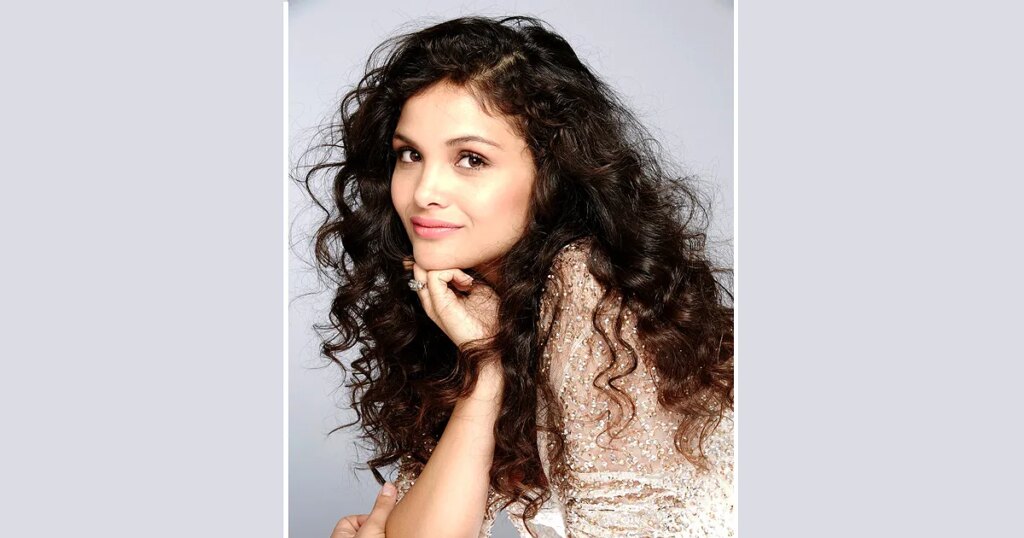

‘I did not give up on acting; I was always open to it. I just wasn’t actively chasing it for a period of time.’

Photograph: Kind courtesy Ayesha Kapur/Instagram
Key Points
- ‘With Black, it wasn’t the role itself that overwhelmed me. The experience of making the film was actually incredibly deep and moving.’
- ‘Growing up in Auroville, I learnt very early on not to place too much importance on things like someone’s background, age, wealth or fame. None of those things make one person better than another.’
- ‘What matters much more is who someone is at their core, how they treat people and the kind of person they are.’
The young Michelle McNally from Sanjay Leela Bhansali’s Black has grown up.
Ayesha Kapur‘s adult acting career did not go according to plan, as her much-discussed association with Shekhar Kapur’s Paani did not materialise. Ayesha eventually stepped away from acting to pursue her education and explore other interests.
She returns with Om Ka Hari as Priya, a young woman from a middle class family in Bhopal.
In a candid conversation with Subhash K Jha, Ayesha says, “After signing with YRF, I met Shekhar Kapur over a period of about six months and did a couple of screen tests with Sushant Singh Rajput. Eventually, the film was confirmed and reported in the press. Unfortunately, for various reasons, it never ended up going into production.”

IMAGE: Santhy Balachandran, Lakshmi, Alexx O’Nell, Madhoo and Ayesha Kapur in Sweet Karam Coffee.
It was a surprise to see you as a leading lady in Om Ka Hari. How did that happen?
I did not give up on acting; I was always open to it. I just wasn’t actively chasing it for a period of time.
I was offered a role in an OTT series called Sweet Karam Coffee, one of Amazon’s early originals in the space.
At that point, I was a little disillusioned, to be honest. I had put a lot of time, energy and devotion into something that ultimately didn’t happen.
I was signed with Yash Raj Films and was supposed to do Paani, which, as everyone knows, didn’t happen.
After that experience, I think I became a little more cautious about putting so much pressure on one project or one big launch.
‘I love the idea of showing diversity in the kinds of characters I can play’

IMAGE: Anshuman Jha and Ayesha Kapur in Om Ka Hari.
What made you take on Sweet Karam Coffee as your first foray into histrionics after Black?
Sweet Karam Coffee felt very low pressure. It was an English-speaking role, the shoot dates were confirmed and it felt like I could just dip my toe back into acting without putting too much pressure on myself.
I was doing other things at the time, including health coaching, and I thought, let me just see what it feels like to be on sets again. And it felt so good!
I realised how much I love being part of a larger creative project.
You were open to more offers after that?
I started pursuing acting much more actively. I started visiting Bombay more often and making it known that I wanted to act. It definitely helps to be seen.
I’ve known Anshuman Jha for years — I first met him when I was interning on a film in Mumbai — and he told me about Om Ka Hari one day. He thought I was perfect for the role.
When I read the script, I immediately saw that it would be challenging for me, particularly because my diction had to feel authentic. Culturally, Priya is quite different from me and I found that exciting.
I love the idea of showing diversity in the kinds of characters I can play.
I also really believed in the team. Everyone in the cast is a very strong actor, and I loved (Director) Harish Vyas’ approach. I had to audition and then workshop with the cast before I was finally given the role.
‘I wish a scene I had with Raghubir Yadav in Om Ka Hari had remained in the theatrical version’

IMAGE: Shivani Tanksale, Soni Razdan, Anshuman Jha, Ayesha Kapur and Kashish Gangwani in Om Ka Hari.
Did you feel the pressure of transitioning from the phenomenal child in Black to a leading lady?
I think my approach to acting is different now. I don’t want to put so much pressure on the idea of a big launch or the perfect comeback. I want to work on projects I believe in, follow my heart and intuition, and choose things that interest me.
The one thing I do wish is that a scene I had with Raghubir Yadav in Om Ka Hari had remained in the theatrical version.
A portion of the film was shortened for the cinema release, and unfortunately, that scene was removed.
Priya is very supportive and gentle through most of the film but in that scene, she finally stands up to the patriarch and expresses what she feels. I had a substantial monologue there, and I think it showed gave the character more depth and impact. I’m hoping it might still be there in the OTT version.
But overall, the film was an important step because it allowed me to come back, take on a character very different from myself and remind people, and myself, that this is something I want to do.
It was a completely different world from the one I grew up in. I liked the challenge of stepping into something so unfamiliar and also being able to show audiences that I could play a character like this, learn the diction and inhabit a very different background.
I studied sociology in college, and I think it probably comes from the same place, just a fascination with understanding people, how they live, what shapes them and the different worlds they come from.
‘I still try to meet people without being overly influenced by status’

IMAGE: Ayesha Kapur and Amitabh Bachchan in Black.
Your performance as the rebellious nine-year-old Michelle is among the best performances by a child in an Indian film. Looking back, how do you evaluate the impact of the performance, playing blind and hearing impaired, for a child your age? Was it traumatic?
No. Every role is cathartic in its own way. Feeling those emotions and moving through them as a character allows me to process things within myself.
What can be challenging is suddenly becoming aware of other people’s attention, judgements and perceptions. I’m sensitive to that kind of energy, which is also why I sometimes prefer to keep a low profile online.
It’s not necessarily about anyone saying anything explicitly, it’s more a feeling you get when there are suddenly a lot of eyes on you.
With Black, it wasn’t the role itself that overwhelmed me. The experience of making the film was actually incredibly deep and moving. I loved being on set and loved acting. What took some adjusting to was the shift in my lifestyle, and then going back to school and to my normal life.
I really missed acting once it was over because the experience had been so intense.
I think artists are often very sensitive people, and in some ways, that sensitivity is what allows us to do our jobs well. For me, eating well, meditating and practising yoga are important ways of staying grounded and happy. That’s why wellness has become such an important part of my life
I sat with your mother and you at the premiere of Black. You oozed self-confidence. When you look back at the child, do you wonder if that was you?
I think a lot of that confidence came from the fact that I didn’t really know much about Bollywood.
Also, growing up in Auroville, I learnt very early on not to place too much importance on things like someone’s background, age, wealth or fame. None of those things make one person better than another.
What matters much more is who someone is at their core, how they treat people and the kind of person they are.
Even during Black, I often wondered whether I was doing a good job.
There’s a funny story my mom loves to tell from the sets. Sanjay Bhansali asked me to jump from under a table and ‘attack like a tigress’, and apparently when they called ‘action’, there was a long pause without me doing anything.
Finally I crawled out from under the table, looked at him and said, ‘But Sanjay, how does a tigress attack?’
I’ve always thought a lot about things and always been a bit of a perfectionist, so in that sense, not much has changed. Of course, now I’m more aware of the industry and who people are. Naturally, that does affect how I interact with them.
But fundamentally, I still try to meet people without being overly influenced by status, and to treat everybody with the same basic respect as a human being.
Amitabh Bachchan tells me you insisted on calling him Amit during the shooting. Would you still call him that if you met him?
I think I actually called him Amitabh. Just like everyone else, I called people by their first name.
As I got older, I started wondering whether that might come across as disrespectful, so I started adjusting how I addressed people based on what everyone else around them called them.
I suppose I could get away with it as a child in a way that I probably couldn’t as an adult. But it really just came from the way I grew up in Auroville.
Teachers, my friends’ parents… everyone encouraged us to call them by their first names, so it felt natural to me. There was no disrespect intended at all.
‘It was disappointing because I had invested a lot emotionally in Paani‘

Photograph: Kind courtesy Ayesha Kapur/Instagram
Your journey into adult roles has not been easy. How do you look back on Paani, the film with Yash Raj, Shekhar Kapur and Sushant Singh Rajput, that didn’t happen?
It was a role I was really looking forward to playing. There were aspects of the character that I connected with naturally. Because she spoke in English, I felt I could focus directly on the acting.
Of course, the idea of working with Shekhar Kapur was incredibly exciting because he has a unique body of work in Bollywood and Hollywood.
After signing with YRF, I met Shekhar Kapur over a period of about six months and did a couple of screen tests with Sushant Singh Rajput. Eventually, the film was confirmed and reported in the press. Unfortunately, for various reasons, it never ended up going into production.
My family had always wanted me to continue with my education if acting didn’t move forward. By then, quite a bit of time had passed, and they gave me another six months to see if something concrete would materialise.
I was still signed with YRF, so I was waiting to see what the next role would be while continuing to work on things like Hindi, dance and other things for future projects. I spent about six months volunteering at the Adishakti theatre in Auroville, so I could continue focusing on my craft.
When those six months were up and nothing had materialised, I re-applied to college. It was obviously disappointing but looking back, I think the experience taught me a lot.
Now that you have begun your new innings, what are your hopes and expectations?
I hope to keep adding to my body of work, although I believe in quality over quantity. I’d love to explore different characters, backgrounds and worlds because that’s one of the things that excites me about acting.
I also really value working with artists and filmmakers I connect with creatively, people who understand me, challenge me and bring out the best in me.
More than chasing a certain number of projects, I want to keep doing work that feels meaningful and exciting to me.
I’d love to work with someone like Zoya Akhtar. I really connect with the worlds she creates and the kind of characters, relationships and performances that come through in her work.
Photographs curated by Manisha Kotian/Rediff