
Babystar begins with a group of young, blindfolded children being taken from an anonymous white van. Cameras surround them, and the three figures they are being presented to. Outside a clearly affluent house, it looks like some sort of cult ritual. In some ways, it is – the children have won the opportunity to hang out with Luca (Maja Bons), a social media star, and her parents.
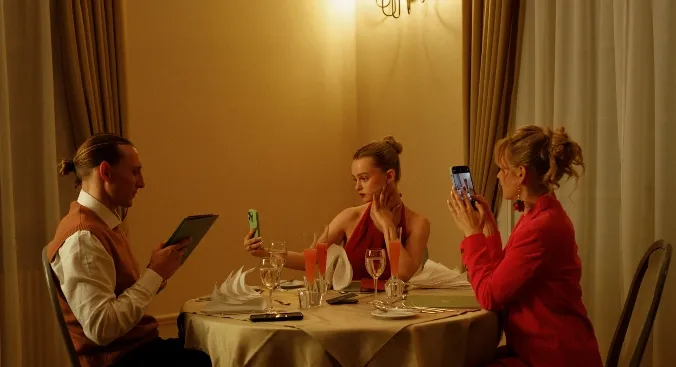
Things are going well for the family. They have a massive house, a successful business – selling themselves – and what looks like a perfect, tastefully-curated life. When parents Lars (Christian Koch) and Stella (Bea Brocks) decide they want another child, though, the facade cracks. With her entire life, from birth onwards, filmed and edited for public consumption, the imminence of this sibling prompts Luca to reflect on her strange existence.
It becomes clear very early on just how isolated Luca, a pretty, open-faced sixteen year old, is. “I’m busy now, so friends aren’t a priority. My parents are the most important,” she says to her kidnapped fan-guests. For such a tragic line, it’s delivered without much emotion.
Later on, when a company develops an AI companion for her fans to talk to, Luca becomes dependent on the digital twin for comfort and advice. “What do we do,” she asks it when she begins to go off-script herself. With her existence commodified, her very self made up of brand deals and social media trends, Luca has no real idea of who she is.
Throughout the film, images and the naming of specific brands is censored. We hear just the ‘T’ of TikTok before it’s bleeped out; logos in the foreground and background are blurred. It draws attention to just how prevalent these brands are in the entertainment and art we engage with, inescapable presences that could always be sneakily sponsored ‘content’. By removing their names and images from the film, director Joscha Bongard both rejects this commercialisation and, perhaps, emphasises that this feature is explicitly not sponsored by these companies.
Much of the film is shot from unnervingly surveillance-style angles, as if the action is being seen through a CCTV camera. Sometimes it really is – Luca keeps track of what’s going on in her house remotely, watching her parents nap on the sofa or talk to one another. Other times there’s just the threat of an omniscient watcher infringing on Luca’s personal life, which arguably there is. Events are interspersed with social media videos from Luca’s upbringing, from first steps to potty training and intimate, mother-daughter conversations.
In recent years, there has been increased scrutiny around family vloggers and their exploitation of young children. Just a few years ago Illinois approved a law that would allow children to sue their guardians if they took too much of their profits, and lots of home-grown child stars, now all grown up, have talked about the dark side of the industry. These stories have perhaps become so familiar that Babystar’s commentary lacks any shock value, its criticisms somewhat tepid. Luca’s actions are fairly tame, and her parents never face consequences for their actions – nor do they seem to realise the damage that they have done. Babystar is clear in its criticisms, but they could be far more incisive.
Babystar is in UK and Irish cinemas from 25th September