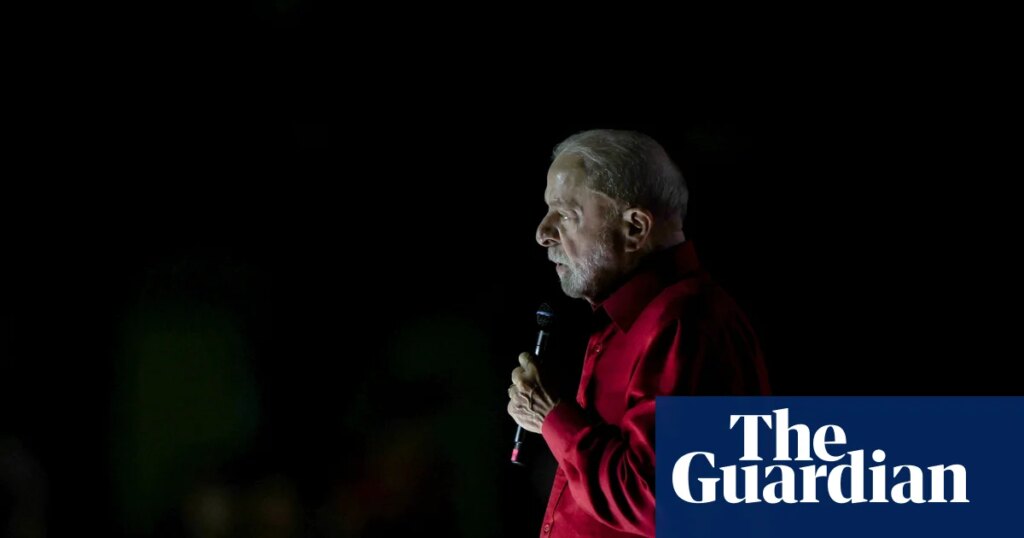

Brazil’s president, Luiz Inácio Lula da Silva, has announced a 15% increase in the country’s main cash-transfer programme for poor families, as well as free weight-loss jabs, prompting criticism from opponents who say the moves are electorally motivated just two weeks before the presidential election.
On 4 October, the leftwing incumbent will face the far-right senator Flávio Bolsonaro, son of the former president Jair Bolsonaro, who has been gaining ground in recent weeks.
The rise in the monthly payment, from about £98 to £113, that he announced on Thursday is due to take effect on 19 October, just before the likely runoff vote on 25 October.
The increase is expected to benefit between 15% and 20% of voters in what promises to be one of the closest ever presidential races in Latin America’s largest country.
Lula said it was not really an increase, but an adjustment in line with inflation to “protect the purchasing power of the most vulnerable families”, but his opponents have criticised its timing so close to the election.
Flávio Bolsonaro called it an “act of desperation” after polls showed him gaining ground – although the most recent survey, released on Thursday night, still showed Lula numerically ahead despite the technical tie. The senator added that Lula was trying to “buy the votes of the poor”.
Created in 2003 during his first term as president, the programme, called Bolsa Família, was a flagship cash-transfer policy that helped lift millions of families out of poverty during his first two terms.
Currently, families with an income of up to £32 per person are eligible, covering about 50 million people, or roughly 27 million of voting age.
The programme has long been fiercely criticised by rightwing politicians, including by Jair Bolsonaro, although he kept it in place during his presidency.
On the eve of the 2022 election, Bolsonaro announced a 50% increase in the monthly payment, prompting Lula’s campaign to file a case with the electoral court alleging abuse of political power and electoral use of the state machinery.
The similarities have sparked a debate between those who say Lula is doing the same thing Bolsonaro did four years ago, and others who argue that the two cases are different.
The journalist Miriam Leitão wrote for O Globo that although both Bolsonaro and Lula made the adjustments “out of electoral interest”, the current incumbent’s increase is in fact limited to inflation over the past four years, during which there had been no adjustment.
She also noted that Bolsonaro’s increase had an expiry date – precisely at the end of the electoral period – while Lula’s is permanent.
Victor Escobar, a researcher at the Laboratory of Parties, Elections and Comparative Politics, agreed. He said that although Lula, like his predecessor, is also being criticised for unveiling a package of benefits on the eve of the election – including a promise to distribute weight-loss jabs free of charge through the public health system – Bolsonaro’s measures were “even more irresponsible from a budgetary point of view”.
In addition to increasing benefits for poor families, Bolsonaro introduced temporary monthly payments of up to £727 for two groups that broadly formed part of his support base, taxi drivers and truck drivers, along with a series of other social benefits whose projected impact on the budget was so large that critics dubbed them the “kamikaze” package.
Escobar acknowledged that Lula’s intention was also electoral, but said that, as long as the measures comply with the law, “it’s something entirely expected when we’re talking about an incumbent running for re-election, who will try to use the legal mechanisms available to improve their voting numbers”.
Some electoral law experts have said that an inflation adjustment is not, in principle, prohibited, but another far-right candidate, the influencer Renan Santos, filed a case with the electoral court seeking to suspend the increase until the president-elect takes office. Although critical of the measure, Flávio Bolsonaro has not done the same, reportedly because of concern about the impact such a move could have among voters who benefit from the programme.