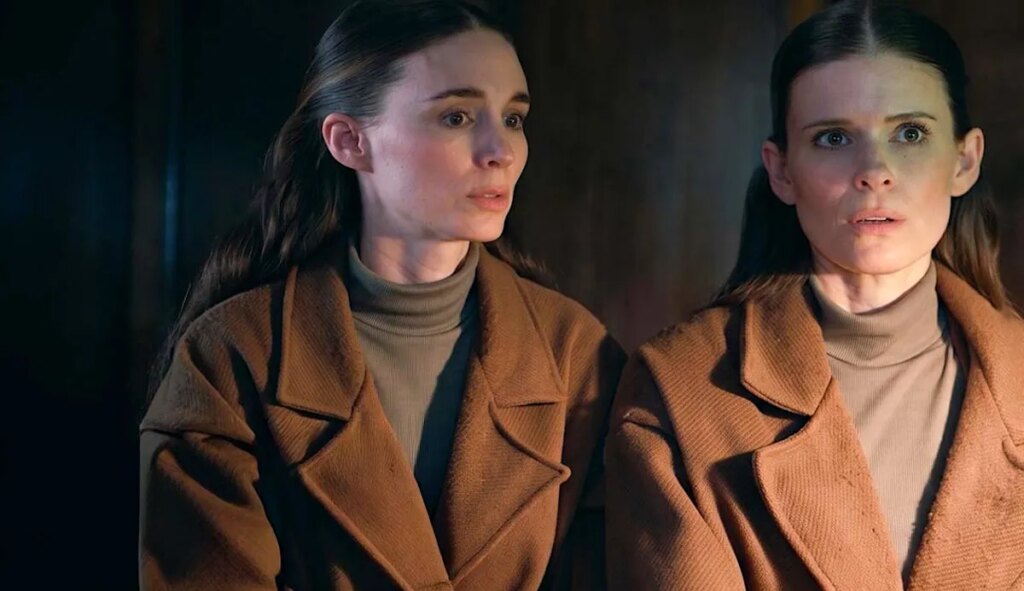

One can almost hear Herzog chuckle as Kate and Rooney’s faces flicker between sweet reverie while recalling meeting this cad in church to, not so convincingly, saying they had nothing to do with the fire that nearly immolated his house. When Bloom insists they’re crazy, the Maras scream “Bucking Fastard” with such synchronized fury, it creates a natural reverb echo in the ear.
For the first hour or so, the movie delights on this wavelength, even as it dutifully and almost obligatorily scaffolds a more bittersweet allegory atop the joke. There is, indeed, a method to Herzog’s madness, as revealed in an unexpectedly melancholic third act, but sometimes the matching clothes and four-pupiled wide-eyed stare is really all we needed.
Loosely based on a real pair of English sisters (who were, in fact, twins), Herzog’s Rooney and Kate deliberately occupy a kind of ethereal alternative reality. Theirs is a magical existence where Bloom can kick open the doors of church and storm through with a pint of beer in his hand like the Second Coming landed on Oktoberfest morning. Notably the story is also set in the UK, and yet both Maras make no attempt to hide their natural American accents. Increasingly a documentarian in his advancing age, Herzog returns to narrative storytelling in order to find the surreality of actual events.
It’s easy to see why the story of real-life Freda and Greta Chaplin appealed to the director of Aguirre and the most tender-hearted and weeping twist on Nosferatu we ever got. The Chaplins’ life reads like a bittersweet fever dream that was preserved in several docs I’m sure Herzog sought out. In his own peculiar manner, the filmmaker wants to use that truth to imagine a fiction interrogating the cost of being different. The filmmaker, Kate, and Rooney seek to celebrate the thinly-fictionalized Holbrook sisters’ iconoclastic singularity (times two), but Bucking Fastard ultimately becomes about the cost of going by the beat of a different drum.
In the film’s back half, the Holbrook girls are dispossessed by the culture around them. Their parents, whom we never see, want nothing to do with their now nationally notorious daughters; the only friends in their lives are intriguingly a rotating chorus of men, some of whom pity the poor things, and others like Bloom have obviously more lascivious things on their minds. None of them really get through to either Joanie or Jeanie about becoming their own person. There are occasional flashes of discordance, and curiously Herzog tends to foreshadow that danger whenever he has Kate move to the left of frame, and Rooney to the right. But these are less epiphanies than moments of disharmony, like the string of a fine violin snapping mid-concerto.
Soon enough, the sisters are always back where they’re happiest, which in the third act involves living out in the country with a kindly aunt, a fox they befriend, and a cave that becomes a not-so-subtle visual metaphor for the social destiny they built for themselves.