
One thing Josephine writer-director Beth de Araújo remembers from that day in Golden Gate Park is looking for a seatbelt.
It was the ’90s. She was eight. She and her father, while walking through the park, interrupted a man assaulting a woman. While police pursued the man, they put Araújo in the backseat of their police car with the woman, and the child did what children are supposed to do.
“You get into a car as a kid, the first thing you’ve been trained to do is put on your seatbelt,” Araújo recalls. “So I was just like, ‘Where’s my seatbelt?’ and being like, ‘This is not a normal car.’”
Araújo recreated many parts of the day for the stunning Josephine, which follows an 8-year-old girl who, like, Araújo, witnesses a sexual assault in Golden Gate Park and must try to understand what she’s seen.
The filmmaker prefers to keep some details to herself, out of respect for the woman. Those moments in the back of the police car were the only time they spent together. Their rules and expectations about safety, suddenly gone.

In the film, Josephine, played by a preternaturally composed Mason Reeves, must testify against the assailant in court. It provides at least a chance at the kind of resolution Araújo never had in real life.
“I didn’t have to testify. My father testified,” she recalls. “I think he hoped I didn’t understand what was going on, which I didn’t. But it didn’t make me not want to understand it, when he wouldn’t talk about it. I think it made me really, really curious.”
She developed a sense of hypervigilance that shaped the rest of her life, and led to Josephine.
The film has received overwhelming respect and acclaim, winning the U.S. Dramatic Grand Jury Prize and Audience Award in its Sundance debut. It succeeds despite — or because of — a refusal to make things easy for the audience. The rape scene is shot with blunt rigor. The courtroom scene leaves open questions. There are many places where Araújo could have compromised, to let viewers off the hook, and she never does.
Her determination to get everything right — added to the difficulty of the subject — help explain the film’s 12-year journey to the screen. She could have cut costs, to make it more appealing to studios, but she knew that doing so would have hurt the film.
“The subject matter certainly is something that I think everyone was always very scared of,” says Araújo. ”When I would pitch it to people, producers or financiers, they would usually say that they loved it but the subject and genre don’t match the budget. Meaning, if you make a film about a tough subject matter, it better be real cheap.”
She also wanted to shoot in San Francisco, which felt intrinsic to the story.
“So instead of changing the script and shooting in Toronto,” she says, “I just waited and waited until I had the right recipe of actor star power who also were right for the role and financiers who saw a business model with it and believed in our team’s vision for it.”

The star power arrived.
Gemma Chan, who plays Josephine’s mother, Claire, committed to the film in 2019 — before Araújo had made a first feature.
“From the moment that I read it, I couldn’t shake the feelings that it brought up in me,” Chan recalls. “And then I spoke with Beth, and immediately from hearing what her vision for the film was, and just her as a person, as well as what she wanted to do as a filmmaker, I was just like, ‘I’m all in.’”
Channing Tatum, who plays Josephine’s father, Damien, drew from his own experience as a father and from conversations with Araújo about her father. He sees Damien as a man desperate to protect his daughter.
“I really related to Damien and where he’s at in his life. He is really pushing for justice all the way through this story. But even as a dad, you want everything to go right, and life isn’t always that way. I related to the almost impossible task of wanting your kid to grow and learn and that you can’t do everything for them,” says Tatum. “To love someone and want them to learn, want them to do a good job, want them to just do the things that you ask them to do and build those healthy boundaries — it’s not easy.
“You have to ask yourself, ‘Is this my fight to fight or is this her fight?’It’s the hardest thing as a parent to feel that.”
Beth de Araújo on the Origins of Josephine

Born in San Francisco to a Chinese-American mother and Brazilian father, Araújo didn’t set out to be a filmmaker. She loved movies, but it just didn’t feel like a viable career.
She went to UC Berkeley and began studying sociology, something she attributes to what she witnessed in the park. She hoped that understanding how atrocities happen might help prevent them.
“I was just very drawn to how people turn out the way that they do, you know, nature versus nurture,” she says. “I believe we’re born with a certain element of our personality, and then nurture takes us quite a bit farther… with politics, with race, obviously gender.”
She cites an example that will resonate with anyone who grew up in the California of past decades.
“I think a lot about when serial killers became a huge problem in the ’60s and ’70s in America, and the FBI created a huge multimillion-dollar study to really try to understand and prevent these people from becoming this way, to prevent the crimes going on, unpunished,” she says.
She wondered why there wasn’t the same commitment to stopping sexual assaults.
“It’s almost like we’ve just accepted it as a society,” she says.
She notes the notoriously short sentences for people convicted of rape: “If someone sold you cocaine today, they would get more time in jail than if someone sexually assaulted you today,” she says. “It’s actually lunacy.”
She considered going into public policy or non-profit activism at one point, but “worried it would make me too cynical,” she explains.
She also began to find her voice artistically.
“I was taking poetry classes, specifically in the African American Studies Department,” she recalls. “I loved to write. I found it very, very freeing. It’s a great place to tell the truth that in social settings feels very uncomfortable to talk about.”
When she graduated, she knew she wanted to write, and kept studying writing in night classes. Her parents, meanwhile, wanted her to be a lawyer, but couldn’t pay for law school. So she studied for the LSAT and interned for an attorney.
An attorney who, it turned out, had cinematic aspirations.
“The lawyer was like, ‘Hey, I wrote this book, and I know you like to write — do you want to outline a screenplay for it?’ So I was like, ‘OK, I don’t know how to do that, but I’ll figure it out.’ And so I went to the library and just got like a bunch of screenplay books, and was just trying to figure out what the structure was, and I think that was really kind of an aha! moment: ‘Oh, creativity within structure, I like that.’”
She made a sudden decision to move to Los Angeles to try screenwriting. Some friends visiting from Ireland were planning a trip to L.A., so she packed up her things to join them.
Her parents, especially her dad, pleaded with her not to do it.
“It was truly the craziest thing I’ve ever done,” Araújo recalls. “The day before I left, my parents were like, ‘We will pay for law school. We know that we said we can’t afford it, but we’ll make it work.’ And I was like, ‘No, it’s fine, I really want to do this.’
“And so I just packed all my belongings into their tiny little, like, Honda, and had them drop me off at this place where I was gonna sublet for a month, and then just begged for a waitressing job a couple of blocks away.”
The job was at La Scala, an Italian restaurant where she wrote during breaks.
After a year, in 2011, she entered the American Film Institute, and soon began making shorts. They included 2014’s “Brown Bag,” about a high school girl with an extreme crush; 2015’s “Initiation,” about college hazing; and 2018’s “Chevy Chase,” about a woman addicted to Oxycontin.
She started working on the Josephine script in 2014, and got into the 2018 Sundance Director’s Lab.
“Without it being in the labs, this film never would have gotten made. I feel very certain about that,” she says.
In 2019, the same year she released the darkly comic short “I Want to Marry a Creative Jewish Girl,” about love and superficiality, her Josephine script made its way to Gemma Chan.
It happened through Tom Castonovo, the production designer on both Josephine and Araújo’s 2022 feature debut, Soft & Quiet. His agent, Ann Murphy, asked to read the Josephine script, and passed it on to Chan’s agent, Esther Chang.
Soon after, Araújo got a call from Chang, asking if she would consider Chan for the role of Claire.
“And I was like, ‘What?’ Like on so many levels, what? Are you for real? She had just finished Crazy Rich Asians, which was a huge hit, as you know. And so I was like, ‘Does she understand that is like a small independent film?’”
She did. And she was the first to sign on.
Two Chans

Chan, like Araújo, could have been a lawyer.
The English actress graduated with a law degree from Worcester College, Oxford, but decided to pursue acting instead. She was drawn not only by the emotional aspects of Josephine, but how realistically it handles the legal system.
She notes that in the United Kingdom, the conviction rate for rape is so low that it’s like “a de facto legalized crime, which is absolutely terrible.”
The subject was also close to her heart because of her role as a celebrity ambassador for UNICEF, the United Nations Children’s Fund. Her experience with UNICEF has included meeting with Syrian child refugees.
“The world feels like it’s on fire, quite frankly, at the moment. And what gives me hope is really the next generation, and children, and I feel very fortunate to be able to do a tiny part to try and advocate for them and for the work that UNICEF does,” Chan says. “People in terrible circumstances have such resilience.”
Her character, Claire, wants to shield her daughter, but also teach her that kind of resilience.
“She has, obviously, this vulnerability, and she’s emotional, and she has trauma in her past, but she also has a pragmatism, and I would say a very strong core,” Chan says. “I don’t know, actually, how people may react to the way she parents Josephine, and some people may agree with it, and some may not at all, but I feel that actually what she’s trying to say to Josephine is that you will be OK, and you can get through this, and it won’t be the only thing that you’re about in your life.”
Chan stayed committed to Josephine for years. In that time, Araújo made Soft & Quiet, a terrifying portrait of white supremacist women, shot in what appears to be a single take.
The film, presented by Blumhouse, further raised Araújo’s reputation as a filmmaker on the rise, and helped clear the path for Josephine.
So did finding her Josephine.
Bay Area to her bones, Araújo discovered Mason Reeves at San Francisco’s Clement Street Farmers Market.
“She talks to you like she’s your grandmother,” Araújo says. “Her emotional intelligence is so astute. She picks up on so many little things, so many different interactions and subtle things that are happening between people. She can feel them really strongly, and she’s just really special. I just feel really lucky. I think about this all the time: What if she wasn’t at the farmer’s market that day?”
One of the last obstacles was casting Damien, Josephine’s father. Araújo remembers going to a general meeting with Zoë Kravitz and explaining why it was so hard: “I need a leading dad who’s going to play second on the call sheet to an undiscovered eight-year-old girl.”
Kravitz was Tatum’s partner at the time. “She was like, ‘Channing wants to work with you — he’ll do it,” Araújo recalls.
She worried at first that Tatum might be too big a star, because stars of his calibre can often get whatever they want, even if it may hurt the film overall. But then she rewatched him in Foxcatcher, and was struck by how much vulnerability he brought to his role as a tormented wrestler. She sent him the script, and they met.
“As a director, I feel sort of very protective of all of my narratives and all the vision of it, and you’re like, ‘You’re a huge star, you could take this over, in a way, if you wanted.’ And he was just so deferential, and so lovely, and so great with Mason.
“He has a daughter himself, and so I think it was really helpful, and she loved him and was glowing whenever he was on set. She just wanted to play, and, like, hang out.”
Araújo adds: “He came to the meeting like a school boy. He had a pad of paper and a pencil. And I was like, ‘Oh, great, you’re really thinking about this. OK. Oh man. I love that.’
“I really trust him. I trust him a lot. With each other on set, we really trusted each other, and that was like something I’m very grateful for.”
Why did Tatum want to do a small movie like Josephine, when he’s in demand to make franchises and blockbusters?
“It comes down to Beth’s script and the feeling you get when something like this comes to you,” Tatum explains. “I honestly admire her as a director — taking a swing at really trying to tell something from a unique place and from an honest and special place.”
He continues: “Beth and I talked a lot about her dad and me as a dad, and we tried to kind of cherry pick the sort of things that felt honest. Not trying to exactly replicate her dad, but to take the intentions and the feelings that were really true for him at the time.”
Both Chan and Tatum (who, coincidentally, goes by Chan for short) were able to spend some time with Araújo’s parents, who inspired their characters.
“We’re not trying to simulate and replicate these two very complete human beings as they are, but we’re kind of interpretations of them and their experiences, and really it’s more about their reactions to what happens to Josephine,” Chan explains. “I felt a big responsibility playing this part.”
Josephine and Family

Chan and Tatum had to not only be believable as Reeves’ on-screen parents, but also help protect the young actress from being traumatized by the film’s subject matter.
Araújo shot the film carefully, so that Reeves doesn’t see or hear the same intense things the audience does. But there were still moments when she needed extra reassurance.
“We were lucky enough to get time ahead of shooting to hang out together as a family. Mason and I had some laughs. She’s the best, so smart, and honestly, so wise for her age. Beth sent us to get pedicures together and just have fun. It was so important to connect with each other and build that bond. Playing around off-screen, even spending time with her parents, too. I felt that as long as I was being present and honest with her, especially with it being her first role, we would be in a good place,” recalls Tatum.
“I would be clear during those tricky scenes and say to her, ‘All right, Mason, I’m gonna have to be a little loud and a little strong. You know this isn’t real, this is actor Chan.’ You always have to keep those lines straight.”
Gemma Chan remembers hanging out in San Francisco with her movie family, going to the park and getting pizza as they built a rapport.
“We wanted to make sure that we had that ease with each other, as you would in a family, before this terrible thing happens,” she notes. “That felt very natural, and credit to Beth for creating that environment where we felt very safe. There was just a real trust between all of us.”
She also credited Tatum for being “very connected to his own vulnerability and emotions. He definitely made me feel very comfortable.”
He felt the same. “Working with Gemma felt so natural — she’s such an amazing scene partner, especially with the more challenging scenes we have with each other. It was always a conversation together and with Beth to build that realistic tension, because our characters love each other so much, but they also have totally different approaches to parenting. We were all so close on-set and I think that’s what you’re seeing — that bond that we built.”
Reeves, who is now 10, turned 8 on the Josephine set. The cast and crew held a party for her, with Tatum working the piñata.
One Shot

The most harrowing sequence in Josephine — aside from the assault — is a single-take courtroom scene that appears to be a seamless 12-minute shot. It gave Araújo and Josephine cinematographer Greta Zozula, who also shot Soft & Quiet, a chance to revisit the single-shot approach that was so effective in the 2022 film.
The scene, of questioning and cross-examination, forces us to imagine how the messiness of the criminal justice system might appear to a child. Damien struggles to contain his fury as he watches a defense attorney (Dana Millican) try to shake his daughter’s confidence.
Zozula moves the camera with cool efficiency, making the audience feel as trapped as Josephine.
“The frame is very specific, that I want to land on, so she memorizes it, basically, in her body,” Araújo says of Zozula. “We rehearsed it all one day and then we shot it the next day. Normally you wouldn’t take a whole day to rehearse on a proper set on an indie like this, because you don’t have the resources. But it would take us probably two or three days to shoot this if we were doing traditional setups.”
By spending a day memorizing all the movements, they shot the entire 12-page scene the next day.
The courtroom sequence is followed by another scene, at the film’s conclusion, in which Damien had to decide — to borrow Tatum’s phrase — whether the fight is his or his daughter’s.
Talking about it, and the uncertainty of it, Araújo thinks back to her decision to catch a ride to Los Angeles, to start a film career, and her dad trying to talk her out of it.
“At that moment, my dad was like, ‘Please don’t do this,’” she recalls. “I was like, ‘Dad, you’ve taught me that I can do anything I want to do. You’ve raised me to be this independent woman. I know I can figure it out.
“So it might take me a long time, but I’m just gonna commit.”
Josephine arrives in theaters November 20 from Sumerian Pictures.
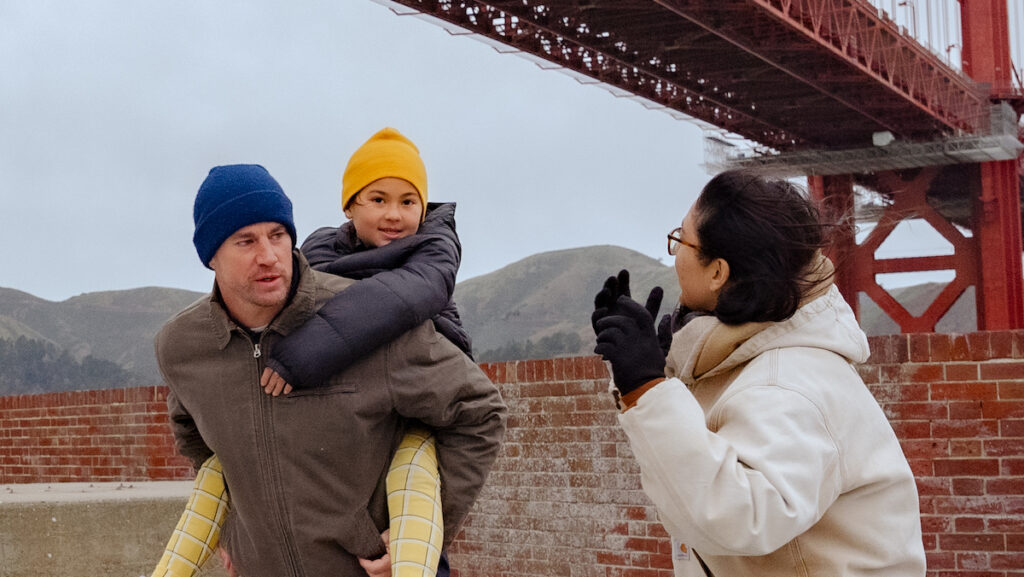
Main image: Channing Tatum, Mason Reeves and Beth de Araújo on the San Francisco set of Josephine. Photo by Stafania Rosini. Sumerian Films