
Before an impish monkey named Julius—emblazoned on everything from T-shirts and sweatpants to lunchboxes and handbags—became virtually inescapable in the early 2000s, there was just a sewing machine, a stack of vinyl, and a makeshift workshop in Paul Frank Sunich’s Southern California garage. Those homemade experiments would eventually grow into Paul Frank, a global brand that turned Sunich’s cartoon monkey into a pop-cultural touchstone for an entire generation.
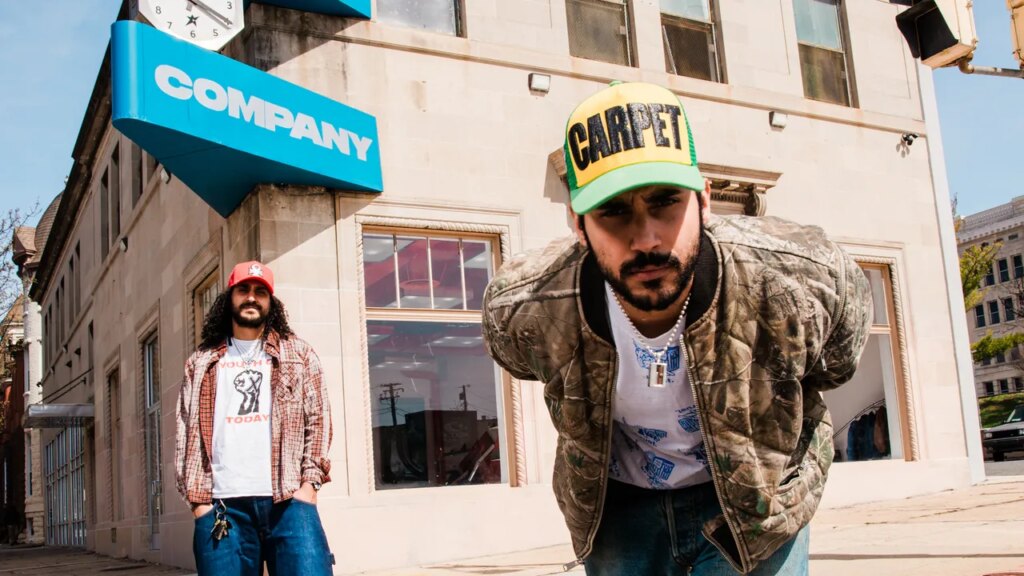
Ayman and Osama Abdeldayem got their start in a similarly DIY fashion. When the brothers behind the Baltimore skate label Carpet Company wanted to print their own T-shirts, they bought a used screenprinting press off Craigslist and set it up in a friend’s grandmother’s basement. They cobbled together the rest of the setup: a lamp to expose screens, a bathtub to wash them out. “It was really bad,” Osama remembers. “But it was fun for us to learn.”

Courtesy of Kyle Myles
A couple of decades and a few thousand miles separate those two DIY experiments, but next week they officially collide: Carpet Company is releasing a collaboration with Paul Frank, which has lately found new life amid the Y2K revival. For Carpet Company, called simply Carpet by its many fans, the partnership is the latest turn in a decade-long project to see how far two brothers can take a simple idea without losing sight of where it all began.
Carpet’s chaotic, experimental sensibility took shape long before the brand did, when Ayman and Osama stumbled across a VHS tape their older brother had left behind. They assumed it was a porno, but it turned out to be Welcome to Hell, Toy Machine’s landmark 1996 skate video. “The mayhem that we had inside of us immediately connected to it,” recalls Osama. They were restless kids, fans of late nights, fireworks, and paintball guns, and their parents, Egyptian immigrants raising five boys in Maryland, were often stretched thin. The eldest looked after the younger ones, and the rest sorted themselves out.
Skateboarding gave that mayhem a direction. It also taught the Abdeldayem brothers how to succeed and fail repeatedly without losing momentum—hurling yourself to the ground over and over in pursuit of a single trick tends to have that effect. Years later, that same persistence would become fundamental to Carpet.
At first, they printed images they liked on T-shirts, simply to see if they could. Eventually, they moved on to skateboard decks, which proved significantly harder. Months went by without success, but because there was no timeline, no pressure to turn anything into a business, it didn’t matter. What started as something closer to an art project slowly crystallized into a skateboard company and a clothing brand. That unhurried approach is tied, in part, to geography. “If Carpet started in New York or LA, we’d either be really big or dead,” Ayman says. “Because we’re in Baltimore, we’re blessed with being able to do what we want at our own pace.”