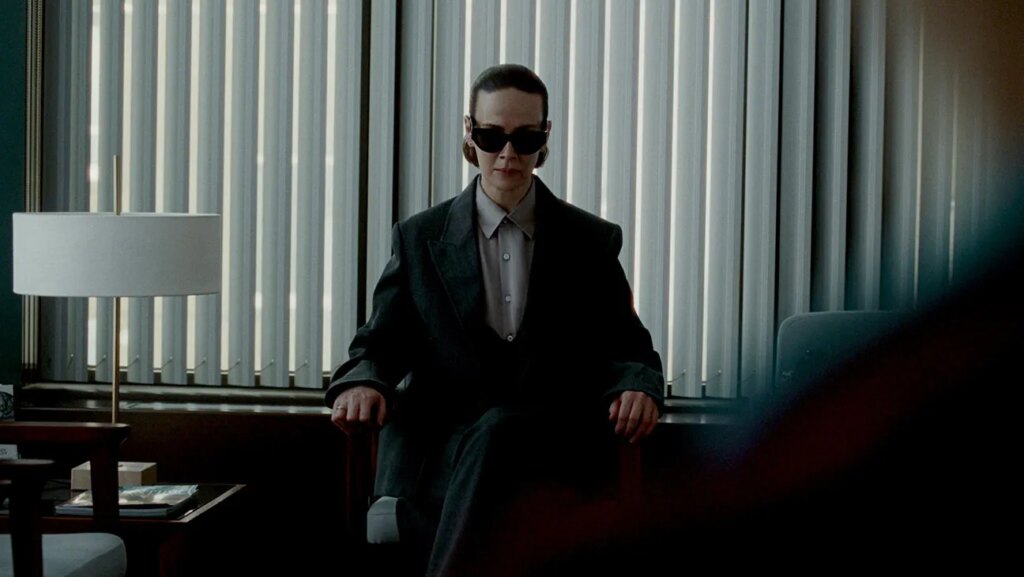

Is actor-turned-director Cody Fern’s debut, Closing Night, intended as a refraction of John Cassavetes’ Opening Night, the 1977 Gena Rowlands vehicle about an actress grappling with a debilitating personal crisis? Seems likely, though that would be just one of several instances of the filmmaker’s aim exceeding his reach. For at least half the movie’s running time, the desired style appears to be the heightened melodrama of Pedro Almodóvar’s tales of turbulent motherhood scarred by traumatic family secrets. But Fern lacks the firm grasp of tone to pull that off, or to smoothly navigate the eventual transition into anguish and sorrow.
The other key influence — intentional or not — appears to be Ryan Murphy, with whom Fern has worked frequently as an actor. There’s a kinship in the arch tone, though sadly, none of the camp. Unless you count Sarah Paulson as celebrated star of stage and screen Sandra Vale, played with a death-stare severity that might be appropriate for her sadistic psycho-nurse in Murphy’s Ratched. All of which is to say that no matter how accomplished the cast, the self-conscious movie only really starts half-working once it gets out of its own way.
Closing Night
The Bottom Line
A soft-impact lurch from archness to angst.
Venue: Toronto International Film Festival (Special Presentations)
Cast: Sarah Paulson, Naomi Watts, Dianne Wiest, Toby Wallace, Odessa A’zion
Director: Cody Fern
Screenwriters: Cody Fern, Devon Bostick
1 hour 55 minutes
Sandra is in rehearsals for her Broadway return in Brecht’s Mother Courage — and therein lies the first clue to her festering secret — but the seasoned pro is having uncharacteristic trouble remembering her lines and motivation. Nonetheless, she sends out formal invitations to her estranged family to attend the play’s opening.
Her jittery sister April (Naomi Watts) bristles at being “summoned” to a reunion after three decades of silence. But she can’t get there fast enough, concerned that her rudderless son Theo (Toby Wallace), who’s living in New York, should be kept away from his self-absorbed aunt. Before April can run interference, Theo drops a bombshell by revealing that he has already connected with the black-sheep diva. The scowling posters of Aunt Sandra all over town suggest that encounter was all but preordained.
April and Sandra’s tart-tongued, boozing mother Diane (Dianne Wiest, in brilliant form) takes a hard pass on the trip from their distant hometown, where she owns a shabby hair salon. But once April starts reporting back, the blowzy old woman — still pissed about Sandra sleeping with April’s boyfriend when she was 15 — hops on a plane.
The first big news to emerge is that Toby’s girlfriend Lucy (Odessa A’zion, wasted in a nothing role) is pregnant, a fact discovered by April when she’s snooping in their bathroom and finds a positive home pregnancy test. (She also randomly steals a hairbrush, the result of a klepto habit that doesn’t add much.) Then when Sandra starts slurring and scrambling her lines before collapsing on the stage, she receives a shattering diagnosis, which helps move along the thaw between her and April — though not so much with crotchety Diane. The biggest secret, however, pertains to Theo and the reason Sandra distanced herself from the family all those years ago. If you can’t guess what that is, seriously, wake up!
The script by Fern and fellow actor Devon Bostick takes a solemn turn in the final act, when Sandra resolves to take a drastic step and enlists April’s support to go through with it. Those developments become lugubrious, though not without affecting moments. But the leap from the seriocomedy of the early action to the sadness and self-recrimination of the concluding stretch is not something the filmmakers negotiate gracefully.
It’s also hard to feel too much for the characters when only Theo, his emotions bounced about among the women, and Diane, who amusingly specifies while making her travel plans that she wants a hotel room with a minibar, seem like real people.
While it’s always a pleasure to watch Paulson and Watts work, Fern forces them to work way too hard. (Certainly harder than they have to work on Murphy’s risibly awful legal soap, All’s Fair, in which performance integrity seems irrelevant.) Sandra and April are characters who might almost have been more at home in some kind of chewy Southern Gothic that didn’t have to rely so heavily on Diane to inject a bit of much-needed humor. That said, Watts does prompt a wicked smirk or two when April instantly appropriates Sandra’s misfortune as her own.
Ultimately though, whether it’s going for caustic dysfunctional family chaos or somber drama, any movie with this lineup of female talent ought to be a lot juicier.