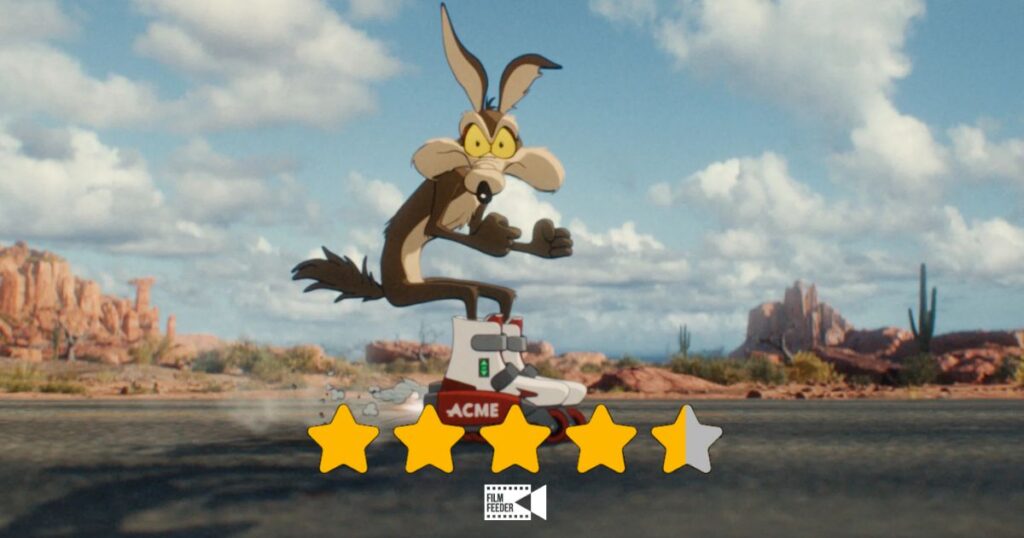

WHAT ARE MY THOUGHTS ON COYOTE VS ACME?
They say there’s no such thing as bad publicity in Hollywood, and in the case of director Dave Green’s Coyote vs Acme, it couldn’t ring truer.
Its dramatic and heavily publicised journey to the big screen – TL; DR: Warner Bros originally cancelled its 2023 release and were set to delete it entirely for a tax write-off, before public outcry from filmmakers and audiences everywhere helped it land at new worldwide distributor Ketchup Entertainment – is ironically the best thing that could have ever happened to it. What started out as a silly concept, even for a Looney Tunes movie, has become the unlikely uniter of viewers and creatives alike against the callous and irresponsible practices of studio conglomerates, particularly those who are more concerned with their own cash flow than the art that they’re supposedly there to champion. Regardless of whether that activism translates into strong box office, the fact that it exists at all has made it the toast of film lovers who now view it as a symbol of unfair oppression by corporate greed, a distinction that will help it last longer in people’s minds than had it been released as planned.
But there’s another reason that Coyote vs Acme not only needs but deserves as much support as it can get: it’s actually very good. Specifically, in addition to being many other things – a genuinely solid legal conspiracy thriller, a fiercely anti-corporate allegory, and a surprisingly heartfelt ode to resilience, to name a few – it is at its core just a really good Looney Tunes movie. It isn’t just the best of these live-action/animated hybrid Looney Tunes movies by far, even coming closer in both tone and spirit than all of the others combined to the grandfather of live-action/animated movies Who Framed Roger Rabbit, but it also nails the classic cartoon ethos while adding newfound appreciation for these wacky, chaotic, and – yes – looney characters that have endured for generations.
As the title suggests, the central character here is one Wile E. Coyote, the non-verbal predator who’s made it his life’s mission to catch and eat the impossibly fast Road Runner, only for the various gadgets and devices of the Acme Corporation, purchased by him to aid his efforts, to literally blow up in his face. Having finally had enough of the physical and mental strain, Wile E. travels to the offices of local lawyer Kevin Avery (Will Forte) to put together a lawsuit against Acme for every single one of their faulty products. But although Kevin – who specialises in settling cases of cartoon violence for practically nothing, which has caused him to become far less ambitious in his overall practice – is eager to wrap the whole thing up swiftly, especially when going up against Acme’s intimidating lawyer Buddy Crane (John Cena), Wile E.’s refusal to settle leads to a full-on David vs Goliath legal trial, during which the attorney, his niece Paige (Lana Condor) and his silent client investigate and eventually uncover a much larger conspiracy lurking within Acme’s history.
Unlike the Space Jam films or even the underrated Looney Tunes: Back in Action, and very much like Who Framed Roger Rabbit, this is a movie where it truly feels like humans and cartoons are living comfortably aside one another. That’s because both director Green and screenwriter Samy Burch (who adapts Ian Frazier’s humorous New Yorker magazine article of the same name) gives this universe a lived-in quality where humans are largely unfazed by the actions of the characteristically destructive Looney Tunes, with sticks of dynamite blowing up inside offices and spring-powered ejectors in courtrooms being just regular everyday occurrences. The effects that bring characters like Wile E. Coyote, Daffy Duck, Foghorn Leghorn (who in this universe is Acme’s unsubtly evil CEO) and of course Bugs Bunny to life are a little inconsistent, with some of the more prominent figures having a more 3D quality to their designs whereas some are clearly much more hand-drawn, but in general it does often feel as though they are truly interacting with the human actors, with natural camaraderie and a normal emotional flow – or at least, as normal as you can get with Looney Tunes – that you’d find among regular performers.
Also like Who Framed Roger Rabbit, it’s a film that gets surprisingly intense in places, with the central mystery here coming with its own brand of suspense that makes it hard to predict where exactly things are going to go. It helps that the movie is even shot and structured like a straightforward legal conspiracy thriller, with cinematographer Brandon Trost giving the film a grainy and almost dramatic look that you’d find in films like All the President’s Men or Michael Clayton, even as we enter realms that are distinctively of cartoon origin (there is a very creative sequence involving the classic Looney Tunes gag of black paint creating reality-bending tunnels). Of course, the movie never gets as dark or harsh as those films, not even Who Framed Roger Rabbit, but it does pretty well to give the mystery some real weight while still indulging in all the fast-paced cartoon slapstick you’d expect from the misadventures of Wile E. Coyote and his fellow animated pals, without feeling as though it’s tonally jarring or out of place within this well-established universe.
In addition to retaining the hilarious and zany spirit of the cartoons, to where multiple viewings are required to pick up on the blink-and-you’ll-miss-it sight gags, there is a real drive among Green, Burch, the various human actors and all the crew members to bring the Looney Tunes to life like never before, and here they go a step further by adding a much more emotional layer to their zaniness. Wile E. Coyote being the main focus here is a difficult task, because him only communicating via handheld signs (“it’s a limited number of signs”, reads one) runs the risk of him being overshadowed by the characters who can verbally communicate, but the filmmakers really make sure that Wile E. is central within the spotlight at all times, with his tireless pursuit of the Road Runner and his reasons for not giving up that lifelong and seemingly impossible goal becoming one of the film’s most endearing messages about persevering through hardships until at last it works out. As weird as it is to say about a character that is definitely not human, Wile E. Coyote is deeply humanised in this film, but still displays all the typical characteristics you’d expect from him, such as his conniving spirit and his dogged determination which makes him a fun foil for Will Forte’s co-lead that’s much more of a straight-man figure than the SNL veteran is used to portraying.
It’s funny, endearing, creative with its outlandish slapstick, and provides a solid mystery that most audiences can engage with, all within that classic Looney Tunes mindset that can still work wonders when in the right hands. After all that behind-the-scenes drama, it’s refreshing to know that the long and blistering fight to keep Coyote vs Acme from never seeing the light of day was more than worth it.