
Dave Boyle, a filmmaker who grew up Mormon in Tucson, may seem like one of the least likely people to make Never After Dark, a masterful Japanese ghost story about a young psychic hired to rid an aging property of a troublesome apparition. But Boyle knows the material inside and out.
Boyle learned Japanese as a Mormon missionary to Sydney, which has a sizable community of Japanese expats. He spent years working on several independent films with Japanese and Japanese-American collaborators before he was recruited for Netflix’s House of Ninjas, which became a global hit. After the success of the series, he and House of Ninjas producer-star Kento Kaku teamed up to produce Never After Dark.
Rather than set him apart from Japanese horror, Boyle’s Mormon upbringing gave him a unique connection to it. The Salt Lake City-based religion places a deep emphasis on genealogy, because of the Mormon belief that family connections continue after death, and that the living and dead can be united through sacred sealing ceremonies.
“I grew up hearing ghost stories from my relatives all the time, and 99 percent of them were about somebody who was in the midst of doing research on genealogy, research on their family history, and getting some guidance from their ancestors, getting some, you know, visitation in one form or another,” Boyle tells MovieMaker.

He remembers hearing the separation between the living and dead described as “a veil,” and learning that “when you start to study your ancestors, the veil becomes very thin.” He borrowed the “veil” as a term in Never After Dark.
The film has impressed some of the most skilled masters of horror, including Stephen King, who calls it “amazing and haunting” and The Black Phone director Scott Derrickson, who found it “intelligent, unpredictable and bone-chilling.”
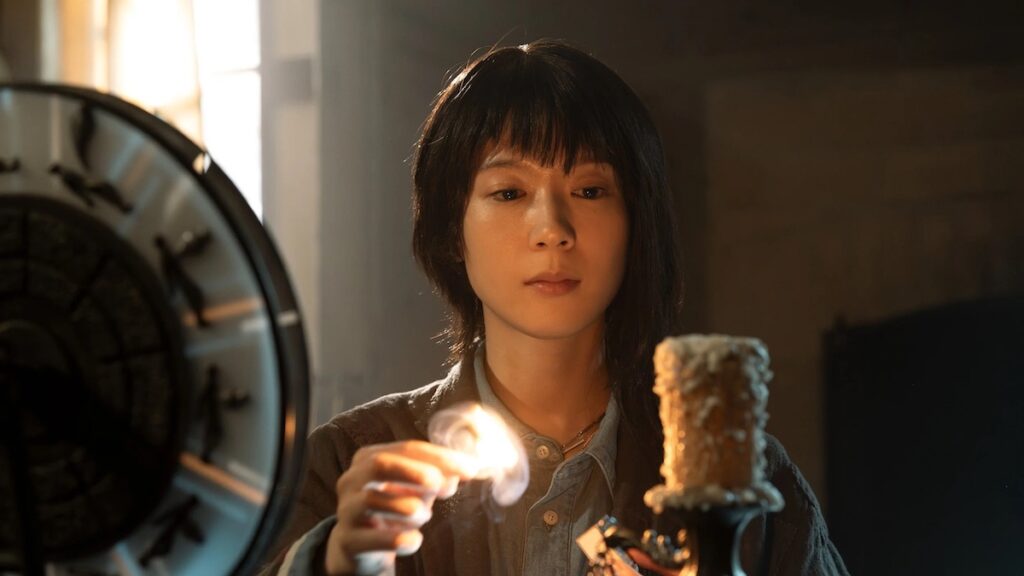
Never After Dark stars Shōgun actress Moeka Hoshi as Airi, a medium who travels from place to place conducting psychic investigations alongside her sister Miku (Kurumi Inagaki). A new homeowner named Teiko (Tae Kimura) enlists Airi to rid her sprawling, isolated house of a repellant, sinister force. Kaku plays Teiko’s son, Gunji, who is both skeptical of Airi — and drawn to her.
Airi expains in the film that she never makes contact with spirits after dark, because in darkness, “the veil’s too thin.”
The film plays with the expectations of Japanese ghost stories, known as kaidan — and with ghost-story tropes across all cultures. For example, something that might be a huge reveal in a lesser horror movie is addressed in the first minutes of Never Before Dark.
“I felt like the usual pattern was to sort of drag out the is-this-real-is-this-not-real question in the audience’s mind, and I felt like there was more to be mined from giving the answer right away,” Boyle says.
The film is notable for its extremely confident cinematography, in which the camera becomes a curious and opinionated guide through the haunted home. Never After Dark marks Patrick Ouziel’s feature debut as a cinematographer, after he previously shot several shorts.
“He was the one other American that I brought in on the production, and a lot of the reason that I chose chose him was just because — besides the fact that we share really similar tastes, and I just really believed in his talent and vision — he’s somebody who has a real sense for precision and and for specifics,” Boyle says.
‘”I really felt like this was the kind of movie where there was a real benefit to making sure that the the camera was in exactly the right place, and oftentimes, you know, just just for the kind of the practical effects and the gags that we were executing, it really was like there was no other place for the camera to be,” Boyle adds. “So I I wanted somebody who was really going to take the opportunity to make something really designed and really formal.”
He’s glad to give Ouziel his first opportunity to shoot a feature.
“You don’t always get the opportunity to to hire whoever you want on movies, and sometimes it’s sort of more of a blind date. But I just always believe that if you’re in a position to sort of choose whoever you want, taking a gamble on somebody whose talent you really believe in always pays off. So, I was really glad I was able to do that this time,” Boyle says.
Never After Dark Director Dave Boyle on Differences Between Japanese and American Filmmaking

Despite his experience with Japanese collaborators throughout his career, House of Ninjas was Boyle’s first time living and working in Japan and following a Japanese approach to filmmaking. He pitched for the opportunity to work on the show.
“I was a working writer in Hollywood and kind of in that the development-hell sort of grind for for a long time, working on various projects, and that just came to me as as a writing assignment,” Boyle says. “It was a job that I pitched for, and just slowly the scope of my responsibility on the show increased until it was essentially my show.”
House of Ninjas was based on an idea from Kaku and his collaborators, and Boyle served as showrunner. He was the lead director, though Kaku directed as well. The collaboration worked so well that they decided to make Never Before Dark together.
“We wanted to make this something that would would work for Japanese audiences that functioned as a fully domestic Japanese-style production, made in Japan, with Japanese financing and everything, but also have it be something that is of interest, accessible, understandable, et cetera, to worldwide audiences,” says Boyle.
“And the other thing we wanted to prioritize was just making a theatrical movie. I love working in streaming, but we wanted a change of pace after doing eight episodes of a streaming show. The other thing was this kernel of an idea that we both felt was an opportunity to make something that both honored and also gave a fresh twist to some of the conventions of J-horror, or traditional Japanese ghost stories.”
Boyle has noticed several interesting differences between the typical American and Japanese ways of making a film. He notes that both countries have been making films for about the same length of time, and that he doesn’t consider one approach better than the other.
One key difference is the role of the assistant director. In the United States, Boyle notes, the 1st A.D. typically keeps the production moving and on time.
“In Japan,” Boyle says, “the first assistant director typically isn’t even on set. So, starting with that, you can kind of see how the differences are already kind of starkly different.”
Also, in Japan, the 1st A.D. serves only the director, not the producers. And the assistant director role “has been designed from day one as a place to train directors to give them slowly more and more scope of creative responsibility.”
He also noted that in Japan, assistant directors “come on early and they function as a research department in the early days, so they are breaking down the script and coming up with ways to improve it. Like in in our case, for example, they’re doing a lot of research on spiritualism and mediums from various cultures, just looking for tidbits that the art department or anybody else could use to carry out their work.”
Another difference is that in Japan, “the camera department and the lighting department are a little more separated than they are in the U.S. — the lighting department has a little more autonomy. There is a Japanese Academy Award for best lighting.”
Never After Dark is just the start of the collaboration between Kaku and Boyle: The film is the first from their new production company, Signal 181.
“Part of the reason why Kento Kaku and I wanted to start a company together and do movies that are sort of Japan-centric but have an international bent to them is just to try to increase the Venn diagram of the interaction between creatives from all over who may have different working styles,” Boyle says. “As long as everybody understands the reasons why things are done a certain way, then there’s no reason they can’t work together.”
Never After Dark arrives in theaters Friday from Magnolia Pictures.
Main image: Moeka Hoshi in Never After Dark, courtesy of Magnolia Pictures