
Antonin Baudry’s ambitious de Gaulle epic concludes, following the superb first part, De Gaulle: Résistance. At the start of that film, , viewers saw General de Gaulle with nothing but hope and a dream. He had no office, no staff, no supporters. The Free French was a nascent concept.
By the end, the general was a man whose imagination built the persona of de Gaulle, the leader. The Free French battalion was successful in the former French colonies; his troops had grown to the thousands, and De Gaulle was a player on a major stage.
De Gaulle: Liberté opens in 1943. By now, the liberation of France no longer seemed impossible. But the question was, who would be in charge of France when that liberation arrived? Would it be former Vichyists? Would it be the Americans, who wanted to create an Allied Military Government of Occupied Territories (AMGOT)? Or would it be de Gaulle’s still-precarious Free French?
Simon Abkarian continues in his excellent portrayal of de Gaulle. Continuing his massive self-belief that he should lead France, he finds his battles are now closer to home. Conflicts ensue both internally among various French factions and externally with UK and US allies.
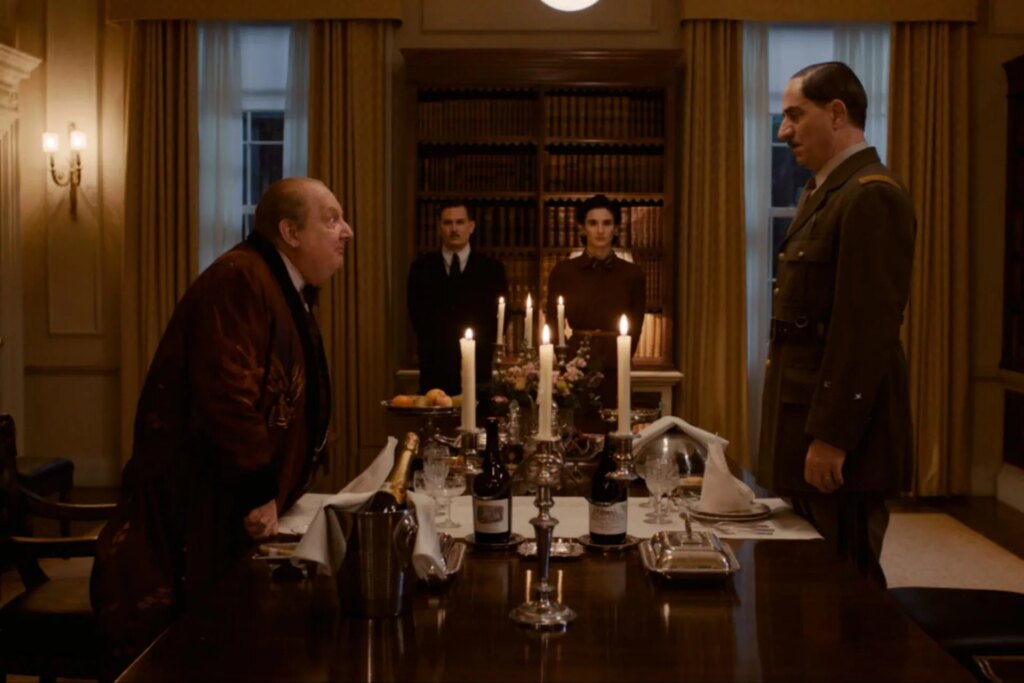
His relationship with Churchill (again a delightful Simon Russell Beale) is central. These two remain in the ‘frenemy’ zone. As France’s closest ally, de Gaulle must keep Churchill onside, but this is a challenge when Churchill is, at times, under Roosevelt’s thumb.
Franklin D. Roosevelt (Campbell Scott) is consistently annoyed by and dismissive of de Gaulle—the two leaders do not see eye to eye. The movie portrays FDR as a realist; he has legitimate doubts about France as a post-war power and even greater doubts that de Gaulle should lead it.
Campbell Scott doesn’t make for an amazing Franklin D. Roosevelt—his accent never quite matches the actual Roosevelt’s, and the dialogue itself comes across as modern. However, he holds his own against Abkarian and Beale.
All this political strife between Allies could make for a dull film. Baudry avoids this by treating these scenes as battles. Who’s sitting where, and who has what invite to what conference, all become skirmishes. Even scenes as simple as handshakes become pivotal. It’s all about image and spectacle, something that de Gaulle thrives on.
On the actual battlefields, Niels Schneider’s is excellent as General Philippe Leclerc, who becomes increasingly important. Schneider brings the action scenes to the film, and boy does he step up.
His sequences focus primarily on the instrumental Mareth Line in southern Tunisia. Watching French troops confronting vastly superior German armour is particularly effective. The scenes are tense and physical and make viewers feel incredibly patriotic to France, even if they aren’t French themselves!
Meanwhile, Anamaria Vartolomei expands her role from the first film as resistance radio operator Livia. Her scenes take place in occupied France, where she now works under Jean Moulin (Felix Kysyl). He has a larger role in this film, trying to tie together the various resistance factions under de Gaulle’s leadership. Here the tension is vice-like in its grip. The denouement of his story is brutal and hard-hitting.
Again, the costuming, the cinematography and music are incredible. There is a real sense of historical gravitas. And yes, there are oodles of patriotism. By the time the Free French liberate Paris, you may find yourself singing the La Marseillaise.
The film clocks in at roughly two and a half hours. Viewed alongside part one, it is an enormous historical undertaking. But Baudry manages this immense scale in a viewer-friendly mode. It is also a wonderful addition to the plethora of British and American films centred around World War 2.
De Gaulle: Liberté is in cinemas now.