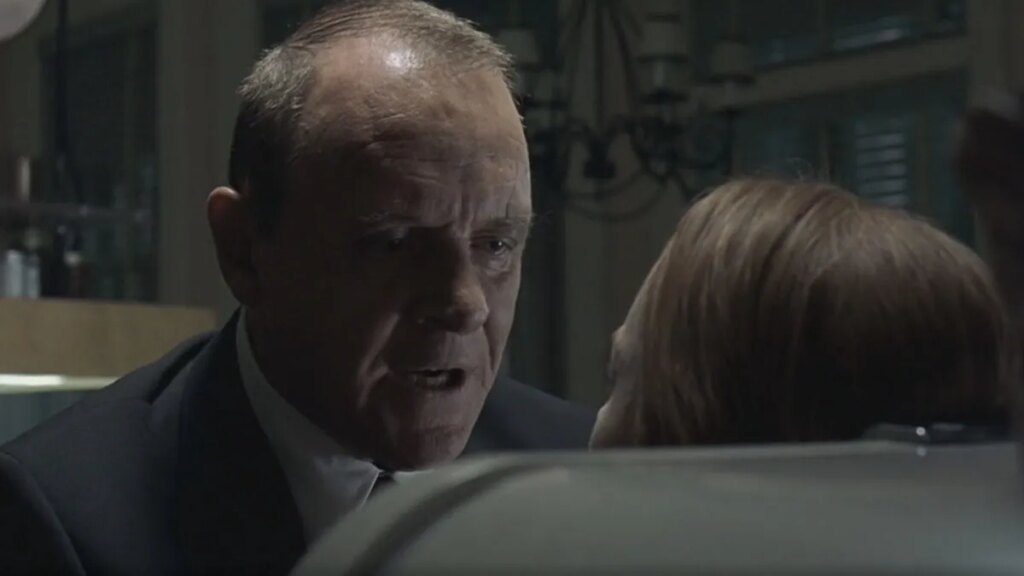

The spaciousness of the plot does make Hannibal feel unwieldy. The first two acts split time between Washington, where Clarice finds herself under greater scrutiny after a drug bust gone wrong, Lecter’s adventures gallivanting around Florence, and Mason’s haunted mansion. The primary characters interact mostly on phone or by staring at screens, only bumping into one another through artless plot contrivances. The plot continues to feel clunky when they all come together for the final act, which first takes place at Verger’s mansion and then retreats to the home of Paul Krendler (Ray Liotta), the smarmy Justice Department official overseeing Starling.
Certainly, the clunkiness stems in part from the tortured production process, which itself connects to Harris’ issues writing the book. Rumors swirl around the production of the book, ranging from claims that Harris’ publisher and/or The Silence of the Lambs producer Dino De Laurentiis forced him to write the book to Harris feeling disgust over the sudden popularity of his character. Harris has never confirmed or denied these claims, but it is clear that the success of The Silence of the Lambs weighed on him.
Harris remained in contact with Demme throughout the process, as the director planned on filming the follow-up. Yet, when he read the final draft, Demme found the work too disgusting to adapt, as did Tally and Foster. In particular, the creatives took issue with the ending of Harris’ book, which saw Lecter and Clarice come together as a couple.
Scott removed the overtly romantic ending from the story (with Harris’ blessing), and the screenplay that David Mamet and Steven Zaillian hammered out does excise some other icky elements—most notably Verger’s sister, who kills him by shoving an eel down his throat—but they retain much of the novel’s icky tone. And that’s exactly what makes Hannibal great.
An Old Antagonist For Dinner
Two things are true of Hannibal: it is disgusting and it is beautiful. Everything about the film is unpleasant, especially in comparison to Silence. Where Clarice once retained her compassion, here she guns down a female criminal with a baby strapped to her chest. Where Demme put us in Clarice’s POV as men leer at her, here we look through Krendler’s eyes as he stares at her legs. Where Levine retained some sadness in Buffalo Bill, Oldman plays Verger as gleeful about both his abuse of young boys and his plans for Hannibal. Even the kindly orderly Barney (Frankie R. Faison), who seemed in Silence to win over Lecter with basic human decency, swipes Hannibal’s personal belongings and sells them to Verger at elevated prices.
Even worse are the gore moments. Editing, Dutch angles, and slow-motion blur the flashback scenes in which Verger cuts off his face and feeds it to the dogs, but other sequences are presented more clearly. We see in full when Lecter slices open Pazzi’s stomach before placing a noose around his neck and shoving him out a window, so that his entrails spill out when his neck snaps. We watch the pigs consume Verger after his physician Cordell (Željko Ivanek) shoves him into the pen.