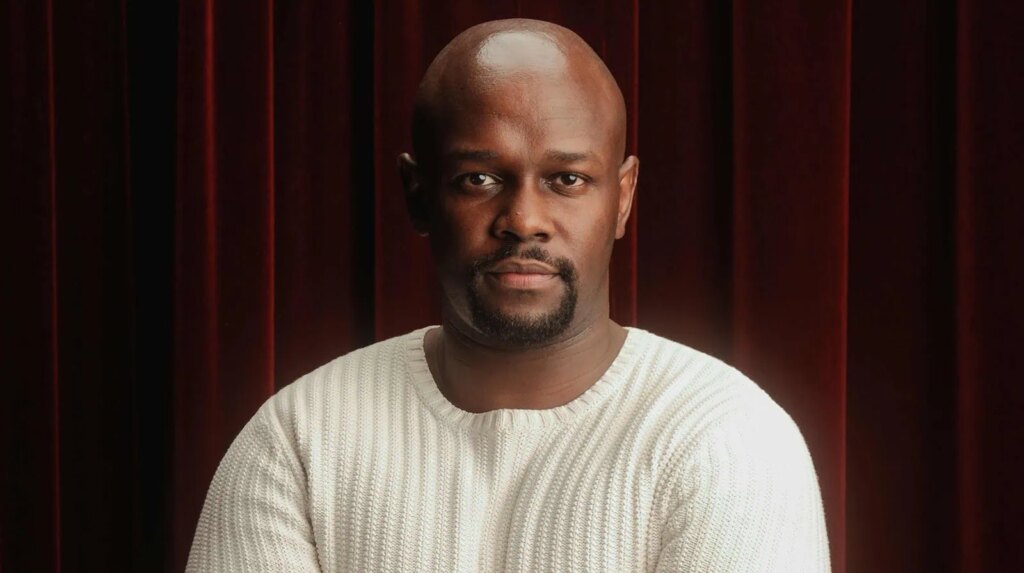

From Nairobi to London to Los Angeles, Dennis Mailu has built his acting career across continents, bringing an international perspective and a growing reputation for physically and emotionally committed performances to his work. Born and raised in Nairobi, Kenya, Mailu grew up speaking Kikamba, the language of his Kamba heritage, as well as Swahili and English. His fascination with performance began early, but it was during high school that acting became something more serious. After writing and performing in an award-winning play, Mailu began looking beyond Kenya and toward a future in the entertainment industry.
That ambition eventually took him to the United Kingdom, where he lived for nine years while continuing to act and perform, before relocating to Los Angeles. He went on to train at both the New York Film Academy and the American Academy of Dramatic Arts, where he received the prestigious Charles Jehlinger Award for Excellence in Acting.
Since then, Mailu has steadily expanded his screen résumé across film, television and emerging formats. His credits include Big George Foreman, Blue Light Melody, the Shudder-acquired horror feature Parasomnia, Person of Interest, Prey, The Spell That Backfired and the Afrofuturist sci-fi drama Catalina. His work has allowed him to move between drama, horror, action and science fiction while drawing upon additional skills including mixed martial arts and stage combat.
Now, Mailu is preparing for another ambitious science-fiction role as Dr. Elias Kamara in the upcoming Ataxia from Legacy Inspired Films, executive produced by Tyronne Tann. The role brings Mailu particularly close to home. Like the actor portraying him, Dr. Kamara was born in Nairobi. But this is no conventional scientist. As Chief Scientist of LevelBio, Elias develops the groundbreaking nanotechnology that saves the life of Andrew Walker and potentially begins an entirely new chapter in human evolution.
We caught up with Mailu to discuss the journey that brought him from Kenya to Hollywood, the importance of African representation, and why the morally complicated Dr. Elias Kamara may be one of his most fascinating characters yet.
You were born and raised in Nairobi. How much of the person and actor you are today, still comes from those early years in Kenya?
A tremendous amount. Nairobi is home, and my Kenyan heritage is fundamental to who I am. Kikamba was the first language I learned, and I used it constantly when we traveled back to the village while I was growing up. I also speak Swahili and English fluently. Growing up with those languages and cultural influences gave me a strong sense of identity, but it also made me curious about the wider world. As an actor, I think that combination is very valuable. You need to know where you come from while remaining curious about people whose experiences are completely different from your own.
When did that childhood interest in performing turn into the realization that acting could actually become your career?
I always loved performing. As a child, I would imitate what I saw on television. I would jump off the sofas dressed as Batman, mimic the Power Rangers or pretend to be a professional wrestler with my brother. There was always this tremendous joy attached to performing. High school was when it became more serious. I started acting in plays and really discovered something about myself through the stage. Eventually I wrote and performed in a play that won awards, and that was a defining moment. I remember thinking, “I can actually do this.” That was when Hollywood stopped feeling like just a dream and became something I wanted to pursue.
Pursuing that dream ultimately meant leaving Kenya. How important were the years you spent in the United Kingdom?
Extremely important. Daring to pursue something big requires courage and sacrifice. I wanted experiences that would build my character, expand my education and give me a broader point of view about the world. I spent nine years in the UK and continued acting and performing there. Living outside your home country forces you to grow because you’re constantly experiencing different people, cultures and ways of thinking.
Then I came to Los Angeles and continued my training at the New York Film Academy and the American Academy of Dramatic Arts. Receiving the Charles Jehlinger Award for Excellence in Acting at AADA was an incredible honor because it represented another stage of that journey.
You’ve now worked across horror, action, drama and science fiction. What are you looking for when you choose a character?
I’m interested in human behavior and connection. I love creating visual and vocal performances where you can really investigate why someone behaves the way they do. I don’t necessarily need the character to be a good person. In fact, sometimes the characters who genuinely believe in something questionable are much more interesting because you can’t approach them thinking, “I’m playing the villain.” You have to understand why they believe they’re right. That’s one of the things that immediately interested me about Elias Kamara.
Let’s get into Ataxia. Who exactly is Dr. Elias Kamara?
Elias is the Chief Scientist of LevelBio and an extraordinary biomedical engineer. He was born in Nairobi to a university mathematician and a trauma surgeon, so from childhood he’s exposed to these two worlds of logic and medicine. His mother repairs human bodies after trauma, while his father solves complex mathematical problems. Elias essentially combines those two influences.
He develops this belief that human beings are fragile, but systems don’t necessarily have to be. If you can understand the human body as a system, perhaps you can repair it. And then the bigger question becomes: if you can repair it, can you improve it? That’s where things start becoming very interesting.
You must have had quite a reaction when you discovered that Elias was also born in Nairobi.
Absolutely! That immediately created a connection. As an African actor working in Hollywood, I’m always interested in seeing African characters placed into worlds where historically we haven’t always been represented. Elias isn’t on the sidelines of this story. He’s a brilliant scientist whose work changes everything.
I love that. His Kenyan background is part of who he is, but it isn’t the only thing that defines him. He’s defined by his intelligence, ambition, scientific ability and the decisions he makes. That’s the type of representation I want to see more of.
Elias is recruited specifically to save Andrew Walker. What makes him the scientist Arthur Walker turns to when everyone else has failed?
Elias is willing to attempt what other scientists won’t. Arthur’s son Andrew is dying. Conventional medicine has failed and experimental medicine has failed. Arthur doesn’t need somebody to tell him what can’t be done. He needs someone willing to attempt the impossible. Elias has already developed a reputation for exploring scientific ideas that other people consider too dangerous or radical.
Arthur sees that fearlessness and thinks, “This might be the person who can save my son.” The interesting thing is that Arthur and Elias begin with what appears to be the same goal, but their motivations are actually very different. Arthur wants his son back. Elias wants to prove something. Obviously, Elias wants Andrew to survive, but scientifically he sees an opportunity to demonstrate that the human body can be repaired from the inside out.
That’s an important distinction because once Andrew survives, Arthur essentially believes the mission has succeeded. For Elias, that’s when the mission really begins.
The nanotechnology Elias develops goes far beyond simply healing Andrew. What has he actually created?
He has developed an entire nanobot system. There are nanobots capable of repairing damaged tissue, neural-mapping nanoclusters that interface with the brain, immune-override protocols designed to prevent rejection, self-replicating nanobot colonies that can sustain healing and adaptive behavioural programming that allows the nanobots to learn from the host. That last part is incredibly important. These aren’t simply tiny machines carrying out fixed instructions. They can adapt. Elias has essentially created technology that can evolve inside a human being.
Interesting … and Andrew becomes the first human subject?
Yes. When Andrew’s condition becomes critical, Arthur eventually authorizes the procedure.
Elias designs everything: the implantation protocol, neural-interface calibration, cellular repair sequence and adaptive learning parameters. He supervises the entire transformation. Andrew survives, but Elias is the only person who completely understands what Andrew’s body endured, what the nanobots rewrote, what they learned and potentially what they have become. That’s a tremendous amount of knowledge and power for one person to possess. Andrew begins developing enhanced strength, reflexes, healing and neural abilities.
Is that the point where Elias crosses the line?
That’s one of the questions I think audiences will have to decide. Elias certainly changes. Arthur sees Andrew’s recovery as a miracle. Elias sees it as proof. If you can repair somebody beyond what conventional medicine believed possible, Elias begins asking why you should stop there.
Could you create first responders capable of surviving situations ordinary humans couldn’t? Could you enhance soldiers? Could human reflexes, healing and neural capabilities be improved? He isn’t trying to replace humanity or create another species. In his mind, he’s expanding human capability. That’s what makes him dangerous and fascinating at the same time.
Would you describe Elias as a villain?
I wouldn’t. And I certainly can’t play him as one. Elias believes he’s right. That’s essential.
He’s not sitting in a laboratory thinking, “How can I destroy humanity?” He’s looking at Andrew and thinking, “I saved a dying man when everyone else had given up.” And he’s right about that. The conflict comes from what he decides that success gives him permission to do next.
When Arthur and the board begin becoming afraid, Elias doesn’t necessarily see their fear as evidence that he’s wrong. He sees it as evidence that they’re unable to understand the future yet. As an actor, that’s much more interesting than simply playing someone evil.
You’ve played several characters recently who operate in morally complicated worlds. Does Elias feel like a natural progression?
Definitely. Person of Interest allowed me to combine physicality with tension and authority. Parasomnia pushed me into horror and a very different type of physical performance with prosthetics and special-effects makeup. In Catalina, I’m again working within science fiction and a future shaped by artificial intelligence. Elias takes me somewhere different because his primary weapon is his intelligence. There is tremendous power in somebody who believes he understands something about humanity that everyone around him hasn’t grasped yet. That requires a different kind of intensity.
Your physical training has played an important part in several of your performances. Does that still influence a character who is primarily a scientist?
Absolutely, because physicality isn’t only about fighting. Every character occupies their body differently. A scientist who has complete authority in his laboratory moves differently from someone who is uncertain. Elias knows he’s usually the smartest person in the room, so that confidence should exist physically without becoming exaggerated.
My mixed martial arts and stage combat background have taught me a lot about control, precision and economy of movement. Those lessons apply to acting even when there isn’t a fight scene.
You’ve spoken before about wanting your career to contribute to greater representation of the African diaspora. Does playing Elias feel particularly significant in that respect?
It does. I want to see African actors and African characters existing everywhere in storytelling, not only in stories specifically about Africa. We can be scientists, heroes, villains, romantic leads, astronauts, executives and everything in between. Elias, being born in Nairobi, matters to me because he’s operating at the very highest level of this futuristic scientific world. His intellect drives the story forward.
The more we normalize seeing African and diasporic characters occupying those spaces, the richer storytelling becomes.
What excites you most about stepping into Ataxia?
The questions it asks. Science fiction is at its best when the technology is really a way of examining human behavior. If we developed the ability to eliminate certain human limitations, would we stop at healing disease? If we could make people stronger, faster or more resilient, who gets to decide whether we should? And what happens when the person controlling that technology genuinely believes he is helping humanity? Elias sits right at the center of those questions. As an actor, that’s an exciting place to be.
Finally, what do you hope Dr. Elias Kamara adds to this next stage of your career?
I hope he shows another side of what I can do. I’ve been fortunate to work across different genres and different kinds of characters, and I want to keep pushing myself into roles that require something new from me.
Elias has intelligence, authority, ambition and moral complexity. He’s Kenyan-born, which gives me a personal connection, but he’s also unlike anyone I’ve played before. That’s exactly what I’m looking for.
Ataxia, from Legacy Inspired Films and executive producer Tyronne Tann, is an upcoming science-fiction project with filming planned in Nashville. For more on Dennis Mailu you can visit his Instagram.