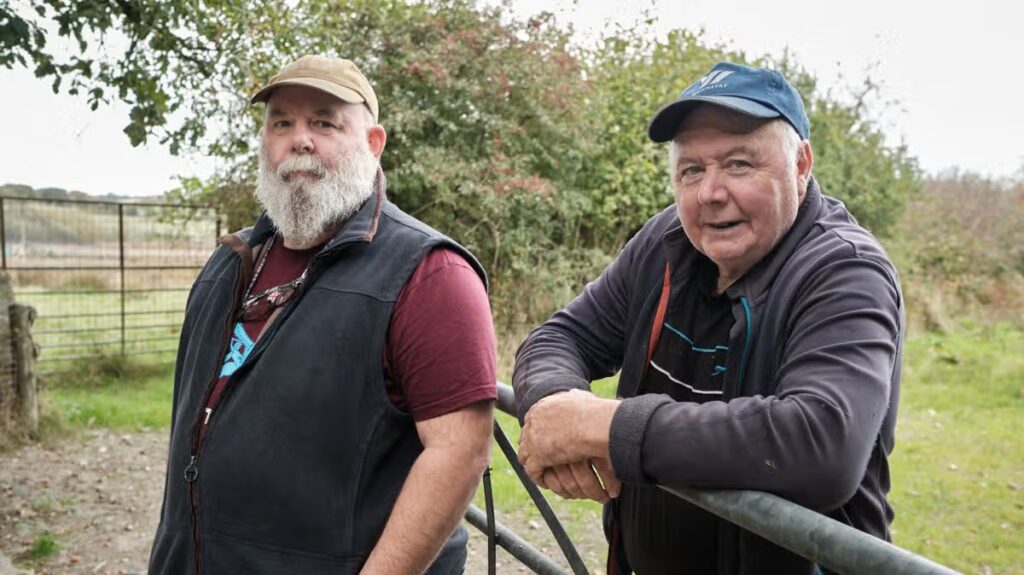

With winter food prices forecast to be 50% higher than 5 years ago when the cost of living crisis began, and our green and pleasant land battered by climate change, UK farming has never been in sharper focus. And two west Devon farmers, both called Derek – who share a name, location, profession and very little else – have become unlikely filmstars, largely because of their radically different views on how to tend their land.
Derek Gow, 61, is a fervent conservationist, credited with bringing the beaver back to England, who has turned his 400 acre plot over to nature. His neighbour, Derek Banbury, 72, is an intensive farmer with both dairy and beef herds – and is outspokenly distressed by what he sees as Mr Gow’s neglect of good farming land.
They are at loggerheads concerning how to secure a viable future for UK farmers, in a world plagued by climate change and rising costs. The resulting film, Derek vs Derek, in cinemas from October 2, which portrays their turbulent relationship, is both thought provoking and hilarious.
Former sheep farmer Mr Gow, a devoted conservationist, has made his land into a wildlife haven – in a kind of rage against the toll taken by climate change and intensive farming – introducing native species like the Eurasian beaver, water vole, and white stork back to Britain.
Owning several wild boar, he uses them to cultivate his land naturally, by foraging, or ‘rooting,’ using their powerful snouts and tusks like a plough, turning over the top layer of soil. Mr Gow says: “Sometimes you don’t need a machine. Sometimes a pig will do.”
Contemptuous of his neighbour’s approach, when a boar strayed on to his own 400 acre farm, Mr Banbury shot it and served it for supper. He scoffs: “It was tough as old boots.” Disgruntled, Mr Gow retorts: “When a male wild boar reaches a certain age, it tastes like p***. It’s only fit for sausages. You should have sent it back to me.”
The film explores the ongoing debate over food production versus nature restoration, with the Dereks’ opposing views perfectly illustrating the differing visions for the UK’s agricultural land. Mr Gow says: “Nature has been at the bottom of the national agenda for far too long. I’m on a mission to change that.
“Derek takes great care of his animals, but has very little time for wild creatures. Derek views the countryside as a food production machine. If anything opposes him, he just gets a shotgun out and blows its face off. But there won’t be a Britain left to farm if we continue to destroy it. I farm to save the wildlife Britain is losing. This is my land, and I’m going to heal it. I don’t use chemicals at all.”
And the wildlife serves a purpose, he says, adding: “Trees, restored wetlands and animals like beavers slow down rainwater run-off, which helps stop severe flooding and reduces wildfire risks.”
Mr Banbury disagrees, bellowing: “I don’t agree with what he’s doing. In fact, I dislike it intensely. It’s such a mess. Bushes and sticks in the fields. Massive holes everywhere that he calls ponds. He says it’s for wildlife. I couldn’t stand it.
“What this country needs is food. The population is growing and British farming is in decline. I love butterflies, but to turn 400 acres of perfectly good farmland into a swamp is crazy to me. I won’t change. We couldn’t farm here with the amount of animals we have, without fertiliser and sprays. You just grow the crops as big as you can. Derek has all these big ideas, but what is he actually doing?”
Mr Banbury’s beliefs are not without foundation. Figures released this month by the National Farmers’ Union show Britain is producing less food than it did 30 years ago.
Official Farmers’ Weekly data reveals that UK food self-sufficiency dropped to 60% in 2025, down from 65% the year before. Production for 10 out of 11 everyday foods – including wheat, fresh vegetables, and meat – has fallen over the past three decades.
Mr Banbury explains: “The UK faces mounting pressures on food security, as a growing population intersects with severe climate-driven droughts, inflation, and vulnerable supply chains.”
After record-breaking summer heatwaves and prolonged drought across England and Wales, harvests have suffered badly, with wheat yields down roughly 14% and oat production dropping by at least 9%, alongside severe strains on root vegetable and livestock production.
Mr Banbury says: “Simply put, we need more food in the country. And we need the country’s good, fertile land to do it. Gow keeps buying more and more acres. He’s making a right mess of good land that could be used to feed the country.”
But, Mr Gow insists that restoring Great Britain’s decimated wildlife should be a landowner’s top priority. Great Britain is one of the world’s most nature-depleted places, according to The Wildlife Trust, with nearly one in six species at risk of being lost – from dormice to red squirrels, water voles and wildcats.
Mr Gow, whose partner, Jo, is an artist and has two grown up children, says: “I have a wildlife consultancy business, run wildlife photography courses, and hire my land out for filming. I also get subsidies from the Government. British wildlife is in crisis. I’m doing what I can to help. I don’t have much at my disposal, but what I do have is land.
“Since I began to conserve it, I now have white storks, black storks, turtle doves, harvest mice, owls, water shrews, ponies, cattle. I’ve resown it back to wildflowers and, as a result, have swarms and clouds of butterflies and insects. It’s working. I’m healing the land.”
Speaking to our reporter in Devon, over tea and homemade scones, Mr Banbury’s wife-of-46-years, Linda, a former district nurse, now manages the farm and holiday cottages on site, says: “Since we got married, all I’ve done is work. That’s the reality of farming.”
Dad-of-four, Mr Banbury adds: “It’s getting harder. Milk is now cheaper than water – 35p a litre is all we get, even though it’s the best goodness that you can ever buy. My dad had 13 cows when he started farming, and he made a good living. Now I have 200 and it’s a struggle.”
Banburys have lived on Frankaborough Farm for three generations, while Mr Gow moved to Coombeshead Farm 20 years ago. Despite their not inconsiderable differences, the two Dereks do help each other out.
They met 20 years ago when Mr Banbury rescued Mr Gow, who recalls: “I had a few fields and 300 cows. One day I fell down a hole and Derek had to come and fish me out. I was glad he was there.”
Only last week, history repeated itself when Mr Gow became wedged under a quad bike. He says: “I was stuck fast, so I called Derek. He came, like the cavalry in a white stained vest, and pulled me out. When the chips are down, he’s there every time. We help each other. We work together, and that’s what farming is really all about.” Mr Banbury laughs: “What are friends for?”
Meanwhile, there is an expert to support each Derek’s argument. NFU president Tom Bradshaw says: “If we start rewilding vast tracts of British farmland then we will reduce UK food production. If we do that and simply import from countries with lower standards, then we may end up living in a green oasis here, but we have offshored our production and any environmental impacts that go with it.”
Rebecca Wrigley, Rewilding Britain’s chief executive, supports Mr Gow, saying: “Rewilding and farming don’t have to be competing visions for the countryside. They can work hand in hand – with farmers producing the food we all depend on, while restoring the soils, water, wildlife and natural processes that sustain healthy farmlands. Rewilding has to be part of the future.”
*Derek vs Derek is in UK cinemas from October 2