
In the broadest sense, each successive twist in this vein is revealed as Digger drills ever further down, one layer of narrative artifice at a time, all while staying committed to doing a jaunty spoof about oil executives and complicit governments bringing about the end of the world. I wouldn’t say the ulterior instincts are mistaken, or even lesser, but smashing together these two (or three) narrative sediments and attempting to tell each of them with an earnest, if not imperious, request for applause undermines all levels until, like a deadly shelf of ice the size of multiple American cities, the whole thing starts to crack under the pressure of its own pretensions.
Of the elements I can most freely describe, the movie is about an oil man named Digger Rockwell, a third or fourth generation tycoon so blue-blooded that his austere, Yosemite-chic mansion is lit in a perpetual dreary morning-gray overcast by cinematographer Emmanuel Lubezki. Still, it doesn’t make all the dead animal heads and guns on the walls, floors, and even ceilings look any less garish. It’s from this taxidermist paradise ol’ Digger runs the world, keeping the President of the United States (John Goodman) and attendant handlers and Cabinet secretaries waiting downstairs, and telling the eggheads on his Zoom calls, where they complain about safety concerns, to put a cork in it while the oil flows.
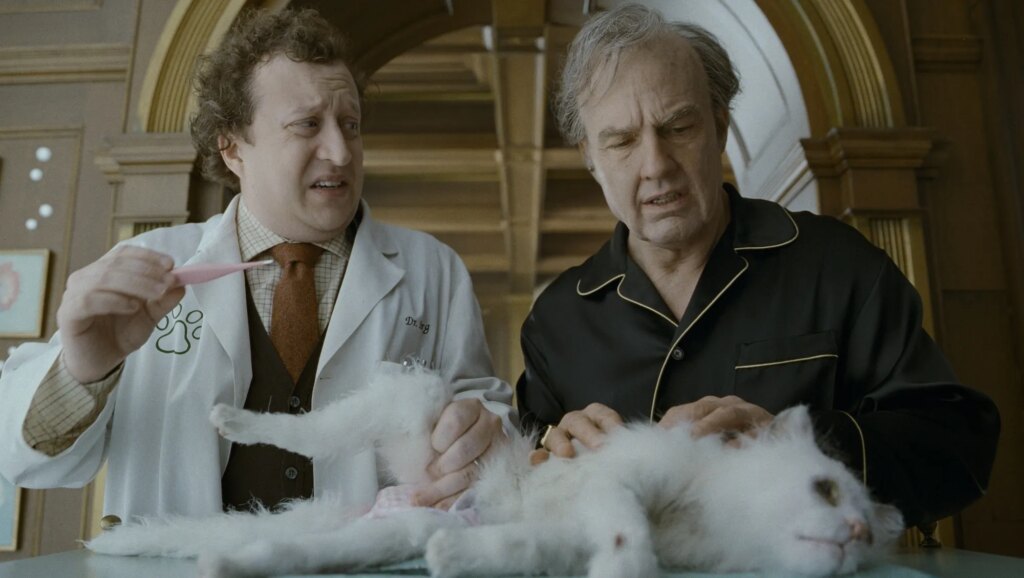
Unfortunately on the morning we meet the rascally billionaire, those unstoppable commands meet an immovable rock—or rather a quite rapidly moving ice shelf that has broken off a glacier in Greenland and is expected to make landfall with accompanying tidal waves in about three days. The ailing, mortality-obsessed president wants to pass the buck to Digger, the president’s men want Digger’s chief scientist Dr. Ganesh (Riz Ahmed) to come up with a miracle solution when bombing the ice shelf proves futile, and Digger… he just wants to find a loophole in the crisis he can exploit for financial gain. It is, after all, the American way. More pressing for our hero, though, is that no one is able to do anything for his cancer-ridden, comically-obvious animatronic cat!
The artificiality and theatricality of Digger’s End Times scenario, and pussycat, is of course the point. In a world where titans of industries and the winners of real-life Monopoly command, own, and even have patented the technology of the spotlight, all the rest is just a stage for their indulgences and eccentricities, with anyone earning less than 10-figures relegated to the invisible audience in the dark. In this context, Digger is the ultimate diva, and Cruise plays most of his scenes like he’s feasting on a Texas-smoked solo aria. He kicks, he grins, he finger-bangs, and he spits while raving. Some might be reminded of the similarly crude Hollywood caricature Cruise played in Tropic Thunder, but that was done with peculiar affection for his hometown’s line of work.
Digger Rockwell is essayed with leering disdain where the archness is intended to belie the emptiness of the man. The movie offers a pittance of humanity due to his doting concern over a cat that clearly has three paws in the grave, but the obvious unreality of the feline’s on-screen, robotic visage speaks to the realer antipathy the film and actor offer their antihero: he’s a devil who can tap into Cruise’s bottomless charisma, as best demonstrated in a bravado sequence where Digger stands before the eyes of the Hague and world to equally invite their scorn and desperate pleas for liquid black gold. We’re more expected to shudder at and maybe enjoy his folksy rottenness, but we never empathize. Or laugh.
It is an unhinged and liberating performance for Cruise, and yet perhaps the most damning thing about it comes when another character observes, “but it isn’t funny.” Indeed, it’s not, and this articulation draws attention to the gaping hole in the satire; there is an obvious logic to this choice, hence the on-screen admission, but it still cannot paper over what becomes one of the movie’s significant deficiencies. For a film so desperate to posture as a comedy, there is too much didactic anger, and even more smug self-satisfaction, for this basic objective to be fulfilled: it fails at being funny, and thus there is little catharsis in its doom prophesying.