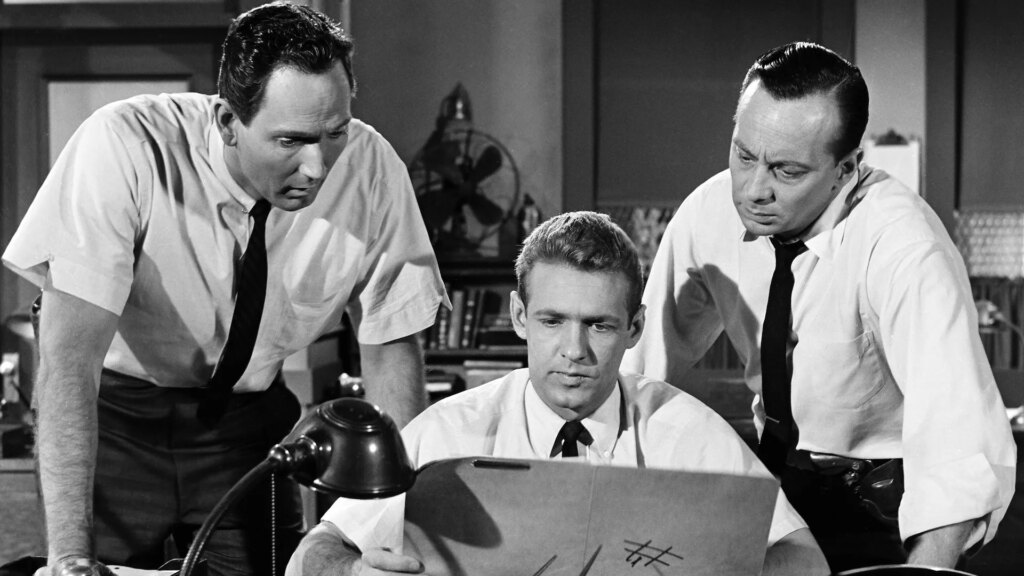

But McBain wasn’t interested in just getting the details right. He was also interested in characters, which is what distinguishes his work from Dragnet, and what sets the model that everyone else followed. McBain filled his novels with complex, compelling characters, partially drawn from archetypes of hard-boiled fiction of the preceding century.
His main character is Steve Carella, a large man capable of violence, but who more often solves cases through determination and dumb luck. After getting married early in the series, McBain introduced Cotton Hawes, a tall redhead of Puritan stock, who becomes the romantic lead. Carella often works alongside Meyer Meyer, a Jewish detective whose legendary patience stems, in part, from the silly name bestowed upon him by his jokester of a father. There’s the aforementioned Bert Kling, who worked his way up from being a beat cop but who suffers endless calamities in his relationships. One of those relationships is with fellow detective Eileen Burke, whose undercover work puts her in danger.
This small sampling of characters gives you an idea of the breadth of the 87th squad, which is McBain’s most important innovation. Even though Carella serves as the main character of the series, McBain always wanted the squad room itself to be the main character, with different officers working different cases within the same novel.
That focus on the community and the changes within it allows the police procedural to evolve past Webb and Dragnet. For all of its popularity, Dragnet channeled all of its stories through the single and impersonal view of Sgt. Friday. McBain showed that police work is done by people, lots of people, who have sometimes wildly different ways of doing their jobs and, thus, can tell different types of stories.
Beyond the 87th Precinct
In the 1987 novel Lightning, the slovenly, but effective, detective Ollie Weeks complains to his fellow officers that he had been watching Hill Street Blues, the hit television series, and noticed some familiarities. The main character was an Italian guy called Frank Furillo. There was a gruff but lovable desk sergeant, not like the 87th’s own Dave Murchison. The bullpen included detectives of Jewish and African American descent, which reminded him of his co-workers Meyer Meyer and Arthur Brown.
Even though they come from one of the more reprehensible people in the station, Ollie’s observations match those of McBain himself, who complained that Hill Street Blues ripped off his series. McBain may overstate his case (for example, the put-upon Henry Goldblume who Joe Spano played on Hill Street Blues has none of the patience or gregarious Meyer Meyer), but he was right in general.