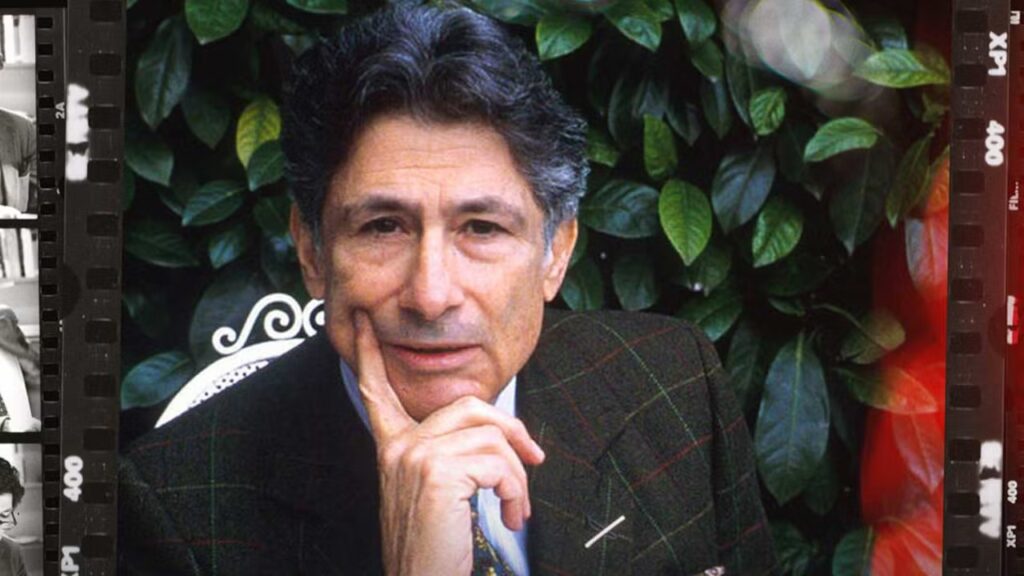

The life and work of the late Palestinian American scholar Edward Said will never be fully captured in a single documentary. Not only are his writings too urgently influential and remain worth reading in their entirety 22 years after his death, but Said’s very existence was one that contains great multitudes. To condense that into even a dozen films, let alone just one, will inevitably mean losing much of both the man and the writer.
But if you’re going to try, one can only hope it looks like Maiken Baird’s thoughtful and admirably comprehensive “Edward Said: Between Worlds.”
Hearing from Said in his own words as he takes us through decades of history and his place in it, the documentary is as rigorously detailed as it is moving and emotional. Rather than cut away to talking heads, it instead gives center stage over to Said so we can take in his own voice and writing. It’s a reverential work of resurrection, relying on archival footage and recordings of his various speeches that he gave over his life. Even though the filmmaking itself is rather cut-and-dry, Said’s words alone make this documentary resonate all the same.

Hearing Said speak with poetic lyricism about the many ways that the people of Palestine have struggled to survive and endured through unimaginable circumstances is valuable in its own right. Baird’s filmmaking then cuts together Said’s life and the broader sociopolitical impact he left, ensuring one cannot be separated from the other. His film is then an essential profile of Said, capturing his feelings of displacement after he had to leave his home and eventually come to America, just as it is a chronicle of his attempts to challenge us to think more critically about the way the world is ordered.
Indeed, whether you’ve read Said many times or never even heard of him, “Between Worlds” has value for all. “Orientalism,” his most significant writing, is not just a foundational text to understand the cruelty of so much of the world, but one that remains tragically relevant. To hear Said reflect in one interview on his piece’s significance and success, refusing to center himself as to express solidarity with Palestinians’ struggles, is moving. For all the impact he had and the incisiveness of his writing, Said was a deeply compassionate figure, which we come to know on a deep level through this documentary.

That being said, one still wishes that there was a little bit more creativity to the filmmaking. Looking to another title like Raoul Peck’s “I Am Not Your Negro,” a portrait of James Baldwin which pushed its form in engaging new directions just as it captured the complexity of its subject, one can only imagine how a similarly imaginative approach could have drawn viewers even deeper into Said’s work and life. The ethos of the two films are the same — each wants to give their subjects the room to speak for themselves — but their execution is quite far apart. Both remain essential, but this one could have dared to dream a bit bigger.
Still, there remains an enduring power to “Between Worlds” because of Said himself. Whenever we get those unbroken moments of him speaking, you see a man who gave so much of himself in an attempt to push the world in a better direction. He is tragically no longer with us, having passed from leukemia in 2003 at age 67, but in this documentary, we see how his work will continue to live on. One can only hope more heed his voice.