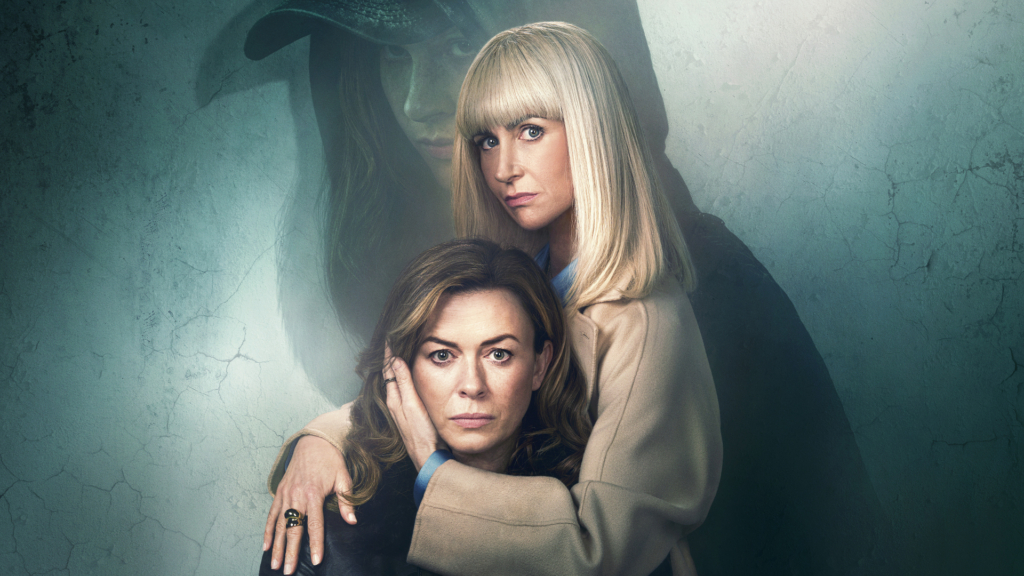

Those who tuned in to The Crow Girl Season 1 finale were shocked by a major plot twist which revealed that Dr Sophia Craven (Katherin Kelly) suffered from Dissociative Identity Disorder (DID). Now, a year and a half later, the crime drama returns as DCI Jeanette Kilburn (Eve Myles) and Dr Craven continue their hunt for the killer of young men.
Season 2 picks up exactly one hour after the events of the season 1 finale. As Kilburn and Craven uncover a generational ring of child abusers and the show explores the harrowing trauma that can cause DID, and how the illness itself can manifest, the show brings with it a much darker tone than the previous season.
Sitting down with FILMHOUNDS, lead actors Eve Myles and Katherine Kelly discuss the uncertainty around the series renewal, exploring DCI Kilburn and Dr Craven’s romantic relationship, and why they view their characters as women who have been victimised but refuse to be victims.
Season 2 is darker and heavier than season 1 because it explores the extensive sexual and psychological abuse Victoria has suffered, caused by Dissociative Identity Disorder. Why do you think it was necessary to ease the audience into the scale of criminality across two seasons, and how did the gradual pace inform your performance choices?
Eve Myles: I think the team were incredibly ambitious with how they told this story in series one. There were no apologies for what the series was. It was tonally honest from the the first scene, and then to carry on into series two, we never really knew we were going to get a series two. So if that had been the end of The Crow Girl, then that would have been an open ending. Sometimes, you know, stories don’t get tied up in a neat bow; they just get sort of left open, and that’s what you’re left with. We’re coming into episode seven (S2 Ep1), which carries on an hour later from episode six (S1 Ep6), which we shot with two years in between.
So this series had to be about finding out who Victoria is, why Victoria is the way she is, and why she does what she does. You’re dealing with really, really difficult situations and really difficult, complex illnesses. We need to find out the whys, the hows and the wheres to move through this story and follow the character of Victoria through Sophia. And it’s dark; it is incredibly dark, actually, and you’re always worried it’s too dark. I thought for the first series, “Where will this land? How will this land? And who will enjoy this?” And it landed. People really enjoyed it and were very much looking forward to another series. What’s really clever is that, among all this horror, there’s an awful lot of humour in there also, and it is a story about hope.
Katherine Kelly: This whole thing has just been a surprise to me because I didn’t even know the twist at the end of season one when I agreed to my part. We were filming the first four episodes, and then I found out the twist. Sophia’s on a different journey with Victoria to the main plot and every other character. Her only throughline into the main story with the case is through Jeanette. She does still help a little bit with some witnesses, but mentally she is now elsewhere. She’s suffering with these blackouts. She’s worried about her state of mind.
The overarching commentary in season 2 is that the justice system fails victims. Why is Jeanette not disillusioned with the justice system despite witnessing and being implicated in its failures? And how do Victoria/Sophia respond to Jeanette’s lack of disillusionment?
EM: I don’t think that she’s disillusioned with the justice system. I think that she knows no different. She was born into it. Her father was also a DCI. There’s a DCI running through her like a stick of rock—it’s who she is, it’s in her DNA. She believes in the justice system. She believes that it needs a change and upgrade. She believes she might be the person to do that, but she believes that good will always outdo bad, and that she will never give up on catching the bad guy. That’s why it’s so heartbreaking with Lou. What Lou actually did, yes, was against the law, and it’s not what she practices, but she can also see why he did that because he’s of a different policing schooling, a different generation, where he took matters into his own hands and was completely disillusioned and crossed a line. Jeanette believes that that line should never be crossed. She’s a maverick, but she’s a maverick in a very different way.
KK: I think she (Sophie/Victoria) thinks that’s a beautiful thing. She’s (Jeanette) a true believer. She was once a Catholic and Victoria is an atheist—she knows that that ain’t true. She’s grown up in chaos, where not only does she not believe in a justice system, she has not been brought up in a family where the father is the father and the mother is the mother. She’s seen the worst of these men and women who are supposed to be the pillars of society. So she’s seen that society is rotten, that society portrays one thing and it’s actually another. So I think to meet somebody who is the antithesis of the chaos that she’s been around, and no matter if in years to come they got down to talking through what Jeanette actually believes, just instinctively, this is an honourable woman who believes in something that is true and good. She’s been surrounded by men and women who’ve undermined all her instincts about what’s right and wrong. That’s why Victoria kept crying out. She kept trying to tell people, social workers, teachers—and they didn’t believe her. Here’s a person who believes her, and she believes her 100%.
EM: I think it really does highlight that you’ve got a woman who’s always fighting for hope and is a beacon of goodness. She’s a messy, messy lady, but her role is to bring hope to people who have lost their voice.
Unbeknownst to the characters, Sophia and Jeanette experience parallel involuntary returns to childhood—Sophia’s flashbacks of child abuse and Jeanette moving back into her childhood home. Shared experience seems to strengthen their romantic bond. Do you think that there is more to their romantic relationship than just physical escapism?
KK: I think certainly from Sophia’s point of view, yes. It’s something that she thought that she could never plug into somebody like that because of the trauma that’s been suffered. So, for her to feel that is something that’s overpowering, completely addictive. She has to be with her. Her connection to Jeanette is far stronger; we see it growing by the episode. Also, the fact that she knows, because of the life she’s lived, how long will this last? How many more times will she get to see her? She needs to get that fix when she’s with her. So I think it’s a full 360. It’s not just physical. It’s mental. It’s souls. It’s the meeting of souls, minds. It’s overwhelming for Sophia.
EM: No, she (Jeanette) doesn’t have time for it. She doesn’t have time just for a physical thing, a fling, and she’s not a woman who would ever do that. She’s never ever cheated on her husband. I think this is the most frightening part of Jeanette’s life. Everything is on the line. She’s lost everything. She’s lost a son. She’s lost her husband. She’s lost a house. On her way to losing a job. Everything that holds her together is crumbling. Sophia is the anchor that keeps her anchored in the real world and gives her hope. These two very fragile human beings are living in a world of monsters, and by a chance meeting in a lift, there’s a spark, and the case brings them together, but it’s not why they’re together. What’s keeping them together is their connection, and that they’re madly, madly in love with each other. They found peace, and they found serenity. It’s the heart of the story, dealing with a lot of darkness, but among all the mess is a beautiful love story.
The Crow Girl season 2 is available to stream on Paramount+.