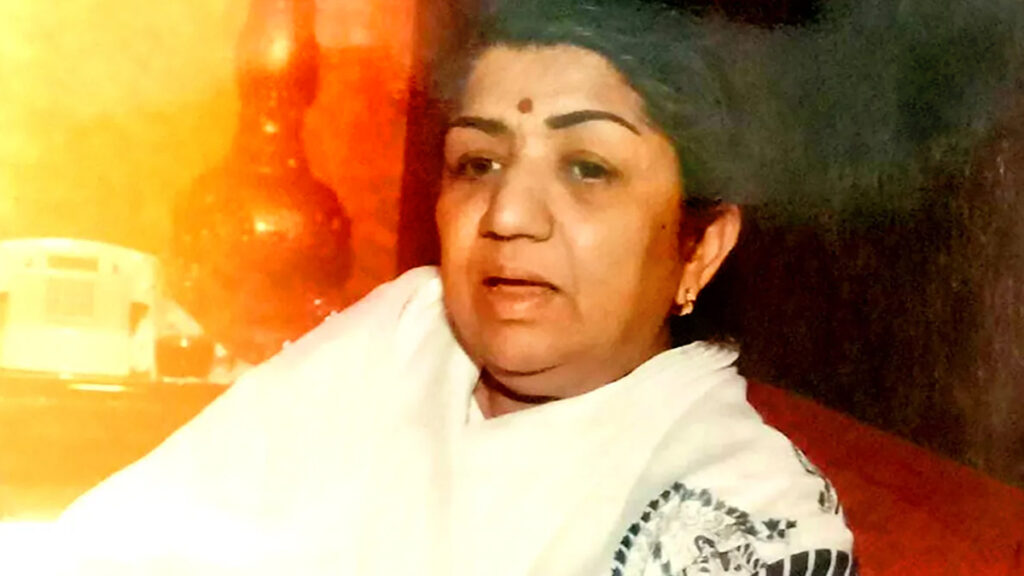

‘I was always open to those who wanted to teach me the intricacies of singing.’
‘Naushad Saab would tell me which notes to stress during singing.’
‘Anil Biswas would tell me where to breathe in and breathe out while singing and where to pause.’

IMAGE: Lata Mangeshkar, Incomparable Legend. Photograph: Rediff Archives
Key Points
- Lata Mangeshkar’s breakthrough year was 1949, with hits like Ayega Aanewala from Mahal.
- Ghulam Haider was a crucial mentor, giving her a significant break and predicting her future success despite initial rejections.
- Anil Biswas and Naushad also played vital roles, teaching her subtle nuances of singing and helping her refine her craft.
As we celebrate 97 years of the cultural phenomenon known as Lata Mangeshkar, we revisit the beginnings of her coronation as the crooning queen.
Lataji‘s first Hindi film song was Paon Lagoon Kar Jori in a film called Aap Ki Seva Mein in 1947. But it was in 1948 that she blossomed as a singer with such milestone numbers as Ghulam Haider’s Bedard Tere Dard Ko in Padmini, Sham Sunder’s Sun Lo Sajan Dil Ki Baat in Lahore and Anil Biswas’s Mere Liye Woh Gham-E-Intezar in Anokha Pyar.
Recalling Early Recording Challenges

IMAGE: Ashok Kumar and Mumtaz Shanti in the song Bedard Tere Dard Ko from Padmini.
In an unpublished interview, Lataji recalled, “Actually, Anokha Pyar was sung for the film by Meena Kapoor. But it’s in my voice on the disc as she was ill during the recording. In those days songs had to be recorded twice — once for the film and again for the disc.”
Her favourite of 1948 was Ghulam Haider’s Bedard Tere Dard Ko. “Ghulam Haider Saab was the first major composer to give me a break.” Haider had predicted way back in 1947 that Lata would wipe out all competition in time to come.
Revealed Lataji, “One night I received a message that Ghulam Haider Saab wanted to see me right away. I went over immediately with my cousin even though I wasn’t feeling well because he was scheduled to go out of town soon after. He was sitting in a small projection room of a studio and working on the background music of a film.”
“I waited the whole night, dozing in a chair while he played on the piano. The next morning at around 7 am he composed the tune for Bedard Tere Dard Ko on the piano. I rehearsed the song and we recorded it in a couple of hours. A few days later I went to HMV and recorded an abridged version of the song for the disc. Soon after, Ghulam Haider Saab left for Pakistan.”
‘I remember every song I recorded’

IMAGE: Munawar Sultana in the song Dil Mera Toda from Majboor.
Lataji regarded 1948 as a special year in her career. “I remember every song I recorded that year. Many of them were released one after another. One of them was Dil Mera Toda by Ghulam HaiderSaab for Majboor. But the song wasn’t such a hit.”
“My duet with Mukesh Bhaiyya from the same film, Angrezi Chhora Chala Gaya, was a big hit. Sun Lo Sajan Meri Baat from Lahore was another. It was composed by Shyam Sunder. I first met Shyam Sunder in 1945 when I was working as a child artiste for a Master Vinayak film. I was introduced to Shyam Sunderji as a budding singer. He listened to me without any expression on his face as though I was a mediocre singer!”
Lataji recalled an interesting story about the song Dil Mera Toda in Majboor. “There’s a long story behind the number Dil Mera Toda. I had sung a duet with Madan Bhaiyya (Madan Mohan) for Ghulam Haider Saab in Shaheed. After that he wanted me to sing for Kamini Kaushal.”
“We had even rehearsed the song Badnam Na Ho Jaye Mohabbat Ka Afasana. But the producer of the film said that my voice would not suit Kamini Kaushal, that it was too thin. Ghulam Saab was very offended. One day he called me to Filmistan Studio after this incident. He wanted to take me to Bombay Talkies.”
“He, my sister and I were waiting for a local train at the station. Suddenly he started tapping a tune on a cigarette pack. That was Dil Mera Toda. We went right back to the studio, rehearsed and recorded the song.”
‘It was Mukesh Bhaiyya who introduced me to Naushad’

IMAGE: Nargis and Karan Dewan in the song Sun Lo Sajan Meri Baat from Lahore.
Lataji revealed that the mercurial Shyam Sunder was not done with her. “One day I was pleasantly surprised when he called me to record a song, Sun Lo Sajan Meri Baat for the film Lahore. Maybe he had heard about my singing after our disastrous first encounter. By then I had sung for composers like Anilda (Anil Biswas) and Naushad Saab.”
“It was Mukesh Bhaiyya who introduced me to Naushad. I sang for him in Chandni Raat, Dulari and Andaz. He even spoke about me to Raj Kapoor. I was recording one evening at Mahalaxmi Studio for Anilda when Raj Kapoor walked in.
“He wanted to hear me sing. He was planning to make his first film, Aag. When Anilda introduced me to him Raj Saab said, “I have heard her. She sings classical numbers, like this…” and broke into a classical alaap. After a week he sent Jaikishan to me.”
‘The recording went on all day until we had a perfect take’

IMAGE: Ashok Kumar and Madhubala in the song Aayega Aanewala from Mahal.
1949 is regarded as Lataji‘s breakthrough year. She had Barsaat, Andaz, Badi Bahen, Bazaar, Lahore and Mahal to her credit that year and had literally wiped out all competition.
Lata’s favourite of the year 1949 was Khemchand Prakash’s chart-buster Ayega Aanewala from Mahal.
“Finally, I was singing for Khemchand Prakash. I had missed out on another film, Aasha. Eventually it had to be Mahal and Aayega Aanewala. The tune had been chosen from many, and we had several rehearsals.
“The producer of Mahal, Ashok Kumar and its director Kamal Amrohi were present at the recording. I was told in detail about the significance of the song. The number had to sound as if it was closing in gradually from distance — as though someone was walking in singing. The recording was done in a huge studio.
“I was made to stand in a corner of the hall with the mike placed in the centre. I inched my way to the mike singing the famous prelude, Khamosh Hai Zamana … The recording went on all day until we had a perfect take. The idea of calling melodies like Aayega Aanewala ‘haunting melodies’ was mine. I presented the concept on stage for the first time in 1962.”
‘Ghulam Haider helped me get over my Marathi accent’

IMAGE: The Laadli poster.
Another favourite of Lataji from the year 1949 was Anil Biswas’s Tumhare Bulane Jo Jee Chahta Hai in Laadli.
“Anilda was a very good singer himself. His song Saanjh Bhayo Banjare Ja Ja Ab Ghar Ja Re was brilliantly rendered. I used to like the music of Anilda even before I sang for him. I used to make it a point to see films with his music.
“His first assignment for me was to sing for a film called Girl’s School in 1949. I liked the solo number he gave me to sing, Tumhi Kaho Mera Man Kyon Udas Rehta Hai and the duet Baar-Baar Tum Soch Rahi Ho Mann Mein Kaun Si Baat which I sang with Shankar Dasgupta.
“After that Anilda composed many raag-based songs for me. During rehearsals, he would stress on subtle nuances. He’d tell me where to breathe in and breathe out while singing and where to pause. He taught me the finer points of singing.
“I still remember the line Muskurane Ko Jee Chahta Hai in Tumhare Bulane Ko. Anilda wanted the suggestion of a smile in the song.
“I was always open to those who wanted to teach me the intricacies of singing. Naushad Saab was a good teacher too. He would tell me which notes to stress during singing. Early on in my career Master Ghulam Haider helped me get over my Marathi accent.”