
WHAT ARE MY THOUGHTS ON EXTRA GEOGRAPHY?
Looking back on some of the most beloved teen flicks of all time, it’s hard to ignore how some of them contain content which, to put it mildly, hasn’t aged well. Clueless, for instance, features a major romantic sub-plot involving the teenage main character and a (slightly) older man who was until recently a step-sibling, which regardless of that former step-sibling being Paul Rudd is a whole lot of ick. American Pie revels in inappropriate raunchy humour, including among many other things the non-consensual livestreaming of a female student during an intimate moment of privacy. Even the grandfather of teen movies John Hughes casually inserted racial caricatures, predatory sexual behaviour and rampant female objectification into his classics like Sixteen Candles, The Breakfast Club and Weird Science.
In a sense, these kinds of problematic teen movies are a target of Extra Geography, which knowingly sets for itself a series of risky goals that would have been normalised mere decades earlier, before swiftly pulling the rug and causing it all to mercifully come crumbling down. Of course, the film – which Molly Manners directs from a screenplay by Miriam Battye, who herself adapts the short story of the same name by Rose Tremain – doesn’t exactly follow through on its most provocative subject matter, lest it face the wrath of more socially-conscious audiences. But its themes allow it to open up some interesting conversations about love, individuality, and the fickle nature of adolescent ambition. All of which, incidentally, amounts to a pretty strong debut feature for Manners that is amusing in its deadpan nature as well as its bouts of emotional maturity.
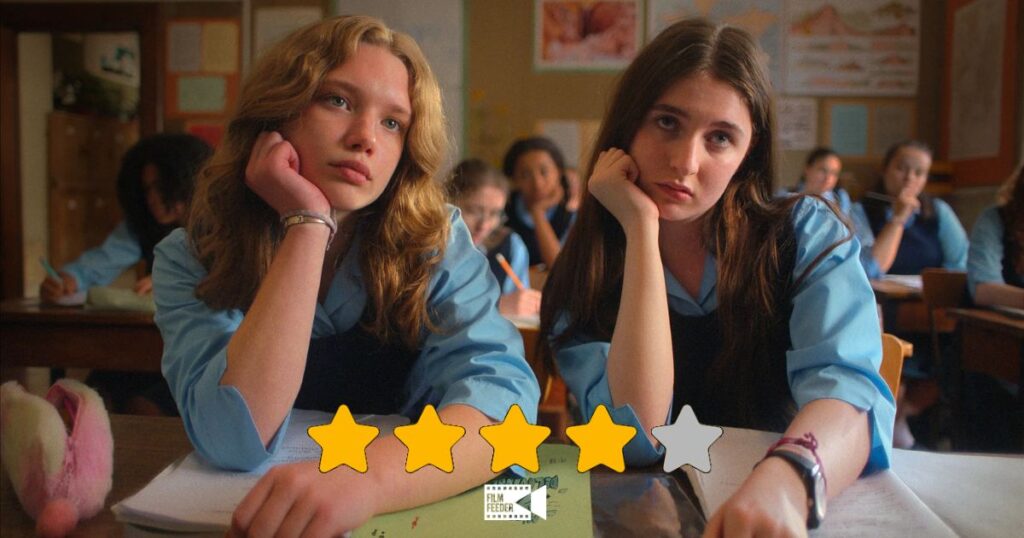
Set sometime in the early 2000s at a prestigious all-girls boarding school in Yorkshire, our protagonists are students and best friends Flic (Marni Duggan) and Minna (the awesomely named Galaxie Clear; someone cast her in a sci-fi movie alongside Chase Infiniti, stat!). When we first meet them, they are the very definition of “inseparable”, walking along the corridors with their arms linked around each other and keen to share every major life event with one another, which at this point in time includes auditioning for the school production of A Midsummer Night’s Dream.
Faintly inspired by the heart-eyed words of that Shakespeare play, they collectively decide that their summer side-project will be to fall in love with the first person that they come across… which happens to be their mousy New Zealand-born geography teacher Miss Delavigne (Alice Englert). On top of that, when Minna is cast in a more central role in the production – leaving Flic in the thankless role of “Tree/Mound” – their priorities shift, causing jealousy and resentment to form between them which ultimately threatens their seemingly stable friendship.
As you can probably surmise, the teen girls lusting after their much older teacher is something that would only exist in those aged teen movies from earlier (or even an adult movie nowadays). But director Manners and writer Battye are keenly aware of their protagonists’ misguidance and, rather than sensationalising the jailbait nature of the situation, use it as a catalyst to examine the awkward growing pains of these characters. You can definitely tell that their attraction to Miss Delavigne is far from natural, forced by themselves in order to follow through on their rather flimsy project, and as both Manners’ direction and Battye’s script pushes them further into uncharted territory, including some hilariously awkward scenes of the girls dreamily gazing towards their unwitting target in the classroom, it’s even more obvious that they’re way out of their depth, both as would-be love conquerors and as general young adults.
Manners apply a keen deadpan tone throughout the movie, a bit like if Yorgos Lanthimos directed Heathers, which smoothens the dry wit of Battye’s dialogue and makes the writer’s increasingly mature themes land much steadier. The director wisely focuses on a scope well beyond her writer’s intentionally problematic central story, or at least enough to cover the grounds of this school (which, save for a brief half-term museum trip, we never leave), allowing the more internal growing pains of its two leads to bubble up to the surface as they start hanging out with boys from a neighbouring school, fighting and then quickly making up with each other, and ultimately find themselves heading in much different directions in life. The impassive nature can sometimes be a bit limiting in terms of the viewer’s overall emotional connection, but the sweetness and certainly the heartbreak of later scenes still manage to shine through just enough for it to work.
The key element to it all is a pair of remarkable turns by Duggan and Clear, who excellently fluctuate between their characters’ eerily synchronised co-dependency and their separate desire to break free of their own spell. The young actors – both making their acting debuts here, incidentally – share such a dynamic chemistry with one another that you could often mistake them for conjoined twins, especially given how close they initially are to each other, while individually they excel as two young girls who are perhaps too ambitious and even arrogant to realise that they’re both becoming radically different people. As they flirt (figuratively and sometimes literally) with forces well beyond their age range, it’s clear which one of them has the social skills to probably succeed in life and which one is less equipped in certain other crucial areas, and both Duggan and Clear show profound emotional wisdom in conveying not just their characters’ misguided ambition but also the harrowing consequences of forcing themselves to grow up a bit too fast for their own good.
Without giving away its ultimate ending point, imagine Extra Geography as a more pubescent version of The Banshees of Inisherin, albeit with far less severing of fingers and the surprisingly poignant inclusion of a donkey (in this case, specifically one that frequents the aforementioned Shakespeare play). However, there is but a tinge of hope in how this tale of adolescence and all its growing pains can ultimately bring about a sense of self-reflection to young lead characters whose shared idea of romance and love is vastly different from what the authors and poets of old once wrote about. Or at least, very different from the more problematic teen movies that it’s making a subtle mockery of.