
John Steinbeck is often considered one of the greatest American writers, with East of Eden as his greatest masterpiece. Referencing the biblical Cain and Abel, Steinbeck tells the story of a multigenerational family haunted by a vicious cycle they can’t seem to escape. Steinbeck’s novel has been taught in classes and discussed at length for the last 70 years, but Zoe Kazan‘s East of Eden, now streaming on Netflix, offers a daring new perspective on the familiar story, pushing boundaries and modernizing the 1950s novel for a new audience.
What Is ‘East of Eden’ About?
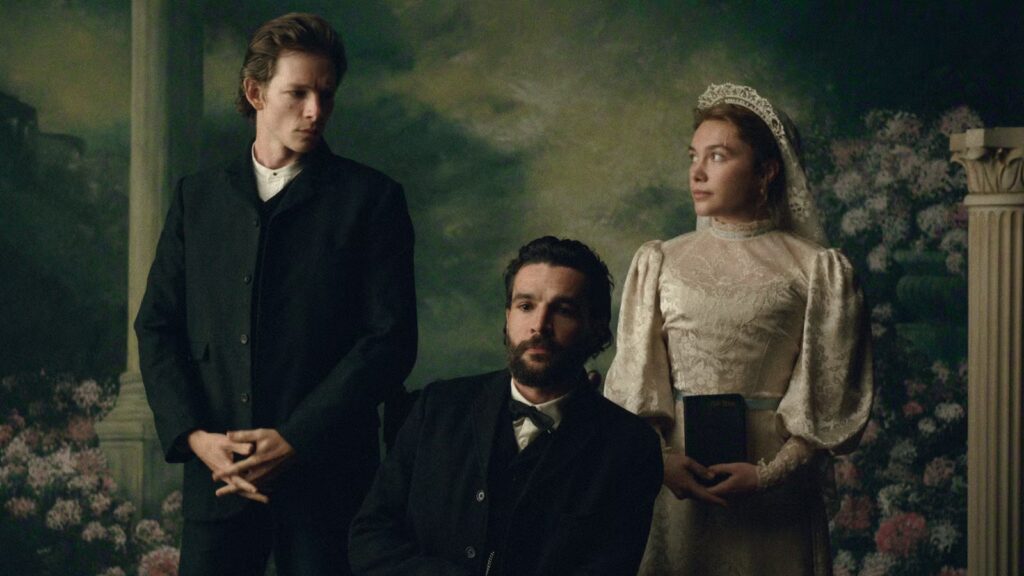
Sticking fairly close to the novel, Kazan’s East of Eden follows two sets of brothers, starting at the end of the 19th century and ending in World War I. Cyrus Trask (Tracy Letts) has two sons: Adam (Christopher Abbott), from his first wife, and Charles (Mike Faist), from his second. Animosity blossoms between the two brothers at a young age when Cyrus, for no clear reason, heavily favors Adam over Charles. Cyrus pushes Adam into the cavalry so his son can become a decorated soldier like him, while Charles, the offspring better suited for the military, is left at home to be a farmer and stew in his bitterness.
When Adam returns from the service, Cyrus is dead, and he is now living with Charles in their childhood home. One night, a woman turns up on their porch, beaten and bleeding to death. This is Cathy Ames (Florence Pugh). While Steinbeck is hardly subtle with his biblical references, Cathy is easily one of his most overtly evil characters, existing as the embodiment of Lucifer and original sin. The author calls her a monster, while the characters themselves compare her to a demon or wild animal. Charles cautions Adam against pursuing Cathy, seeing a darkness in her that reflects his own, but Adam disregards his brother’s warnings. To Adam, Cathy seems to be the survivor of a vicious attack, and while helping her heal, he falls in love with her and marries her.
Cathy and Adam then move to California, and she gives birth to twin sons: Aron (Joe Anders) and Cal (Joseph Zada). When Cathy abandons Adam and their sons shortly after their birth, Adam is left on his own (kind of) to raise his kids. As a father, he inherits his own father’s bad behavior and chooses Aron as his favorite, making it obvious to his sons which one he prefers. As his sons grow, Adam must quietly struggle with whether to keep the secret that his sons’ mother is still alive or to reveal the ugly truth.
If you’re familiar with Steinbeck’s novel, none of this should be surprising. Unlike some recent adaptations, Kazan has no problem sticking to the script when it comes to the source material. She improves on the formula by shifting points of view between characters, letting her actors shine in their roles — particularly Pugh, Faist, and Hoon Lee as Lee, the Chinese cook at the Trask house.
Florence Pugh Is a Wonder as Cathy Ames in Netflix’s ‘East of Eden’
In Netflix’s East of Eden, Kazan delivers a more nuanced look at Cathy. This new version of the character isn’t defanged; she’s still manipulative, mercurial, and a ruthless killer. Unlike the book, however, it’s impossible to watch East of Eden and not at least view Cathy as a tragic figure. Pugh imbues Cathy with all her flaws; she’s cold and aloof, always calculating and scheming, and switches from a capable woman into a helpless one when it benefits her. She’s sharp and instinctual, and Pugh isn’t afraid to explore the hills and valleys of her character, resulting in a multifaceted portrayal. However, Kazan presents Cathy not as someone born evil (as Steinbeck implies), but as a woman forced to become evil simply to survive in a world dominated and controlled by men.
From a modern perspective, it’s very easy to see why Cathy’s life is the way it is, and Pugh’s narration makes it clear: “A girl learns quickly; there is no avoiding the attention of the opposite sex.” As a beautiful person, she learns what male attention can bring at the horrifying age of 5. Stories about her past, which often portray Cathy as inherently evil in the novel, are given a new perspective when viewers see the world through the girl’s eyes. In Steinbeck’s book, Cathy proclaims that she made her Latin tutor kill himself as a girl, and that’s something readers must take as evidence of her deviant nature. But when you’re watching an adult man flirting with a teenager — who is his student, no less — walking her home every day, and professing his love for her, who is the real victim here? The series reminds us time and again that if Cathy is evil, the world made her that way.
Cathy learns quickly that while she can’t avoid men’s attention, she can wield it for her own purposes, using them just as they would use her. At every stop, she is robbed of her agency, her voice, and her future; even Adam, easily the story’s most non-threatening and milquetoast man, dismisses her when she repeatedly tells him she doesn’t want to move to California. That’s not to say she doesn’t commit unspeakable acts, but it’s clear Cathy isn’t simply “evil for no reason”; her motivations are obvious every time she does something.
‘East of Eden’ Goes Beyond Parable With a Stacked Cast of Characters
Aside from Pugh’s standout performance as an antihero, which truly embodies both the nastiest aspects of Cathy’s personality and the more fragile ones, East of Eden boasts an impressive ensemble cast. Like Pugh’s Cathy, Charles is often portrayed as a Cain figure, someone dark and violent, but Faist’s portrayal gives him nuance and allows the viewer to not only sympathize with him but also be keenly aware that, out of the two brothers, Charles is by far the smarter and more capable man. Faist and Pugh’s performances emphasize that Charles and Cathy have always been Steinbeck’s most interesting characters in East of Eden.
Most of the series’ episodes focus on Adam, and while Abbott is dependable as the protagonist, he’s also easily one of the most boring characters in the story; one who we might pity and shake our heads at, but not compelling enough to be anyone’s favorite. Abbott is at his best when he’s working with either Faist or Lee, but on his own, there’s just not enough meat to Adam’s character to really give the viewer something to chew on.
Unsurprisingly, Hoon Lee’s Lee is one of the series’ best characters. The Chinese-American character hews close to Steinbeck’s version, and Lee’s portrayal should show modern audiences how well Steinbeck actually understood the Chinese-American immigrant experience. As a character, Lee serves as the narrative’s moral compass. He raises Aron and Cal while Adam is mired in depression; he has a sharp mind, and he is deeply philosophical. He’s also, in many ways, the heart of the story, and Hoon Lee portrays him with grace and quiet nuance. In scenes opposite Ciarán Hinds‘ Samuel Hamilton (a fictional version of Steinbeck’s grandfather) or Zada’s young Cal, especially, he really shines.
Kazan’s East of Eden proves you can create a faithful adaptation that still takes risks. It never once loses the message Steinbeck is trying to convey, but it shines a new light on a corner that critics might have neglected in the past. Although it might feel like the story has sanded away some of its sharpest edges, East of Eden is less like the parable presented on the page and more about a family caught in a toxic cycle it desperately needs to break free of. It’s a tragic and bittersweet series, but one that is worthy of praise by any Steinbeck enjoyer.
East of Eden premieres October 1 on Netflix.

- Release Date
-
2026 – 2026-00-00
- Network
-
Netflix
- Directors
-
Garth Davis
- Zoe Kazan perfectly balances loyalty to the source material with her own version of the story.
- Florence Pugh is easily the best actor of the bunch, delivering an award-winning performance as Cathy Ames.
- Mike Faist and Hoon Lee deserve praise for their performances as Charles and Lee, respectively.
- Kazan perfectly captures the themes and tone of Steinbeck’s original novel.