
It is hard to imagine the effect Forbidden Planet would have had on audiences in 1956. Arrow’s new release, built around a sparkling 4K restoration of the classic, comes close, thanks to a commentary from two familiar film historians, Kim Newman and Barry Forshaw, capturing the wonder of watching it as a kid and the undeniable fact that it still looks incredible.
Seventy years on, Forbidden Planet bursts from the screen. From the military crew arriving on a mysterious planet (10 years before Star Trek, the first crew on film to travel faster than light), to the pains taken to explain advanced science (an important component we soon learn). From the charming visual effects and epic sets to its inspiration—Forbidden Planet takes its base plot from Shakespeare’s The Tempest.
It’s a problem play in space.
The prologue gives us a short history of Earth’s expansion between galaxies, as the United Planets starship C-57D, under the command of John J. Adams (Leslie Nielsen during his serious period), arrives at Altair IV to discover the fate of the starship Bellerophon, lost two decades before. Ignoring warnings not to land, they find the sole survivor, Dr Morbius (Walter Pidgeon), his willful but naive daughter Altaira (Anne Francis), and their impressive, highly advanced robot, Robby. Prospero, Miranda and Ariel… But where is the campaign of revenge? Well, soon the starship comes under attack from a force they can’t see. As crew members start dying, Morbius reveals the ancient technology hidden deep under the planet.
Forbidden Planet is often talky, and is packed with some actions and attitudes that, well, won’t chime with modern audiences. But then The Tempest isn’t without its problems, and that shouldn’t obscure Forbidden Planet’s huge ambition and its success at bringing that to the screen.
Humans piloting a flying saucer is a thrill. The space scenes are brilliantly realised, but so are the sets. This was the future 70 years ago and boy, does it look like it—a full-sized mock-up surrounded by a vast, painted cyclorama. Inside, the vertical bridge is dominated by a giant gyroscope prop that the commentary points out would later pop up in The Time Machine and The Twilight Zone.
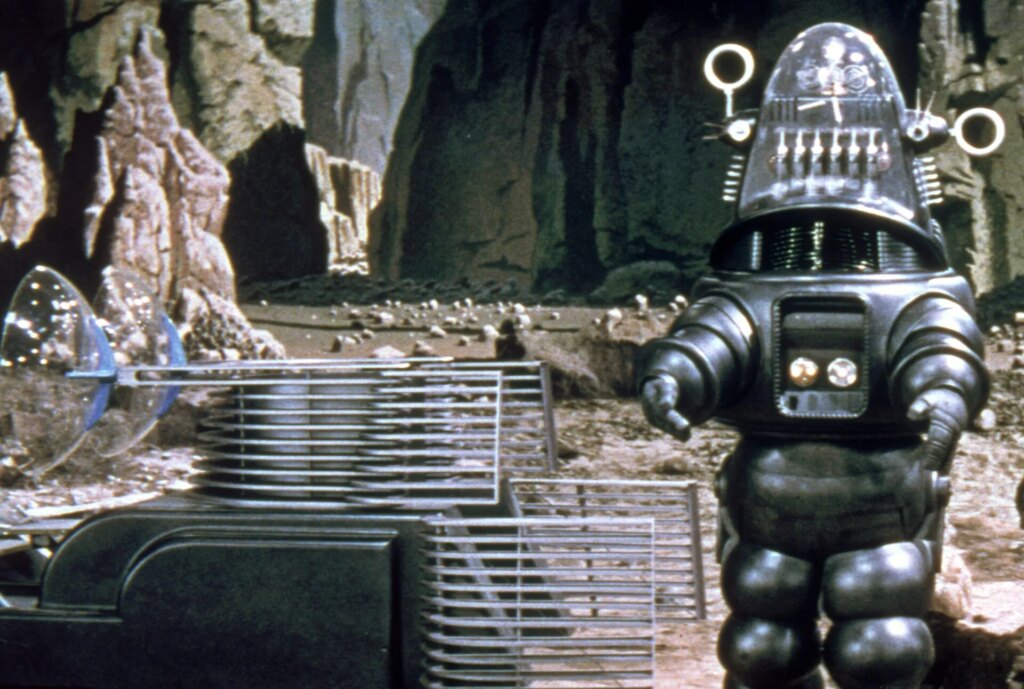
The prop that steals the show, though, is Robby the Robot. A vastly expensive prop, it takes on a King Kong role in the film’s poster, but its treatment, in action and visuals, is an important cornerstone of what we’d now call the representation of AI on screen (interestingly, the term “artificial intelligence” was coined by computer scientist John McCarthy in August 1955). Robby would stagger on to many other appearances on TV and film before being inducted into the Robot Hall of Fame in 2004.
While Robby’s in-film origins remain a little ambiguous, the sorcery of The Tempest transforms into advanced science. As Arthur C. Clarke put it in his Third Law in 1962: Any sufficiently advanced technology is indistinguishable from magic. Although, unlike Prospero, Morbius is at the limits of his understanding; more the victim of the power he’s unlocked than consciously able to wield it. Beneath the planet, vast alien structures are captured in epic matte paintings, while giant labs gleam with the light and chrome of imagination (“Prepare your minds for a new scale of physical scientific values”). Across the board, art directors Cedric Gibbons and Arthur Lonergan and set decorators Edwin B. Willis and Hugh Hunt do phenomenal work.
VFX, from the saucer-landing rays to blasters, are painted on screen, adding an undeniably Disney-style touch—the studio lent MGM veteran animator Joshua Meador. They’re bright and vivid—when was the last time an audience could look at an individual visual effect as a frame-by-frame work of art? The visuals offset the earnest military mission of the grey-clad spaceforce that packs out the film. That said, it’s hard not to take to this band of brothers, even if some of the dynamics strain, not least when a lieutenant and the captain fall for Altaira.
Unlike The Tempest, Forbidden Planet ends on less a note of reconciliation and more a warning about humanity’s place in the universe. While it presents as more of a tragedy than a problem, this committed, imaginative mid-20th century sci-fi has never looked better. Cutting through seven decades of screen sci-fi, more than a few first-time viewers are sure to be mesmerised.
4K Ultra HD Blu-ray Limited Edition Special Features
- Brand new 4K restoration from the original 35mm negative by Arrow Films in the original 2.55:1 aspect ratio
- Reversible sleeve featuring original artwork options
- Double-sided fold-out poster
- Reversible sleeve featuring two original artwork options
- Collectors’ booklet containing new writing by critics Frank Collins and Johnny Mains, plus select archival material
- 4K (2160p) Ultra HD Blu-ray presentation in Dolby Vision (HDR10 compatible)
- Restored original lossless mono, restored original Perspecta stereo, and DTS-HD MA 5.1 audio options
- Optional English subtitles for the hard of hearing
- Brand new audio commentary by film historians Kim Newman and Barry Forshaw
- Unearthly Aura, a newly filmed appreciation of Bebe & Louis Barron’s pioneering electronic score by historian and composer Neil Brand
- Watch the Skies!: Science Fiction, The 1950s and Us, an archival documentary
- Amazing!: Exploring the Far Reaches of Forbidden Planet, an archival documentary
- Robby the Robot: Engineering a Sci-Fi Icon, an archival featurette
- Deleted Scenes
- Lost Footage
- The Invisible Boy, a bonus movie featuring Robby the Robot in his second feature film
- ‘Robot Client’ – an episode of The Thin Man TV series featuring Robby the Robot
- Two excerpts from MGM Parade
- Original Shooting Script
- Theatrical trailer
- Image galleries
Forbidden Planet is available on 4K Limited Edition from Arrow Video now.