
If you wander through Regent’s Park’s English Gardens this autumn, you’ll find the 14th edition of Frieze Sculpture, the annual display that transforms the green space into a completely free outdoor gallery. Partnered with Sculpture in the City, East Bank, The Line and Fourth Plinth, and part of London Sculpture Week, this year’s Frieze Sculpture, curated by London-based curator and writer Fatoş Üstek, explores the idea of hybridity.
“There is almost a triangular relationship between the factual, the virtual and the imaginary,” Üstek says as we walk through the park. “I set myself a curatorial challenge every year, not to repeat myself… This year, we have an undercurrent that has come out of the reality we’re currently living in.” Responding to the park’s own ecosystem and its metropolitan surroundings, the exhibition aims to present sculpture as an accessible “living, adaptive and expansive language”. “It is important to me, because this is the people’s park, that you don’t have to purchase anything; you can just come in and engage with it,” says Üstek. Here are some of this year’s must-see pieces.
Elena Nemkova’s Agony in the Garden looks like a bear claw clasped together in prayer, and here — in Regent’s Park — it could be seen as having reached a point of sanctuary. But brutal in its appearance — it is forged in metal, with scars left across its surface — it carries a past violence and pain. Its title might evoke the biblical Garden of Eden, where Adam and Eve’s paradise is lost, but placed in a green space withered by the summer’s endless heatwaves, it takes on a starker, more timely message, too. Maybe the prayer is a desperate hope for survival — a plea for people not to forget the damage we continue to bring to the world. “I am very interested in doing a show that is informed by the park,” says Nemkova, “and with [Agony in the Garden] there is a very nice current angle… it is almost like a cry out.”
Ramesh Mario Nithiyendran

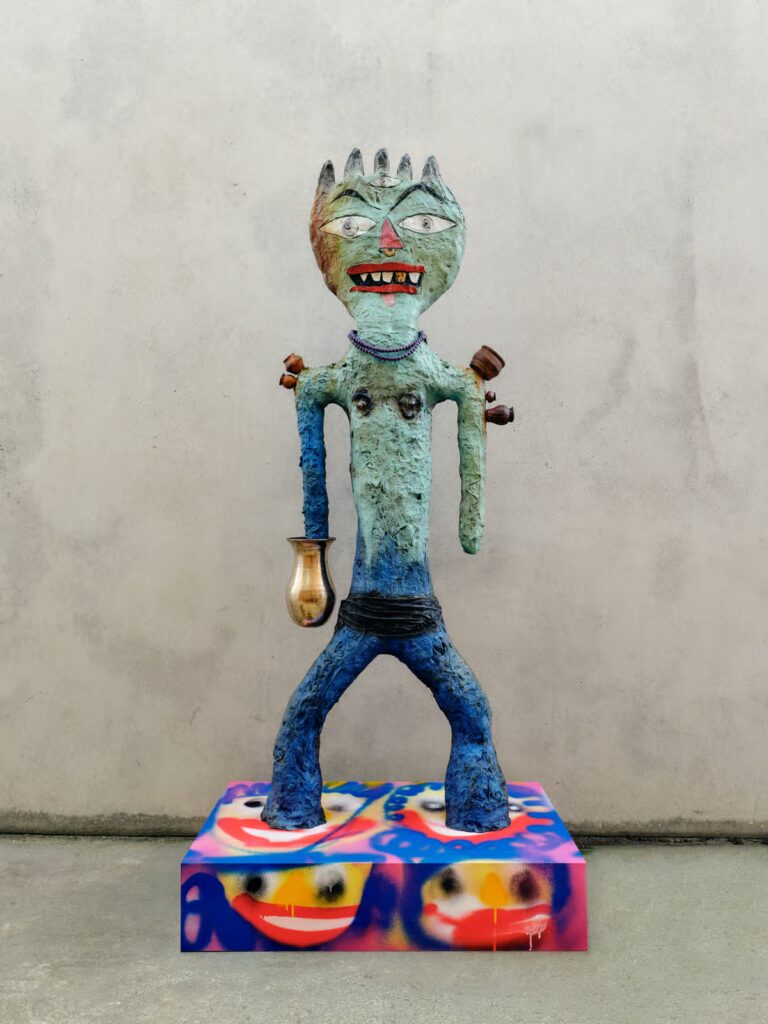
Warrior Figure by Ramesh Mario Nithiyendran
Phillip Huynh
Inspired by global traditions of figuration, Sri Lankan artist Ramesh Mario Nithiyendran’s Warrior Figure is a double-sided speculative idol that blends the vision of an ancient artefact with a futuristic creation. Playing with ideas of ancestral inheritance, identity and merging histories, the figure stands on a graffiti-adorned plinth that brings the old and the new together in a discordant image. “It shows us as a confluence of cultures,” Üstek says. “We are not existing separately from each other, but there are interdependencies and co-dependencies.” Nithiyendran’s choice of materials plays into this idea, too — initially the figure was sculpted in clay and then cast in bronze.
Viewers are encouraged to move around the piece, coming face to face with its two identities: one side a painted, patinated face emerging from textured bronze, while the other is highly polished. Using Hindu, Buddhist and Christian idolatry, it shows how a single being is stitched up of many worldviews and facets.
The Sun Bathes Its Friends and Neighbours
India’s art history and mythology inspire Tarini Sethi’s four-panelled silver gate, a work that speaks both to the current moment and to a utopian future — a vision of what we could dream of becoming. “I think it is so important to think about what our world could look like and what we can aspire to,” says Sethi. “This future talks a lot about peace and the harmony not just between humans, but between humans and the natural world.” In this piece, that sense of togetherness comes through in the drawings within the structure — whether humans, snakes or symbols, they are all connected, forming one intertwined whole. “I use a gate as a sort of sacred threshold, a space of transformation where you walk through them and let go of all the evil, to become good.”

Douglas White Black Palm II
Douglas White and Leila Heller Gallery
Perhaps the most visually commanding sculpture in the display, Douglas White’s Black Palm towers over Regent’s Park at seven metres high, in the form of a black palm tree made solely of tyre rubber and steel. “These tyres actually came from Ghana and Istanbul… this is a series I’ve been working on for a number of years, but it is probably decades since I’ve shown one in London,” White says.
Touching on themes of memory and decay, it has a dystopian magic about it — and the tree, standing among its natural brothers and sisters, feels strangely alive. “It functions very differently here than it would in, say, a forest,” White says. “It really began with the material. When the tyres explode off trucks, the wire gets torn out of them, and they go from this really inert material into this really organic, vibrant thing.”
From a distance, Carolina Aguirre’s Held looks like just another tree trunk in the park. But on closer inspection, you’ll see it’s actually a tall bronze structure, split down the centre, with a white quartz core between two soft but battered halves. Aguirre brought the stone from her family home in Uruguay and placed it at the heart of the sculpture, suggesting that ancestral heritage sits at the centre of her view of the world and draws the different parts of her together. “It’s the idea of the foreign heart needing to be held with tenderness,” Aguirre says.
Sculpture lives and is seen differently at night, Üstek says. And for those fascinated to see how the works in the park transform after dark, you’re in luck. Frieze has been given the keys to the park after hours, allowing visitors to experience the exhibition in an entirely different light. Led by Üstek, who will carry a single torch, the tours will take place under the stars on the autumn equinox, whatever the weather, with visitors locked inside the park after dark — giving the whole thing an appropriately clandestine feel. “Sightlines are obviously not the most visible, but it is about giving people a really different experience [of the sculptures],” Üstek says. “We’re marking the change of season… it is for people who are that little bit more curious.”
Frieze Sculpture runs until November 1