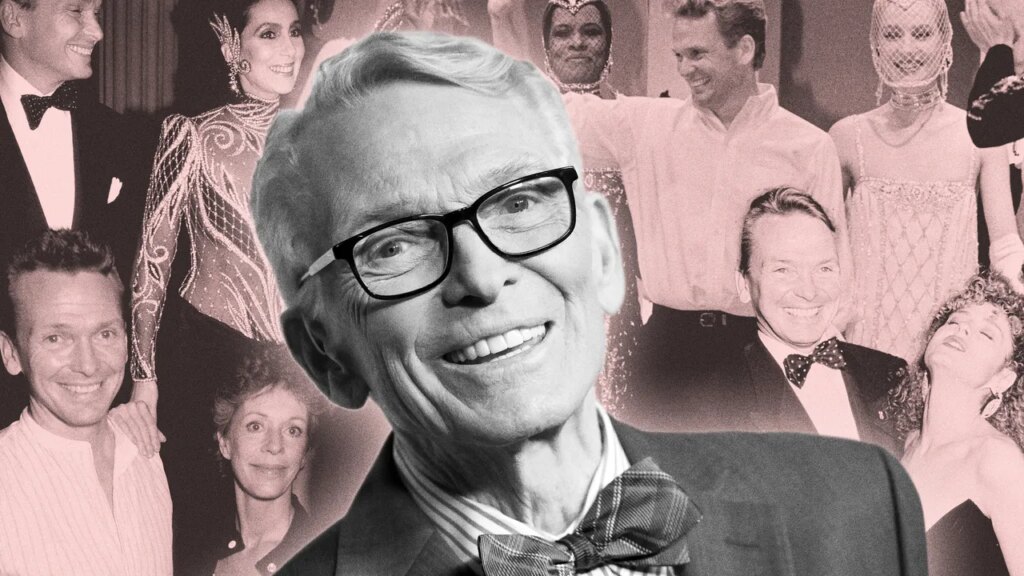

They often say the mark of a true trailblazer is to be cited, referenced, sampled, and duplicated ad infinitum. That much is true of Mackie’s work. Consider the way he continues to inspire generations of pop culture blondes: it was Mackie who, in 1962, sketched Marilyn Monroe’s “Happy Birthday, Mr. President” dress, a sheer, figure-hugging rhinestone number whose lore and controversy only accrues. More than 20 years later, Madonna called Mackie to replicate it for the 63rd Academy Awards; repeating the cycle, Sabrina Carpenter sourced the exact piece for the 2024 MTV Video Music Awards.
He was meant for a life in the “pictures,” as they used to say in a Transatlantic drawl. Mackie came of age at a time when illustrators were pivotal players in the fashion ecosystem. He got his start as a sketch artist, working alongside costume designer Jean Louis at 20th Century-Fox and sketching designs for Monroe’s Something’s Got to Give. Later, he even worked under the revolutionary Academy Award-winning designer Edith Head at Paramount Pictures, helping to dress Natalie Wood for A New Kind of Love and Love with the Proper Stranger.
Over his 60-year career, Mackie won nine Emmy Awards, a Tony Award, and was nominated for three Best Costume Design Oscars: for Lady Sings the Blues, starring his muse Diana Ross; Funny Lady, with Barbra Streisand; and 1981’s Pennies from Heaven, featuring Bernadette Peters.

Diana Ross performs in Paris, 1972.Alain Dejean/Getty Images
But Mackie’s work has so transcended Hollywood that every drag queen has indirectly paid homage—just watch any given episode of RuPaul’s Drag Race or head to your local gay bar on a Friday night. Judy Garland, Bette Midler, Liza Minnelli, Carol Channing, Whitney Houston, and the recently deceased Dolly Parton—the guru of glitter dressed them all.
There was an understanding between Mackie and his muses. He didn’t merely dress them in designs that shimmered; he seemed, more potently, to embellish their inner selves, highlight their features, imbue them with confidence. The clothes could be extravagant, but the relationships between designer and muse were intimate. When Tina Turner left Ike in 1976, she turned to Mackie to craft the wardrobe for her first solo shows, an expression of freedom, strength, and resilience. That Flame Dress Turner wore so effortlessly in the late 1970s? It didn’t create her power, but rather set it ablaze.