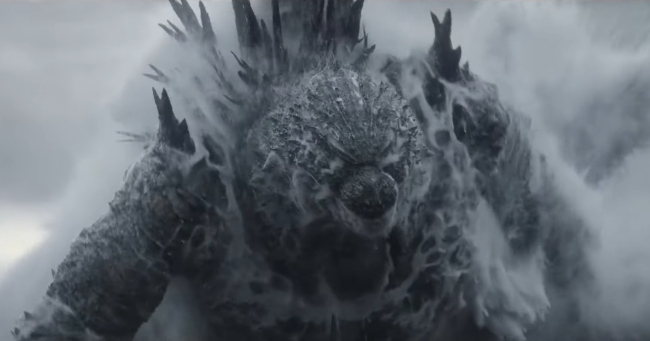

Asked to explain the goofy title he gave to his globally successful 2023 kaiju smash “Godzilla Minus One,” writer-director Takashi Yamazaki explained that it was meant to convey two co-equal things: 1.) That the movie took place before Ishirō Honda’s original “Godzilla,” and 2.) That “people rise up from a postwar Japan that is at zero, and then Godzilla arrives, making the situation even worse and more tragic.”
Continuing the story of its Oscar-winning predecessor while also doubling down on everything that made it the most acclaimed film in its franchise since the King of the Monsters first lumbered out of the Pacific Ocean in 1954, Yamazaki’s thunderously loud and frequently spectacular direct sequel has in turn been saddled with an even sillier title: “Godzilla Minus Zero.” To paraphrase the scene from “Sideways” where Paul Giamatti’s character reveals that his novel is called “The Day After Yesterday”: Isn’t that just… “Godzilla?”


Yes and no. Sure, the title is absurd on its face, but — in keeping with Yamazaki’s logic — it also rather eloquently speaks to the premise of a film about a fragile people who are struggling to maintain (and build upon) the new equilibrium they’ve fought so hard to achieve in the years since their country became the epicenter of Earth’s nuclear era. Another mid-century melodrama with very occasional monster sightings, the more thematically coherent and emotionally affecting “Godzilla Minus Zero” expands on the naive grassroots nationalism of its predecessor by reframing that movie’s characters from victims to survivors, an emphasis that forces ex-kamikaze pilot Kōichi Shikishima (Ryunosuke Kamiki) and his friends to confront a series of impossible questions. How do you balance grief with growth? Vengeance with peace? Self-sacrifice with self-preservation?
By way of answering those questions (or at least asking them in a variety of increasingly anguished ways), “Godzilla Minus Zero” also forces Shikishima and co. to confront a flying, IMAX-sized, three-headed asshole they come to know as King Ghidorah. Possibly the single most hateable kaiju who’s ever eaten innocent civilians on screen before, King Ghidorah is a real piece of work even before he earns his crown. He first rears his ugly dragon head in Matsumoto circa 1949, which is two years after the events of “Godzilla Minus One,” and maybe two weeks after this scaly destroyer of worlds crash-landed into the mountains of Japan on the back of a meteorite (an arbitrary point of origin that feels like a missed opportunity to freight Ghidora with more human-facing pathos). Seeing as how Godzilla was obliterated and left to rot at the bottom of the sea at the end of the previous film, Ghidora is free to terrorize the countryside whenever he isn’t taking cute little naps in the Nagano hills.
Lucky for Japan, and for all of the other nations that are still living under the delusion that none of this monster business will ever be their problem, at least one of the key heroes who “defeated” Godzilla in 1947 has been preparing his people for the possibility of another kaiju attack. Government higher-ups are still nowhere to be seen, but Einstein-haired Naval engineer Noda (a sweet and eccentrically professorial Hidetaka Yoshioka) has been appointed to the head of the Large-Scale Disaster Response Bureau, where he’s joined by newcomer Makoto Aoyama (Masami Nagasawa), a preternaturally gifted meteorologist whose ability to predict the weather proves crucial in the fight against Ghidorah, and also embittered biologist Kanji Murakami (“Twilight Samurai” star Min Tanaka), who survived the bombing of Hiroshima, the attack on Ginza in “Godzilla Minus One,” and the assault on Matsumoto that opens this film — a detail that evokes the terribly remarkable story of Tsutomo Yamaguchi.
Thanks to Noda’s hard-earned wisdom, “Godzilla Minus Zero” is able to skip over the part where everyone has to discover that kaiju like Ghidorah are immune to conventional weapons — if not also strengthened by them. That ignorance is reserved for the occupying Americans, who were entirely absent from the previous movie (which nostalgically privileged the self-reliance of Japan’s civilian population at the expense of a more historical view of the post-war struggle). Here, the U.S. Army is represented by a unit of square-jawed, power-hungry jerks who are only interested in helping Japan so far as it helps themselves. They don’t bear the wounds of nuclear devastation, and so they see kaiju as more of an opportunity than a threat.
The opposite is true for our pal Shikishima, who has absolutely no interest in ever climbing back into the cockpit of a fight plane. Now married to the angelic Noriko — Minami Hamabe, who miraculously escaped “Godzilla Minus One” with a new eyepatch and some big secrets — and embracing his role as adoptive father to the devastatingly cute Akiko (returning champion Sae Nagatani), Shikishima just wants to wear his cool brown leather jacket and messenger bag combo in peace.

If only it were that simple. If only Shikishima were convinced, as he tries to convince himself, that staying out of the fight is the best way to protect the women he loves. If only Noda’s plan of electrocuting Ghidorah to death in the skies above Matsumoto were as successful at killing the kaiju as it is at blowing our hair back.
There are only two sustained monster sequences in “Minus Zero,” which adheres to a similar cadence as its predecessor, but they’re both among the most gripping setpieces of their kind in all of moviedom; they match the grandeur — if not the majesty — of those from Gareth Edwards’ “Godzilla,” and eclipse their violent intensity. The ridiculously thrilling aerial sequence above Matsumoto is lifted by the Wagnerian strings of Naoki Satō’s visceral score, kept aloft by special effects that exponentially improve upon the resourceful but weightless CGI from “Minus One,” and seared into your retinas by IMAX razzledazzle of the highest magnitude. And while the final showdown between Ghidorah and Godzilla is slightly weakened by grayscale atmospherics and a few missing beats (one of them very bizarre), it goes without saying that the climatic brawl is one for the ages, as Yamazaki earns the franchise’s first “R” rating with an elegantly choreographed monster mash that rattles with Darwinian force.
Oh yeah, I suppose it also goes without saying that Godzilla is (eventually) in this Godzilla movie. Somehow, the King of the Monsters has returned — if Palpatine had infinitely regenerative flesh, perhaps his resurrection would have been similarly unsurprising. But fans of Honda’s original film, Yamazaki’s previous one, and/or Edwards’ failed 2014 reboot have come to expect and appreciate that Godzilla is most effective when framed as more of a recurring weather phenomenon than a dramatic engine in his own right, and “Godzilla Minus Zero” doesn’t suffer from its title kaiju’s limited screentime.
On the contrary, his absences are crucial to the construction of a florid tear-jerker about a traumatized country trying to move forward in the atomic shadow of a world that will never feel safe again. While a cursed biologist like Murakami might see vengeance as his only path towards peace, a former kamikaze like Shikishima — the guilt he once felt over not killing himself for Japan now bent towards the responsibility he feels towards living for Noriko and their daughter — is left to wrestle over the best way to protect his family: fighting the monsters, or fleeing from them.
“Godzilla Minus Zero” is hardly the most nuanced or effective film to explore its country’s post-war despair (the original “Godzilla” still towers above it in that regard, to say nothing of “Drunken Angel,” “The Human Condition,” “An Inn at Osaka,” or any number of other cornerstones of Japanese cinema), but the anger it assigns to Murakami is provocative on its own terms, and the path that it contrives for Shikishima is considerably more nuanced and well-earned than the one he stumbled through before. While the future is still uncertain by the end of this latest Godzilla movie (which feels very much like the middle chapter of a trilogy), “Minus Zero” makes rewarding sense of why the series’ numbers are starting to add up.
Grade: B+
“Godzilla Minus Zero” premiered at the 2026 New York Film Festival. GKIDS will release it in U.S. theaters on Friday, November 6.