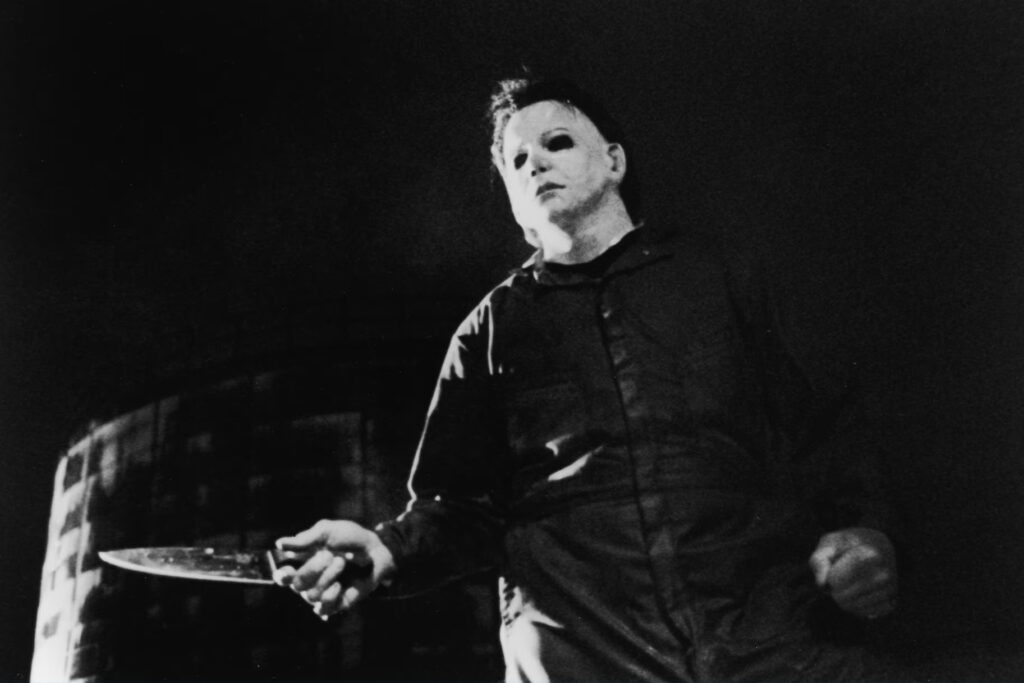

What can you get done in three days? For John Carpenter, it’s plenty of time to score an entire movie.
Not only did he write and perform the soundtrack for 1978’s Halloween in that short timespan, but he also created some of the most iconic film music ever written.
Carpenter had no choice but to do it himself because there was no room in the estimated $300,000 budget to hire a professional composer. To add to that: three days wasn’t even a personal record for him.
John Carpenter Scored Original Halloween in Just Three Days
“We didn’t have money for anybody else,” Carpenter said (via IndieWire) at a recent Academy Museum screening of the film that launched the slasher genre as we know it today. “I scored the movie we made before Halloween, Assault on Precinct 13, in one day. Halloween took three days. It was a lot bigger.”
Jamie Lee Curtis, who played final girl Laurie Strode and was also present at the screening event, described the production as the purest form of independent filmmaking—all the way down to “its marrow.”
Indeed, money was so tight, that cinematographer Dean Cundey had to reuse a clapperboard from his days on flicks like Black Shampoo, Harem Keeper of the Oil Sheiks and The Witch Who Came From The Sea.
“Dean had been using that clapperboard for years,” Curtis explained. “Back in the day they would just put another piece of tape over the name of the movie and write the new one in. Dean had done a lot of porn, so underneath the Halloween piece of tape are a bunch of porno movies.”
The pornography claim is slightly inaccurate, however.
Cundey’s early work did not include straight-up skin flicks. Rather, they were R-rated B movies with lascivious elements (a common staple of exploitation cinema). In any case, the aforementioned clapperboard is now on display as part the Academy Museum’s “Horror Show” exhibition, along with Curtis’ personal copies of the shooting script and one-sheet theatrical poster.
Thanks to the $47 million success of its predecessor, 1981’s Halloween II went into production with a significantly larger budget of $2.5 million. Given that he was gearing up to make The Thing for Universal Pictures, Carpenter handed off the directorial reigns to Rick Rosenthal and co-composed the score with Alan Howarth.
“It was a golden moment [in time, with] Spielberg, Carpenter, Zemeckis and all these guys coming from doing low-budget stuff,” Howarth told SYFY Wire in 2024. “And the studio went, ‘Okay, we’re gonna sign ‘em up. What does he need? $5 million? $10 million? $20 million? Here’s the money. Make your money. Show me what you got, dude.’ And they did it.”
“That’s how E.T. and The Thing and Blade Runner—even Halloween II and some of the lesser-known ones—all got made,” he added. “The studio letting the filmmakers make the movies. Today, it’s all run by the lawyers, accountants and marketing people.”