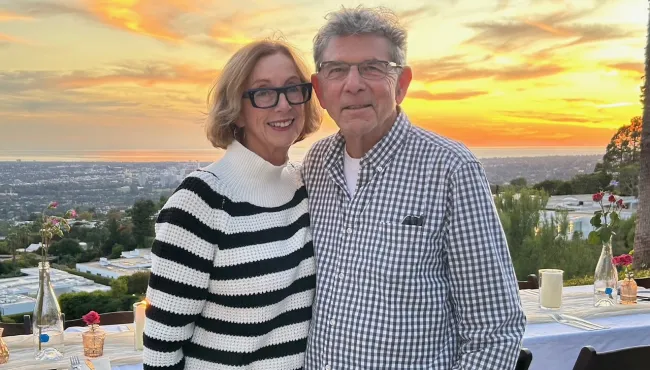

Lead with Love. That’s what the little red button reads on Michelle Satter‘s lapel. The Sundance Institute director wears it every day in honor of her son Michael Latt, who was killed in his Los Angeles home on Monday, November 27, 2023. He had founded Lead with Love, an organization that worked to support “influential women and artists of color.” Among the talent and organizations he worked with were Barry Jenkins, Common, Ryan Coogler, Netflix, the Sundance Film Festival, the DGA, Ava DuVernay’s ARRAY, and UCLA.
In the wake of his death, his two grieving parents channeled their loss by founding the Michael Latt Legacy Fund. Satter and her husband David Latt, a travel writer, funneled their sorrow into fundraising to support up-and-coming filmmakers. They’ve accomplished a lot in the last two years. Up next: an inaugural fundraiser on October 4 at the Los Angeles Underground Museum.


Their work arises from the horrible tragedy that every parent fears. “And we had it happen,” said Latt. “But we looked for positivity. We wanted to preserve Michael’s work, and we needed purpose. For us, this is a positive story. It’s taking grief and using it to motivate us.”
At first, they reached out to organizations and individuals Michael had worked with. “He was our starting point,” said Latt. “It’s not a world we especially knew. Michelle knows her corner of it, which is film and television, but Michael went far afield into areas that we didn’t know about. When we set this up, we thought, ‘if we get $30 or $40,000, we’ll be lucky.’ And then we discovered the depth and range of Michael’s relationships, and of course Michelle’s, and the outpouring was substantial. People wanted to help.”
Their other son, Franklin Latt, an agent at CAA, helped to raise early support from the CAA Foundation’s Michelle Kydd Lee. The Legacy Fund landed grants for $25, $100, $50,000, and one artist awarded them $100,000. “People loved Michael, and wanted to be there to support us going forward,” said Satter. “We raised in that first year $350,000 from about 600 or so people.”
Entering the third year, the Donor Advised Fund (DAF), in league with Liberty Hill Foundation, has expanded beyond Michael Latt’s connections, including a Marketing Impact Grant. “We supported our third artist this year, a filmmaker who I hope gets into the [Sundance] festival,” said Satter. “The last two that we supported through this granting had their films premiere at Sundance.”
Typical of Satter’s ongoing work at the Sundance Institute screenwriting and directing labs, she stays engaged in supporting artists over time. “We have gotten incredible support through Panavision,” said Satter. “It isn’t just a one-off. It’s a relationship, a community, and connection. That’s both implicit and explicit. So the offer is: once we’re connected, you can keep coming back.”

Having too much to do has helped Latt and Satter to cope. “Purpose gives me joy,” said Satter. “One hundred artists are getting supported through this program.” To date, they have raised enough funding to continue granting for another five or six years.
Among the organizations the fund supports is one that represents incarcerated men and women who’ve just gotten out of prison. They’re supporting artist Jarrett Harper, who made a short film “I Got My Brother” about foster youth that screened at SXSW. Michael had met him on a prison tour with Common and they stayed in touch. “Michael was helpful in getting him out of prison,” said Latt. “And so Jarrett was stunned when he heard about Michael’s death. He’s been connected to us in a great way. And we’re helping him using the granting funds.”
Losing their house in the Palisades in January 2025 was another blow. They drove out just ahead of the flames and stayed at their friend Dean Parisot’s ADU until they found a house in the Brentwood Hills. The other major losses in the last year were the deaths of Sundance founder Robert Redford and Satter’s mother. She was 102.
While Satter has Sundance to distract her, Latt wrote a memoir. “Creativity is a part of everyone,” said Satter. “We can all make a difference, we can all make an impact in the world, and storytelling is a force for justice, community and healing. Right now community is more important than it’s ever been — bringing people together.”