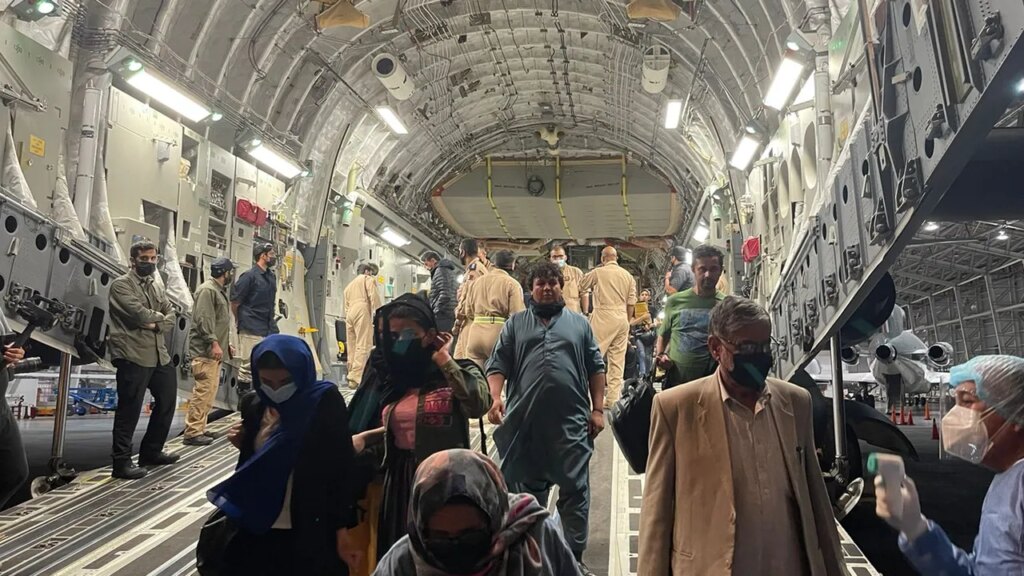

“For my entire life, one backpack,” Marwa said.
In an act of defiance, she pulled on the pink and white dress she had meant to wear back to medical school classes that day. When she stepped out on the street for the last time, into the airport-bound flood of humanity, Marwa looked up and said to no one in particular, “Who is staying back to fight for our country?”
Kabul Came Knocking, AUGUST 2021, Rebecca
For me, Kabul came knocking all at once, almost out of the blue. And quickly, it became all-consuming.
I had never been to Afghanistan, but I had long helped manage the scrappy and brave foreign correspondents who chose to go to war zones, both at The Wall Street Journal and The New York Times. I moved to the Times in 2017 as a deputy managing editor. In early 2021, I was asked by publisher A. G. Sulzberger to work as his partner.
By early summer 2021, the situation in Afghanistan was careening toward a crisis. Our deputy general counsel, David McCraw, grew increasingly concerned and launched an effort to obtain visas for our local Afghan reporters and staff who were considered to be most at risk.
On August 11, one of our leading Afghan journalists, Fahim Abed, sent a note to top editors saying the Times needed to do more to protect the staff who had long worked for us in Kabul. “If you have had a bureau in Afghanistan for twenty years, you know the Taliban,” Fahim recalled writing. “It seems like you don’t have a plan.”
Fahim’s note, along with the Taliban’s shockingly rapid advance, spurred us into overdrive to rescue the whole group. A. G. defined the ask: to find a country that would accept a group of the Afghans who had worked in our Kabul bureau and their families and to get them there. It was a tall order.
David became our “general.” Revered in journalism and legal circles, David is witty and caring but also a pit bull, a not- so secret weapon for the Times. He is brilliant at suing for access to information, shutting down legal threats with withering letters to opposing counsel, and getting journalists out of harm’s way. Afghanistan was quickly becoming one of the biggest crises that even David had ever faced.
With time running out, we pressed every connection we had.
A guiding principle that governed the Times’ approach was to treat everyone who worked for the Times as equally as possible— whether they were our Afghan reporters, cooks, or drivers. Our belief was that any Afghan affiliated with a leading US news organization that had reported aggressively about the Taliban had good reason to fear serious retaliation.
A. G. wanted to avoid a repeat of a dark episode from the past. His view was shaped by the experience of Times reporter Sydney Schanberg, who had won a Pulitzer Prize in 1976 for his coverage of the fall of Cambodia. A defining moment of that conflict occurred when American journalists fled Phnom Penh in the wake of the sudden, violent takeover by the Khmer Rouge in April 1975. Their local staff were left behind, and many perished in a bloodbath that killed an estimated two million people.