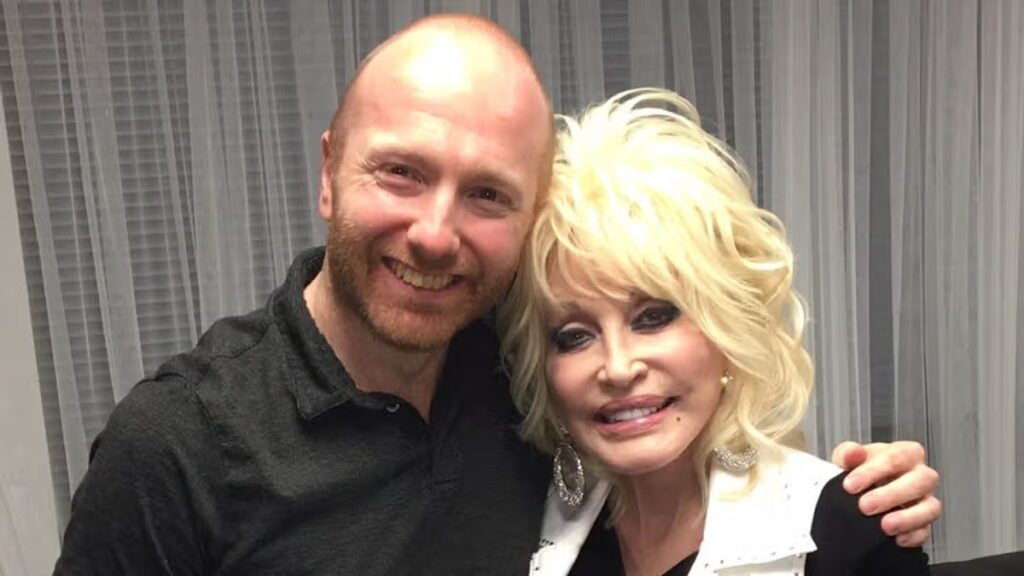

It was easy to understand why so many people fell in love with Dolly Parton: I was one of them. But for me, she wasn’t just a trailblazer who took on the men who ran Nashville and built an incredible legacy on her own terms.
Of all the many times I’ve met Dolly, it was the way she made you feel at the centre of her world despite her enormous fame.
On one trip to Nashville, I made the grave mistake of enjoying the city’s nightlife a little too enthusiastically with her publicist Steve the night before our interview. By the time I sat down with Dolly the following morning, I was horribly hungover and, at one point, could barely get a question out.
Thankfully, she found my somewhat unprofessional predicament absolutely hilarious. “You could do with some water, Tom,” she purred in that unmistakable Tennessee drawl, ruffling my former head of hair before handing me her own bottle. Naturally, it had Dolly’s face on it.
“It happens to the best of us… especially in Nashville,” she cackled.
(Memories of that mortifying interview would years later become one of the reasons I quit drinking. Another thing, I suppose, I have Dolly to thank for).
Then there was the time I was summoned to her manager’s office at 6am on a freezing morning. It was still pitch black outside, but Dolly, who had already been up for hours praying, swept in like sunshine.
“Where’s my Tom?” she hollered from down the hallway, before giving me a bear hug and promptly kicking off her stilettos. Minutes later, I remember her curled up on the settee, knees drawn up almost to her chin. Physically, Dolly was petite. In every other conceivable way, she was enormous with enough charisma to fill a room twice the size.
I even loved her when she stood me up. On one occasion, I flew across the Atlantic for an interview only for Dolly, who was rarely ill, to pull out at the last minute. She was so mortified that she arranged for me to visit her merchandise warehouse and told me, essentially, to help myself.
It was like a Dolly-themed Supermarket Sweep. I emerged with armfuls of T-shirts, calendars and just about every piece of gloriously tacky Dolly memorabilia imaginable. That sort of kindness was par for the course with the Queen of Country.
She remembered your name. She remembered your wife’s name. She remembered your children. Perhaps some of that came from never forgetting where she started: one of 12 children, growing up in grinding poverty in the Tennessee mountains.
However famous or fabulously wealthy she became, you sensed that girl was never very far away. That warmth seemed to extend to everyone around her. Her team were unfailingly lovely to deal with, something far rarer in showbusiness than you might imagine.
She was old school, too. Nothing was off limits and, boy, did she know how to give an interview. She was uproariously funny, filthy and very, very flirty. But she was no pushover.
Once I pushed a little too hard on the persistent rumours about her relationship with her friend Judy when we met in London at her favourite hotel The Savoy.
“It doesn’t upset me but it upsets and embarrasses Judy and her family,” she said sternly. I’d been told.
But this was Dolly and within seconds, the twinkle was back. “I say to her, which would you prefer, being called an old maid or a lesbian? She says lesbian every time.”
Dolly left you smitten, of course, but there was only ever one great love of her life. Husband Carl Dean. I was always fascinated by their marriage, not least because the man himself was almost never seen. He seemed to exist somewhere beyond her technicolour world, content to let Dolly be Dolly while he stayed firmly out of the spotlight.
And despite the endless rumours about her love life, Dolly insisted Carl was never remotely troubled by them. “Sometimes he sees some story and he’ll say, ‘I see you’re having Burt Reynolds’ baby again’,” she once told me. “He’s not jealous.”
Now and again, he and Dolly would walk to the grocery store and were greeted by a sea of lurid coverage of her supposed affairs on the covers of magazines. “Lord, they had me sleeping with everybody – I’d have never got anything done,” Dolly joked before laughing: “And the ones I did sleep with, they don’t know about.”
Talking about Burt, I remember catching up with her shortly after his death, and the news had clearly hit her hard. It was perhaps the only time when the mask gently slipped.
Her voice cracked as she told me: “Burt and I were a good ol’ boy and girl, and I was very sad when he passed away – we were really very much alike.”
Her and Carl’s love story was the stuff of music legend. They met outside Nashville’s Wishy-Washy laundromat when she was just 18. Carl, 21, struck up conversation by saying she was going to get sunburn in her revealing outfit.
“My first thought was I’m going to marry that girl,” Carl once said. “My second was, ‘Lord she’s good lookin’.”
Despite being the subject of red-headed bank clerk Jolene’s advances in Dolly’s famous 1973 song, he has quietly lived on their sprawling farm running his paving firm until he retired. They were ridiculously romantic.
“Come springtime in Tennessee, we have buttercups coming up around the side of the barn and last week he brought me a little mason jar full of them and wrote me a little poem,” she told me a few years ago.
On another occasion, she let me into a big secret: how they marked their 50th wedding anniversary in style by renewing their vows.
“I never got that big church wedding the first time around, with that beautiful dress with the veil,” she told me. “But this time I did. We just had a lovely ceremony with immediate family. It was very sweet.”
She was bereft when Carl died last year and there is something comforting in imagining them together again. Millions fell in love with the Dolly they saw on stage and screen. I was lucky enough to glimpse the woman behind it all. And somehow, the real Dolly was even lovelier than the legend.