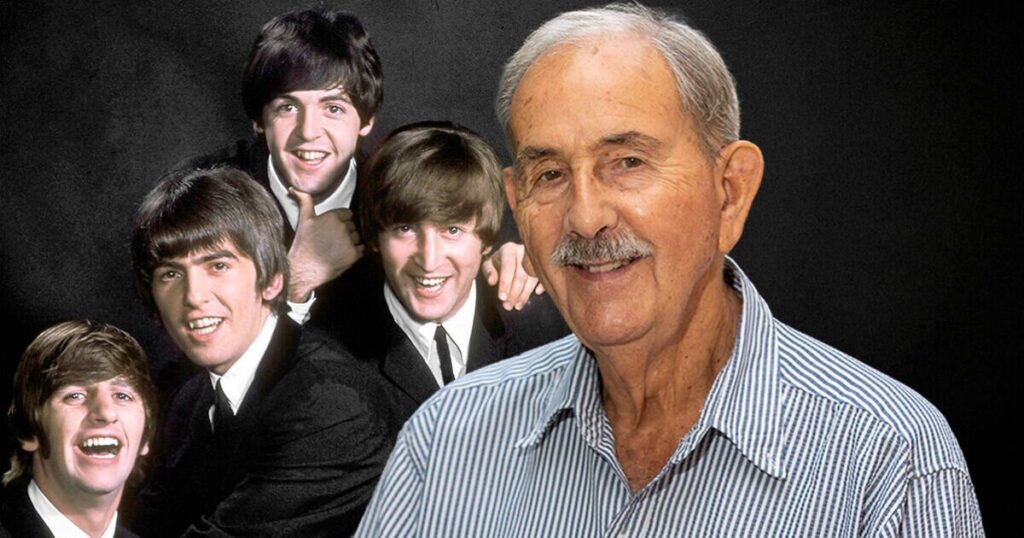


Hunter Davies, right, remains the only official biographer of The Beatles (Image: Getty / Steve Reigate / Express)
When broadcaster Stuart Maconie told Hunter Davies he was thinking of writing a Beatles book, the latter mischievously replied: “Oh you absolutely should. There hasn’t been one for a good half hour.” Indeed, Hunter conservatively estimates at least 3,000 titles have scrutinised every facet of the Fab Four since their sixties hey-day.
Which makes it all the more extraordinary that, notwithstanding memoirs by Paul McCartney and George Harrison, a collection of photographs by Ringo, and John Lennon’s poems and short stories, Hunter remains the world’s first and only authorised Beatles chronicler. Having become friendly with McCartney while working at the Sunday Times in the sixties, he suggested the band needed a proper biography so, when they were asked the same silly questions for the umpteenth time, they could simply refer to the book. The Beatles agreed, Hunter signed a contract with their manager Brian Epstein, spent two years hanging out with the band and their families, and the rest as they say is history.
Since publication in 1968, The Beatles: The Authorised Biography has sold millions of copies and never been out of print. Yet as Hunter admits, even he didn’t see the band enduring as long as they have, let alone growing in popularity to the point where, 56 years after they split, they’re arguably bigger and more influential today than ever before. “I thought I’d always love their music – I couldn’t imagine anyone doing it better – but I expected them to fade with time,” he says. “I thought my book would be out of print in ten years, that they’d be superseded by other acts who would come alone and sell more records, and the world would move on.” Boy, did he call that wrong.

Davies with some of the Abbey Road lyrics he donated to the nation (Image: PA)
“Yes,” chuckles the veteran author, whose knees might be knackered at 90 but whose attitude to life and love, more of which shortly, puts men decades younger to shame. “The further we get from them, the bigger they become.”
Which is just as well for Hunter, who has just published his fifth book on the band (While he will always been known for The Beatles, he’s at pains to point out that they make up a small percentage of his output, having published more than 100 books in the last six decades – with “another 100 good ideas turned down by publishers”).
No wonder he’s managed the remarkable feat of writing something that feels if not entirely new then at least refreshingly different in its take.
Get Back: The Boys Who Became The Beatles, puts John, Paul, George and Ringo in the context of British social history, telling the story of their formative lives – and the author’s own – during the cultural upheaval post-war.
“People will think, ‘What a bighead! Giving himself equal billing with The Beatles’,” Hunter continues. “But we all came from similar backgrounds and we all benefited from the NHS – especially Ringo, thank God, who was in hospital for months as a child and nearly died several times – and improving education.
“That’s why we got on so well. When I joined The Sunday Times, I felt a chip on my shoulder that the old Etonians and ex-presidents of the Oxford Union were ahead of me in the pecking order. But it changed thanks to The Beatles and people like me, who grew up in Carlisle and had a northern accent, became fashionable. They trusted me.
“As I write in the book, my fantasy was to have a Raleigh Lenton bike with Sturmey-Archer gear. When I mentioned that, John said, ‘That was exactly what I wanted too. His Aunt Mimi bought him one. I had to take a paper round to earn mine though.”

Paul McCartney’s swimming trunks which he wore on holiday in Portugal in 1968 (Image: Matt Nixson)

Hunter with Linda McCartney photo of Paul in his bathing trunks (Image: Matt Nixson)
So amid their early lives are fascinating digressions on the formation of the NHS and introduction of the 11-plus and end of rationing. But everything comes back round to the four young men from Liverpool who quite literally, changed the world. The book concludes with the release of their first single, Love Me Do, in 1962.
To underline their continuing global influence, director Sam Mendes will release four feature-length Beatles films next year – one from each band member’s perspective – and it’s fair to say the commercial juggernaut shows no signs of slowing.
“Many of the world’s great musical partnerships only did words or music – Gilbert and Sullivan, Rodgers and Hammerstein, Elton John and Bernie Taupin to name a few,” Hunter continues. “But three of The Beatles could do both and they were brought up in the same period, in the same area and went to school partly together.
“That was such an amazing coincidence. It’s like the stars aligned to create the band that would break the mould forever.”
Much like Shakespeare, I suggest, they’ve entered the canon of British culture. Witness England fans singing Hey Jude to star striker Jude Bellingham at the recent World Cup, for instance. “But unlike Shakespeare, humans will always understand Beatles music whereas, when I was at school, I couldn’t understand a word of Shakespeare,” Hunter jumps in.
His new book was inspired in part by the Sam Mendes project which reminded Hunter of the hundreds of interviews he’d conducted while writing about the band.
“I interviewed all the mums and dads who were alive, I interviewed all their partners, plus the likes of Brian Epstein and George Martin,” he says.
“I even tracked down Ringo’s biological father and the little girl in the street who babysat him while his mum was out working. But my original book was more about them being The Beatles – I had so much about their touring, and so many brilliant interviews of them in 1968, so much up-to-date information, I didn’t need the childhood stuff.”

L-R: Paul McCartney, George Harrison, Ringo Starr and John Lennon in 1963 (Image: Popperfoto/Getty)
In total, Hunter filled 39 notebooks and accumulated thousands of pieces of material, including picking up scraps of paper with handwritten lyrics from the floor of Abbey Road studios in north London during recording sessions.
He donated some of these song lyrics to the British Library in 2013 in lieu of tax, including handwritten working copies of Lennon songs Strawberry Fields Forever, She Said She Said and In My Life, complete with crossings-out and revised words. Today they’re preserved in the library’s Manuscript Room where they sit alongside the Magna Carta and Wordsworth’s poetry.
Then in September 2022, Hunter handed over a further 14 boxes, containing thousands of documents, photographs and magazines from his Beatles collection for the modest sum of £30,000. His only request was that it be accessible to future researchers. Other pieces are on permanent loan but will go to the nation when he dies in lieu of inheritance tax for his three children.
Since then, he says he’s twice been offered £1million by private collectors for his handwritten lyrics to Yesterday, given to him by Paul McCartney in his “very neat handwriting”. So does he ever regret giving them to the nation?
“Not a bit of it. In some cases, I picked them up from the floor, or was given them as presents. The Beatles would have never spoken to me again if I’d made money out of selling them to the highest bidder. And I wanted the collection to be kept together.”
He does still have a few treasures, however, including a pair of Paul McCartney’s swimming trunks dating from a holiday in Portugal in 1968 when the star and his wife-to-be Linda visited for a fortnight.
Hunter and his wife, the novelist Margaret Forster, who died aged 77 in 2016, hosted the couple during their own family break in Praia da Luz, even giving up their own bedroom. The writer, who it’s fair to say, doesn’t take himself especially seriously, says: “When I last saw Mary I reminded her she was conceived in our bed. When I told my family what I’d said to her, they were absolutely appalled!”
His Beatles notebooks are currently being catalogued – “some poor sod is plowing through them as we speak” – but they formed the basis for his new book.
“One of the things from my notes was watching the Sgt Pepper cover being shot,” he tells me. “I asked them, ‘Why isn’t there a footballer there?’ But they just weren’t fans. In the end, John put [Newcastle and Liverpool player] Albert Stubbins in. He remembered the name from when he was a boy in Liverpool even though he never saw him play.”
He was upset when Lennon described his book as a “whitewash” – because he’d left out all the sex so as not to embarrass the band, all of whom had wives or long-term partners. They swiftly made up, but today Hunter admits: “There were a lot of groupies in the early days, they were young men enjoying themselves and they boasted about it. Brian Epstein had a lawyer, one of whose jobs it was to keep women at bay who might make paternity claims.”

Get Back: The Boys Who Became The Beatles, (Ebury, £25) is out now (Image: Ebury)
Hunter last saw Paul two years ago, though has sadly lost touch with Ringo, who spends most of his time in America. “Paul still has his London house, I used to drive over there occasionally,” he says. “Last time he introduced me to his wife, [heiress and businesswoman] Nancy Shevell, who was lovely.
“When he was married to Linda they used to invite us to parties and Linda sent birthday cards to all my children, and Christmas cards. But after Linda died, when he married Heather Mills, we were rather cut off.”
Thankfully they resumed their friendship after the couple divorced in 2008, and Hunter last saw McCartney, who at 84 is six years his junior, play a few years ago at London’s O2 arena. “He was on the stage for three hours without having a drink and without going to the lavatory,” he chuckles. “Absolutely amazing. Afterwards, in the VIP drinkypoos, I asked him, ‘How did you keep going so long?’ He just laughed, but he’s in brilliant shape.”
Hunter, who currently has three books on the go, isn’t doing so badly himself. Having recently split from his long-term girlfriend, he’s looking forward to a holiday in the West Indies in January with his latest squeeze, who he met on the Saga dating site.
What does he credit for his success? “It was being pushy,” he smiles. “I mean, for one book I got into the Spurs dressing room for a year and saw the inside of a top football club, you could never do that today.”
Could anyone enjoy such a close relationship with superstars akin to The Beatles today, I wonder? Taylor Swift for instance.
“Well, there must be some American hack she’s known from when she was younger and whom she’s friendly with,” he replies modestly. Honestly I doubt it. They don’t make them like The Beatles anymore and, frankly, they don’t make them like Hunter Davies either.
Get Back: The Boys Who Became The Beatles, by Hunter Hunter (Ebury, £25) is out now