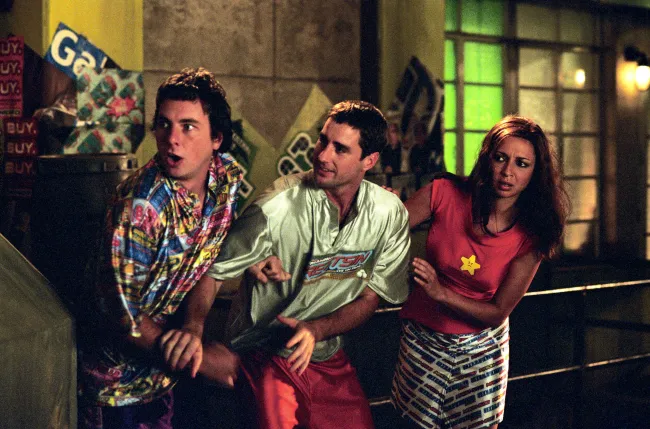

Last July, to mark the United States’ 250th birthday, The New York Times asked its readers, “What is the definitive movie about America?” After tallying more than 4,000 responses, one film emerged as the most frequently mentioned: Mike Judge’s “Idiocracy.”
It’s been a long, strange trip, both for “Idiocracy” and for America. This month marks the movie’s 20th anniversary. The dystopian satire, in which the world is populated by the poorly educated, has become so firmly embedded in our popular culture that it has gone beyond its cult status to become a cultural metaphor with an afterlife of its own. What once might have been considered to be far-fetched and over-the-top in 2006 is today routinely invoked as something eerily…what are the words I’m looking for?


“Prescient,” offered Tom Rothman, former head of 20th Century Fox, who greenlit the film.
“Accidental documentary,” said Etan Cohen, who co-wrote “Idiocracy” with Judge.
“Idiocracy” initially went the way of most cult films. It had a disastrous and short-lived theatrical release, but found its audience on home video and cable, and is today spoken of in reverent tones in the comedy community. But then a funny thing happened: In 2016, when the star of TV’s “The Apprentice” was running for president, upsetting political norms with his tumultuous campaign, headlines such as “We Have Become an ‘Idiocracy’” (Time magazine) began to appear. Last July, following the UFC bouts on the White House lawn, Variety proclaimed, “With UFC Freedom 250 at the White House, Trump Has Reached Peak ‘Idiocracy.’”
Pundits now routinely treat “Idiocracy” as an explicitly political film. It has been listed alongside films such as “A Face in the Crowd” as a predictor of Trump’s presidency. Like “Duck Soup,” it is characterized as political satire. But here’s the punchline: “It wasn’t at all intended to be political,” Cohen told IndieWire. “I just wanted to write the dumbest thing possible.”
“Idiocracy” stars Luke Wilson as the quintessentially average Joe, a military librarian chosen to participate in a hibernation initiative. He and Rita, a resourceful prostitute (Maya Rudolph), are cryogenically frozen. But a scandal shuts down the military base and they are forgotten. Over the ensuing centuries, high-IQ couples wait for just the right time to have children, while their lower-IQ counterparts breed aplenty until mankind becomes exponentially more vapid.
Joe and Rita are accidentally revived 500 years later and emerge into a genetically dumbed-down world where the No. 1 TV show on the Violence Channel is “Ow, My Balls,” the Secretary of State is brought to you by Carl’s Jr., crops are watered with the sports drink Brawndo (“It’s what plants crave”), and Dwayne Elizondo Mountain Dew Herbert Camacho (Terry Crews), a five-time Ultimate Smackdown champion and former porn superstar, is president. He reads profanities from his teleprompter and fires off machine gun blasts to quell protesters.
In this world, Joe is the smartest guy in the room, and Camacho promises the populace that Joe will solve all America’s problems in one week.
“It’s fun and distressing to talk about ‘Idiocracy’ these days,” Cohen said. “It’s become this phrase people throw around for talking about how the world is right now, and it’s beyond anything we could have thought. The only thing we thought might come true is people wearing Crocs all the time, and even that seemed impossible.”

Cohen was in his mid-20s when he started writing the film with Judge. As an MTV intern, he was a freelance writer on “Beavis & Butt-Head” (“Best college job ever,” he said) and later “King of the Hill.” “He remembered that I had written some of the more offensive ‘Beavis & Butt-Head’ episodes and so would be the kind of guy to collaborate with. I hope he was right.”
Judge’s original concept, Cohen recalled, was titled “3001.” “The fun part of writing with Mike was we could consider any part of the culture we thought was going south and that went into the movie,” he said.
Rather than making “some kind of statement,” Cohen said, “I drew on my twentysomething id” when writing with Mike. “It was things I actually liked, but turned up another degree, like the show ‘Oh, My Balls,’ which was something I would have genuinely watched.”
For Terry Crews, Camacho was a breakout feature film role. The former NFL player took to it with gusto. “I’m a big fan of sci-fi, and no one had done this sort of thing. There was Mel Brooks’ ‘Spaceballs,’ but this was something else.”
Crews recalled having to read for the part upward of 10 times. “I learned they were seeing some big stars,” he said. “But Mike loved the way I played Camacho and fought for me. “I’ll never forget showing up in Austin [where it was filmed]. I was like, ‘Here I am.’ I was a huge fan of ‘Office Space.’ This man had made a classic, so I was looking forward to it all.”
His portrayal of Camacho was informed by “some very nefarious preachers” he had experienced. “These guys were con artists,” he said. “They could charm the pants off of anybody. The way they preached was absolute gibberish, but it was so emotional, people got into it. He got them pumped. Camacho wasn’t trying to fool anybody. His charisma is what got him in office. He was just doing what works. And all of a sudden, he finds Joe, who might solve these [and here he slips into Camacho] prolems, and he could say, ‘I’ve got this guy.’”

“Idiocracy’s” practically nonexistent theatrical release looms large in its legend. “When you called Moviephone, it still referred to the film as Untitled Mike Judge Project,” Cohen said with a laugh. “There was no premiere. My wife and my brother and I went to see it on opening day. It was just the three of us and critics. It was so quiet, the first thing you heard was all the pens clicking open.”
Crews was disappointed but pragmatic — mostly disappointed. “I was telling everybody, ‘I can’t wait for you to see this movie,’” Crews said. “We were basically disappeared. You go through a hardcore depression because it’s something you worked so hard on.”
So what happened? “It was extremely difficult to market,” Rothman told IndieWire. “We tried. We always do, and we always loved it. But at the time, it seemed impossibly far-fetched. Imagine 20 years ago trying to cut a 15-second television spot, which is how movies were advertised back then. There was no social media. There were no influencers. We were disappointed we couldn’t succeed.” (Mike Judge was unavailable for comment.)
But like “Office Space” before it, “Idiocracy” had a very rich life in ancillary markets. “In retrospect, the movie had the life that it should,” Rothman said, “maybe even a better one.”
Between its limited theatrical release (inaccessibility makes the heart grow fonder) and reverence for the Mike Judge canon, “Idiocracy” became the archetypal cult film. “Every time it played on cable, people started hitting me up on Facebook,” Crews said, “and I was like, ‘They really like the movie.’ Then I went to a benefit basketball game. Will Ferrell was playing, and he came up to me and said, ‘Dude, Camacho, genius.’”
A repeated maxim in “Idiocracy” is “Lead, follow, or get out of the way.” As a social satirist, Judge has always been in the “lead” role. With “Idiocracy,” he was perhaps too far ahead. “It was an extreme portrait of the degradation and the decline of standards,” Rothman said. “Audiences at the time thought it was ridiculously extreme.”
Then came 2016, and the most outrageous presidential candidate America had yet seen, and “Idiocracy” went from cult to zeitgeist. Crews recalled attending a screening of the film with Judge and co-star Dax Shepard, hosted by street artist Shepard Fairey for his Make America Smart Again voter education initiative. And when he watched wrestler Hulk Hogan tear his shirt off while presenting at the 2024 Republican National Convention, Crews knew everything had changed for the movie. “I got why everybody had started calling it a documentary.”
Rothman had a similar reaction when he watched coverage of the White House UFC event last summer. “I thought, ‘Are you kidding me?’ he said. “Mike was ahead of his time, but not by a lot.”
“This film was not intended as political,” Cohen re-emphasized. “I was proud that conservatives thought we were making fun of liberals and liberals thought we were making fun of conservatives. But it’s interesting how it plays so different now. I used to think it was crazy when people would say, ‘We’re living in Idiocracy. I recently watched it for the first time in many years. I felt, ‘Oh my God, maybe they’re right.’”
New York Times editor Stephanie Goodman wasn’t too surprised that “Idiocracy” topped its readers’ poll, although “The Godfather” and “American Graffiti” gave it a good run for its money.
“The genesis of the story was to find what people considered to be the most American of movies,” she said. “And none of my writers picked ‘Idiocracy.’ It wasn’t something people felt strongly about. The readers, obviously, felt much stronger.”
At a certain point, she said, respondents started submitting their favorite movie. “A lot of them had nothing to do with America,” she said. “Somebody submitted ‘Four Weddings and a Funeral.’”
One thing that hasn’t changed over the past 20 years is that “Idiocracy” is a source of pride for its creators. “This movie exists because 20th Century Fox was brave enough and believed in Mike Judge to the point it was willing to make a film that was so original,” Rothman, now chairman and CEO of the Sony Pictures Motion Picture Group, said.
“Comedy is very hard to do,” said Crews, currently the host of “America’s Got Talent.” “What I love about this movie is that it does what comedy is supposed to do; it makes people laugh, but it shines a light on something and allows people to see it in a different way.”
Cohen, who went on to write the equally provocative “Tropic Thunder,” agreed. “Often, satire is about warning people in a palatable way. Maybe if more people had gone to see ‘Idiocracy’ when it came out, the world wouldn’t be the way it is now.”
Life can imitate art, but in the case of “Idiocracy,” real life is leaving art in the dust. “I don’t think we’re at peak ‘Idiocracy,’” Crews said with a laugh. “Don’t flatter yourselves. We can get a whole lot dumber than this.”
.