
Growing up in Oak Ridge, Tennesse, Born Secret director Riley Fitchpatrick didn’t realize how strange his hometown was.
“I took for granted that an atomic symbol was the logo of the high school, the local bank and restaurants all over town,” he says.
Born Secret, playing today at the El Paso Film Festival, shares stories of Oak Ridge, the “secret city” built as part of the Manhattan Project to build the world’s first atomic bomb.
While the 2024 Best Picture winner Oppenheimer emphasized the role of other key Manhattan Project locations — — especially New Mexico — Born Secret focuses on the isolated Tennessee town that produced the enriched uranium for the bomb, at a plant codenamed Y-12.
Fitchpatrick interviews an array of people who lived through Oak Ridge’s secret history, including retired Y-12 maintenance manager Clara Hughes — who turns 106 this Monday – and Fitchpatrick’s grandfather, David Fitchpatrick, a retired Y-12 pipefitter.
Fitchpatrick made the film alongside producers, brothers and Apple House Pictures co-founders Grant and Adam Conversano, and the latter also edited the film. Ahead of their El Paso screening, they spoke with us about using official photographs from the Manhattan Project, the power of story, and how Blue Valentine director and Oscar nominee Derek Cianfrance came aboard Born Secret as an executive producer.
Riley Fitchpatrick and Grant and Adam Conversano on Born Secret

MovieMaker: Riley, when did you realize you grew up in a very unique place?
Riley Fitchpatrick: Returning to Oak Ridge to shoot the film with the producers Grant and Adam Conversano and cinematographer Katie Mlinek, I realized for the first time how unusual my hometown is. They saw it as outsiders, and that perspective complemented my own. Growing up there, you learn the history, and you know intellectually that other places aren’t like this, but I took for granted that an atomic symbol was the logo of the high school, the local bank and restaurants all over town. I thought that was normal and to them it was just completely insane.
MovieMaker: Grant and Adam, you’ve also make political campaign videos — how did that experience inform Born Secret?
Grant Conversano: [We’ve] made political campaign ads for Democratic elected officials, from House members to senators, and we ran the video team for Dean Phillips’ presidential campaign. Working with political communications you learn to respect the power of images and narratives in our daily lives. I take this responsibility more seriously now than I did in film school because I understand how images affect people’s lives.
There is a great documentary series called Five Came Back, directed by Laurent Bouzereau and executive produced by Steven Spielberg. It follows five Hollywood directors (John Ford, Billy Wyler, John Huston, Frank Capra and George Stevens) who joined the military during World War II and made propaganda to build support for the war effort. Washington needed Hollywood to create the political will to fight after Pearl Harbor, and in a way, this film is a response to and reflection on the kind of images those filmmakers made.
MovieMaker: I loved that during a voiceover in which we hear the rationale for bombing Hiroshima, we see archival footage of Oak Ridge children in air raid bombing drills. What inspired that decision?
Adam Conversano: The history of Oak Ridge is completely wrapped in the duality of what was built there. The town has a nostalgic idea of itself, and we wanted to chip away at that and see what is beneath the surface.
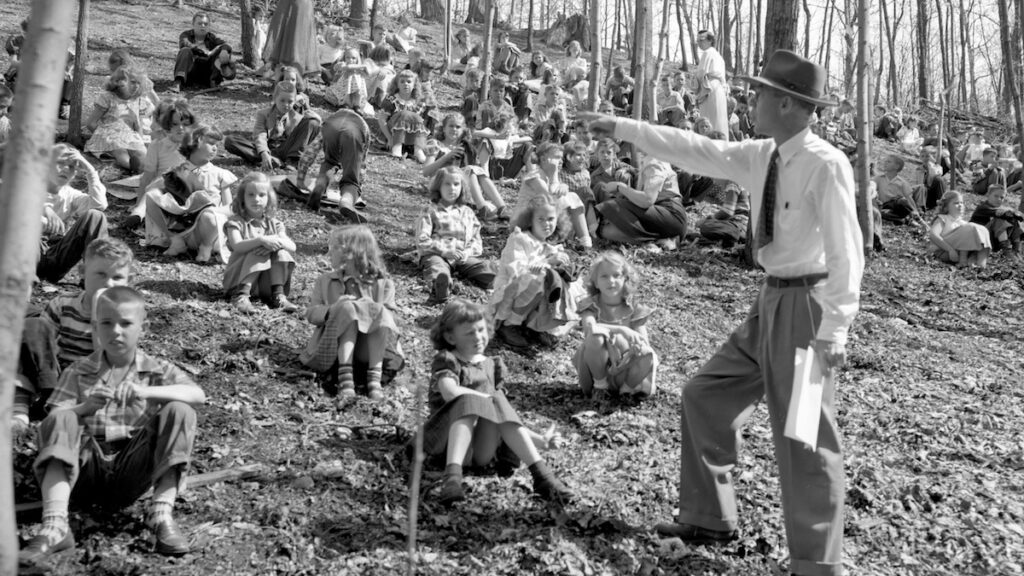
Ed Westcott was the Manhattan Project’s official photographer in Oak Ridge and sought to capture the daily life and industrious nature of the town. We looked through thousands of his photos and chose the images of American children being led out of school and into the woods for a bombing drill because they felt like a fable.
We hear D. Ray Smith, the Y-12 historian, explain why he feels America had to drop the bombs on Hiroshima. Initial U.S. military projections placed the death toll in Hiroshima at approximately 70,000, but subsequent independent assessments indicated that as many as 140,000 lives were tragically lost.
His perspective is that this brought a swift end to the war, but we are showing the Pandora’s box this moment opened. We all live with the looming reality that what was built could be turned back on the people who created it, threatening future generations. The true challenge for all of us is to recognize that any loss of life is a tragedy.
MovieMaker: How did Derek Cianfrance come aboard?
Riley Fitchpatrick: I’ve worked at RadicalMedia in Los Angeles the past couple of years while making this film, and Derek Cianfrance is a commercial director on the roster there. When I first told him about the film, he was encouraging and generous right from the beginning.
I had never made a documentary before, so his advice gave me the confidence to approach the subject matter. Once we got into post-production, he saw the film and joined the project as an executive producer.
MovieMaker: At one point in the Born Secret, Riley, you go back to your old high school to talk to students about the legacy of Oak Ridge. Do you think the students there prioritize nuclear war higher than the other potential problems they face? And how was talking to them on camera?
Riley Fitchpatrick: It was not the focus when I went to high school there. Even though these kids have grown up with a nuclear weapons plant in their backyard, it’s just something they’ve had to get used to.
And when we were talking to them, one of the things that was so freaky was just how cavalier and nonchalant they were when talking about their own potential nuclear annihilation.
Born Secret plays as part of the Documentary Shorts 1 block today at the El Paso Film Festival, one of our 50 Film Festivals Worth the Entry Fee. You can read more of our film festival coverage here.
Main image: A civil defense air raid drill in Oak Ridge in 1953. U.S. Department of Energy