

Nicky Rudolph Calloway makes a remarkably assured and impressive debut with the daring “I Am a Gentleman,” a film that takes its time establishing a sense of mystery and menace before revealing itself as a spikily relevant social critique.
I’m avoiding telling you exactly what it’s about because Calloway does such an excellent job of setting up his horrible but accurate-feeling scenario. If you have a chance to see it at the El Paso Film Festival, where it screens Saturday, please do. It’s a movie that works best if you know nothing going in.
If not, be assured that it’s a wildly topical film in an age of Andrew Tate, government intervention into public school lesson plans, and podcaster bros potentially swinging elections.
Calloway’s film education comes from attended Saddleback Community College in Mission Viejo, California, starting at 17. Just a few years later, he’s currently studying anthropology and archeology, with an eye toward pursuing “an academic career and an artistic one simultaneously,” he says.
“I Am a Gentleman” is both artistic and well-studied, but nothing about it feels academic — its deliberate unreality is gutsy and haunting, and it’s kicker is fantastic.
Ahead of the film’s screening, we talked with Calloway about building tension, plotting audience reactions, and making the film while considering coming out as a trans man.
Nicky Rudolph Calloway on ‘I Am a Gentleman’
MovieMaker: I love the confusion and mystery around what’s happening at the start of this film — can you talk about building the audience’s fear, anticipation and curiosity?
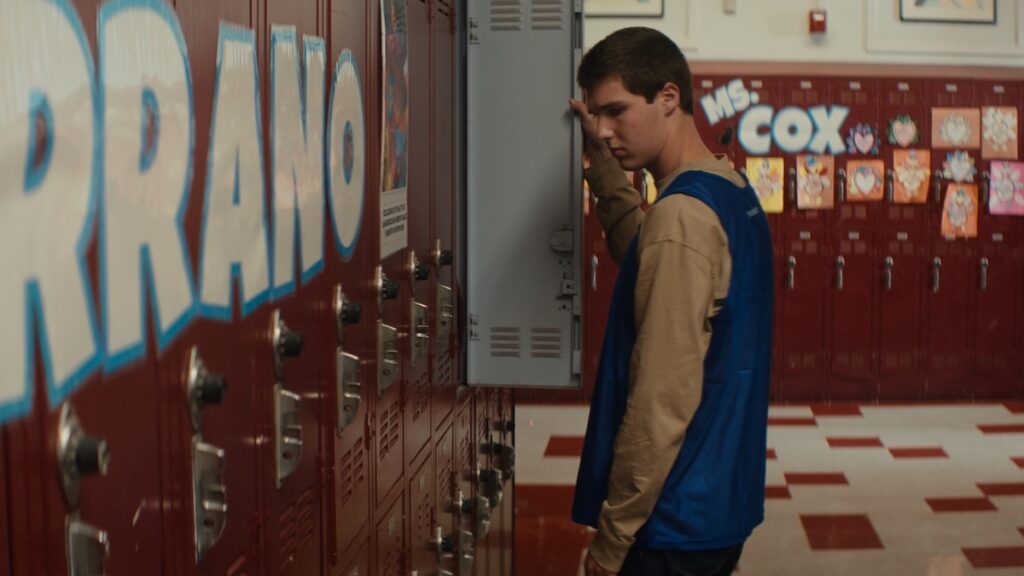
Nicky Rudolph Calloway: Thank you. I wanted to capture the vulnerability of starting high school, so that meant showing my lead character Max [Nathan Becker] studying everything going on around him. He’s anxiously watching the behavior of the other boys and listening intently to his teacher’s instructions for their Sexuality Test. When it’s established that the boys have to wear the results of the Test (a blue or pink jersey) it raises the stakes socially for Max to get the “right” answer in order to belong.
World-building is one of my favorite parts of storytelling. I find it best to tease out the information, so we don’t have all the context when this 14-year-old boy is exposed to these bloody, graphic images during the Sexuality Test. We’re left with a funny feeling of dread when Max triumphantly discovers he “passed” the Test after choosing what we the audience would deem to be the wrong choices. There’s an innocence lost at the end of the first scene, and we see for a moment the darkness Max may be capable of.
MovieMaker: What experiences or events inspired this? I wondered if you worked backwards from this New York Times op-ed, “The Troubling Trend in Teen Sex.”
Nicky Rudolph Calloway: My inspiration came from internal and external pressure around gender in 2020. As the first Trump administration was coming to a rocky close, I was considering whether to come out as a trans man. It felt like the perfect time to transition, within the safety and privacy of self-quarantine. I was reading Reddit accounts of testosterone making people angry and not able to cry that really freaked me out. I started thinking about what being a man meant and if it was inherently bad.
That’s when I wrote “I Am A Gentleman.” It’s about the dangers of teaching gender bioessentialism, of corporations having influence over public schooling, and a government that apathetically accepts male violence and misogyny as the norm. Since writing the screenplay, it unfortunately seems to be more relevant by the day.
We’re living in the second Trump administration, we have a manosphere and red-pilled content preying on young boys, and a male-family-annihilation news announcement every other week. American culture would like us to believe that manhood carries a mythological yet biologically determinate expectation of violence and anger — but my character Max has taught me that just because a behavior is treated as inevitable doesn’t mean it isn’t learned.
MovieMaker: How are audiences responding to this? Do you and old have different responses?
Nicky Rudolph Calloway: The responses across all ages while watching “I Am A Gentleman” have been pretty similar: bewildered laughter in the beginning, uncomfortable silence towards the end, and usually a gasp in the last moment. It’s nice when people react how you intended a certain moment to land. My 80-year old grandpa and I had a really philosophical talk about it afterwards, bridging our own understandings of masculinity two generations apart.
MovieMaker: What was the biggest problem you had to solve to make this film?
Nicky Rudoph Calloway: “I Am A Gentleman” is my first film. The biggest problem was my own mental block around that. I was afraid to direct it, so I put it off. I sent the project away by signing a two-year option to a Swiss production company in the hopes they’d make it. But the script came back to me two years later, unproduced.
When I received a production grant from the Shore Scripts Film Fund in 2025 to make the film, I felt I finally had to suck it up and face my fear.
I think everything still happened at the right time. I needed those years of dragging my feet to build my confidence as an adult and an artist. For me it’s true that the things meant for you will continue to find you, because “I Am A Gentleman” is like the cat that came back.
You can learn more about “I Am a Gentleman,” including screening information, at Nicky Rudolph Calloway’s website. Here are more details on the El Paso Film Festival, one of our 50 Film Festivals Worth the Entry Fee. And you can read more of our film festival coverage here.
Main image: Nathan Becker in “I Am a Gentleman.”