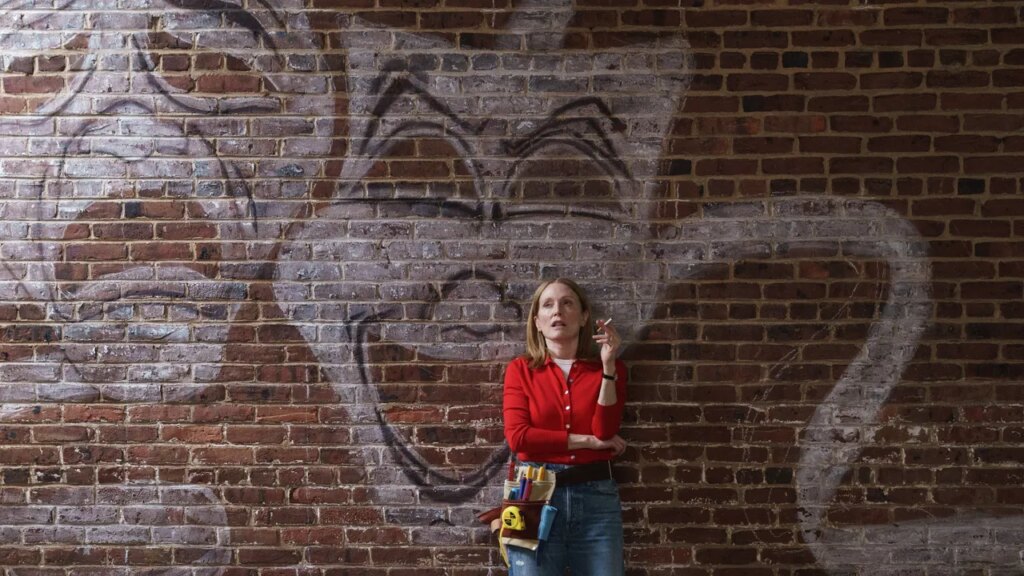

Mona starts out as a relatively ordinary woman who decides on a whim to audition for a local production of fictional musical Nosy Neighbors. With very little experience, she struggles to get the approval of Jerry, the demanding director (Paul Giamatti). When he pushes her to inhabit the character (an apartment building’s tool-belt-wielding superintendent), she takes that direction to the extreme, becoming a crazed method actor in a film that becomes more and more surreal and absurdist as it goes along.
When Moore was sent Eisenberg’s script, she was in awe. “It’s one of the best scripts I’ve ever read in my entire life,” she says. “On page 30, I stood up and had to walk around my dining room for a second and catch my breath.”
Speaking of breath, the film’s musical numbers required Moore to do something Dear Evan Hansen hadn’t: sing live, badly, in front of seasoned stage actors and singers. The supporting cast includes Tony nominee Colton Ryan, Tony winner Bonnie Milligan, singer-song-writer Halle Bailey, and stage legend and two-time Tony winner Bernadette Peters. When Moore had to film the first live-singing number she felt like “I was going to swallow my own tongue. And the looks on their faces when they’re all worried, that was kind of what the atmosphere was like,” she says. “So it was just an amazing creative challenge.”
At the beginning of the film, Mona is meek and untrained. “It’s not hard for me to be a bad singer,” Moore says dryly. But as Mona grows in confidence, Moore has to perform her main number— an original song written by Eisenberg titled “This City May Have Chewed Me Up (But It Hasn’t Spit Me Out)”—with much more skill and gusto. And she delivers, with star power, joy, and comedy.
Eisenberg says he noticed something about Moore when watching the film at Telluride that he hadn’t seen before. When she performs the number for the second time, about halfway through the movie, you see the first hint of skill and confidence, Moore is using her throat, not her chest. But when she performs it again later in the film, Moore uses her chest, as a seasoned singer would. “It’s such a small thing, but musical theater people would understand that that character is making an evolution from something that is instinctive and incorrect to something that is learned and better,” he says.
Midway through the film, there’s a scene so wild that it sparked boisterous applause from the audience. In it, Giamatti and Moore are facing off, as Jerry pushes Mona to go deeper into her character. Moore knew the scene, which is essentially a long, intense monologue, would loom large for her, and so did Eisenberg. Anticipating how actors spiral before a scene like that, Eisenberg offered her a teleprompter well in advance so she wouldn’t spend three weeks silently panicking.
“All of us as actors, whenever we have a big piece of material, we just worry it, worry it, worry it—and drill it,” says Moore. “And so this allowed me to work on it normally without having to do some weird obsessive drilling.” Then, the day of, she didn’t want or need the teleprompter at all. Moore credits Eisenberg for knowing all along that she wouldn’t need it on the day. “I was relaxed enough that I absorbed the language without being scared,” she says. ‘I was like, ‘He’s a fucking genius!’”