
‘It’s a shame that we as a society are far more comfortable watching violence than we are watching love.’

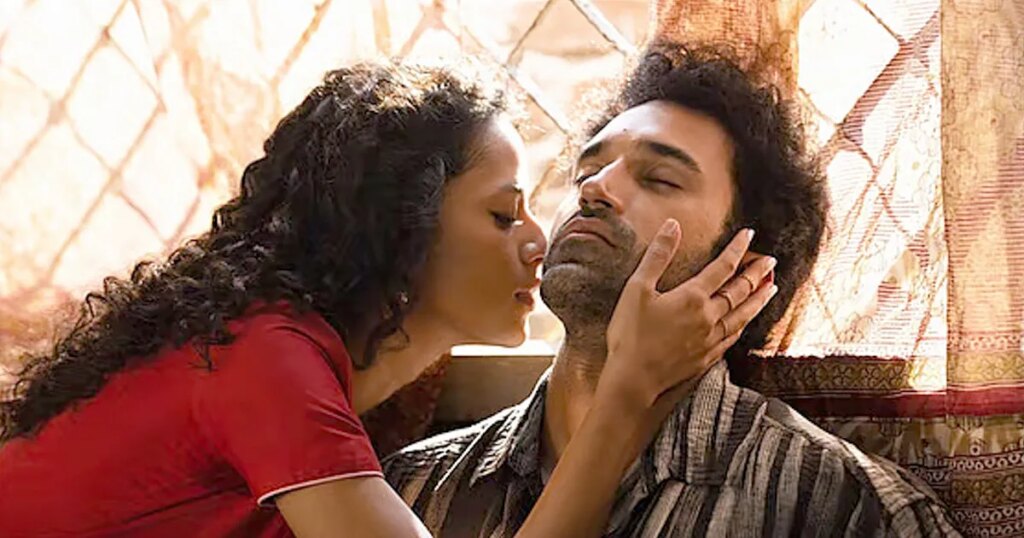
IMAGE: Sana Thambi and Gurfateh Pirzada in Lust Stories 3.
Key Points
- Intimacy coordinators Aastha Khanna Bhardwaj and Parinaz Aga have worked in Lust Stories 3.
- ‘Actors wear ‘barriers’ under the clothing. There may be a hard cricket guard under your clothing, or stuff pasted on.’
- ‘Sexual violence is never easy to shoot.’
One of the many raunchy scenes in Lust Stories 3 has Radhika Madan grab Ali Fazal’s crotch in a lift.
The actors play a married couple on the verge of divorce, but who still can’t resist each other sexually.
They enjoy a tumble in the lift, which looks totally natural on screen, but in reality, it’s a carefully choreographed scene, made possible largely due to intimacy coordinators Aastha Khanna Bhardwaj, 31, and Parinaz Aga, 42.
Aastha is the first intimacy coordinator in India, having first worked in 2022’s Gehraiyaan.
It is their job to see intimacy unfolds naturally on screen, and the actors involved are absolutely comfortable while performing.
When they are not on set, Aastha works as a sex and relationship coach while Parinaz is a therapist and counsellor.
Aastha and Parinaz offer Ronjita Kulkarni/Rediff a peek behind the movie scenes and reveal, “The boundaries vary from person to person, like someone may be very specific as to what level they want to show their chest, or where they will be kissed.”
“We never use tongue in kissing. Another (boundary) would be that some people are not comfortable with LGBTQ stories. They feel discomfort in performing scenes of intimacy with people of the same gender.”
First of all, what exactly is an intimacy coordinator?
Parinaz: This is a role which has come out of a kind of a need, which was a gap in the industry. You can’t tell human stories without talking about intimacy, right?
Now, when actors have to engage in any kind of on-screen intimacy as part of the storytelling, they still have individual lives. They still have individual personalities. They have their own boundaries.
But for the sake of storytelling, they try and work with the director to make the character come alive and tell that story to the best of their ability.
Now, the gap over here is just like you would have a stunt coordinator keeping you physically safe when doing a stunt. This is somebody who keeps you emotionally safe.
Even on a set, there are power dynamics. Individuals might not even feel very comfortable about communicating a boundary. They are not sure whether they can speak out or not.
The intimacy coordinator is a neutralising factor. When there are no power dynamics, it is easy to communicate with that human being, tell them what worries you, makes you feel comfortable.
So if an actor says, I’m not comfortable with this part of my body being shown on screen, it’s a conversation. We’re like, how can we do this differently?
It also creates a safe space for directors to speak. When a director wants to explain what his vision is, sometimes in their mind they might feel like, okay, should I say this? How will it be seen? Is it awkward?
From a production point of view, the producer knows that we are doing everything to make sure that the cast and crew feel safe and respected in their workspace.
‘This was at the back of the #MeToo movement’

IMAGE: Prepping for an intimate scene. Photograph: Kind courtesy Aastha Khanna Bhardwaj
Which was your first film as an intimacy coordinator?
Aastha: I read an article, and got to know about the work. This was at the back of the #MeToo movement. I did my training in 2020. It was also around the time that OTT was growing and they wanted to incorporate international standards in the shoots.
I was working on Gehraiyaan as an assistant before I trained to become an intimacy coordinator. Shakun (Batra, director) said we would use intimacy coordinators since Gehraiyaan had a lot of intimacy in it. So I ended up becoming an intimacy coordinator (Dar Gai was the lead intimacy coordinator).
Parinaz: CTRL was the first mainstream film where I worked independently without a senior.
The intimacy that I worked on was for a supporting actor. It was a first time intimacy scene for that person, and it was a kissing scene. So that experience was not very long. It was a single day of shoot.
Did you do workshops before the shoots?
Parinaz: I worked with three of the four directors, Vikramaditye Motwane, Shakun Batra and Vishal Bhardwaj. For Vishal Bhardwaj’s film, we didn’t do a workshop. For the other two, yes.
All four directors had clear visions about what they wanted to showcase and how the aesthetic would be.
The actors also came with a huge amount of experience. We had phenomenal actors like Radhika Apte, Ali Fazal, Radhika Madan, Aditi Rao Hydari, Siddharth…
Aastha: I worked on Shakun and Kiran Rao’s segments.
‘That scene was fun to do. Everyone was laughing’

IMAGE: Vijay Varma and Radhika Apte in Lust Stories 3.
Radhika Apte’s sex scene with Vijay Varma in the ambulance looked very hot.
Parinaz: Radhika Apte and Vijay Varma are senior actors. They know how to switch into character. They’re also very respectful actors. They’re aware about how to ask for consent, how to have conversations, how to make their co-actor feel comfortable.
My role for that particular scene was more to work out the logistics of how to shoot in the tiny cramped space of an ambulance, and you know, how to make the movement seem as natural as possible.
We had independent conversations with Radhika and Vijay, saying, are you comfortable, do you think this position is comfortable? Do you need something under your back or your head? Do you need some kind of barrier between the two of you so that you can get on top (of the other person) without feeling self-conscious or unnecessarily touching?
The conversation was more technical. It was from the point of view of choreography, and movement because when you are working with such senior actors, they have already worked out a process through the years.
Tell us about the lift scene with Ali Fazal and Radhika Madan.
Parinaz: It was, you know, so well thought out about where the camera’s going to be, how it’s going to be placed…
Shakun had a clear understanding of what he wanted to show in the lift. There was so much technicality that went into it since it was a stationary box.
Ali and Radhika had this amazing amount of respect for each other. Through workshops and script readings, they communicated so much with each other.
I worked out the choreography with Aastha, and both the actors were happy to listen and participate to make something fabulous.
Ali is a fantastic actor. He gives so much thought to his character. Radhika is so playful, so lighthearted.
That scene was fun to do. Everyone was laughing. The director had music playing, songs from our college days. There was no stress.
‘There is a certain degree of awkwardness’

IMAGE: Ali Fazal and Radhika Madan in Lust Stories 3.
There’s no awkwardness in such scenes?
Parinaz: I’m sure, as a human being, each person pushes certain barriers, and there is a certain degree of awkwardness.
But when you have orchestrated the choreography, like okay, you’re going to move from here, you’re going to move your hand here, you’re going to do this, there’s going to be a barrier here… This is what you’re going to wear under your clothing, so that there’s no unnecessary touch to your actual body parts.
So actors layer up during such scenes?
Parinaz: Yes. They wear ‘barriers’ under the clothing. It may be a hard cricket guard under your clothing, or lose barriers like foam/ pilates balls between performers.
So when you’re being touched, it doesn’t feel like your skin is being touched. The co-actor is actually touching a barrier.
There are no surprises.

IMAGE: Aastha Khanna and Parninaz Aga prepare for the lift scene in Lust Stories 3. Photograph: Kind courtesy Aastha Khanna Bhardwaj
Is it difficult to do a sex scene in a room full of people because there are so many people involved in making a movie?
Parinaz: We have closed sets, which means not more than the absolute essential people are around. It’s usually less than 10, never more than 12, and one of those people is the intimacy coordinator.
We also make sure that all cameras and monitors are flagged. Only the monitor that is absolutely required by the director will be there.
Nobody will be the line of sight (of the actors), even among those people in the room. Only the DOP (Director of Photography), of course. We make sure that we do everything possible to allow the actor to perform and not worry about how they’re being judged or reviewed or seen.
Are retakes reduced for such kind of scenes?
Parinaz: For scenes like kissing scenes or where there is intimacy, it would be wonderful if we could just do one take and then move on to the next shot. Sometimes it goes up to two or three takes.
But most times, once the choreography is put into place and if the actors have figured out what they need to do and if the director is absolutely clear, the number of retakes is drastically reduced.
Of course, you have to do different shots, like one over the shoulder, one on the other side etc. That’s different.
‘She’s not actually grabbing him there’

IMAGE: Aditi Rao Hydari and Siddharth in Lust Stories 3.
In Vishal Bhardwaj’s segment with Aditi Rao Hydari and Siddharth, is it easier to shoot intimacy if the actors are a married couple?
Parinaz: You cannot assume that just because they’re married, they are comfortable with being in front of the camera and consenting to any form of intimacy.
So it was still required to have an intimacy coordinator to have those conversations with each of them saying, you know, are you comfortable with this?
This is what you’re wearing, are you feeling comfortable?
That segment was funny, playful.
She’s imagining that he’s doing it a bit differently; the director had a certain idea in mind. If you take a look at the colour schemes and lighting, there was this very distinct change in colours between Aditi’s dream Badru and the real Badru.
Also, the story was not set in the modern age. So the way they speak, and the language, played an important role in making these scenes come alive.
We wanted to bring in a little bit of humour in discussing this topic about female desire. And, you know, looking at female desire through a female lens versus a male lens.
Filming it was super fun. Siddharth brings so much life and energy onto the set.
Were any body doubles used for Lust Stories 3?
Parinaz: Yes, especially for the Aditi-Siddharth segment because we were shooting on parallel sets. A lot of times there were scenes where you didn’t need the main actor to be there, so we had body doubles.
What about the lift scene in the Ali Fazal-Radhika Madan segment, where she grabs his crotch?
Parinaz: No, she’s not actually grabbing him there. It’s a cheat.
She actually has her hand on his thigh, and he was wearing a barrier inside, so she’s not grabbing him there.
‘Some actors feel discomfort in performing scenes of intimacy with people of the same gender’

IMAGE: Gurfateh Pirzada and Sana Thambi in Lust Stories 3.
In the Kiran Rao segment, Gurfateh Pirzada and Sana Thampi are fairly new actors. Is it more challenging for them to navigate intimacy on camera?
Aastha: No. Working with newer performers is often easier than working with performers that have a lot of experience. Of course, they all have separate challenges.
I think new performers come with a fresh perspective. Also, they are very clear of what they want to do, what they can and cannot do. They have a clearer understanding of their boundaries.
Also, they’re not jaded by the industry in any way.
What are some of the boundaries that actors set?
Parinaz: It varies from person to person, like someone may be very specific as to what level they want to show their chest, or where they will be kissed. We never use tongue in kissing.
Someone may be particular at not having their hair pulled at.
Aastha: Nudity is a social boundary that we don’t cross.
Another (boundary) would be that some people are not comfortable with LGBTQ stories. They feel discomfort in performing scenes of intimacy with people of the same gender.
How do you make sure the scene doesn’t look like titillation?
Parinaz: Those involve a lot of conversations around the script, with the director, and the actor. Sometimes, the actor is very concerned about how the scene will be viewed.
So you’re (the intimacy coordinator) in the room, looking at a monitor, using your judgment and doing a retake if you feel that it doesn’t feel like what was expected by the director and the actors.
‘Sexual violence is never easy to shoot’

IMAGE: Siddhant Chaturvedi and Deepika Padukone in Gehraiyaan.
What is the toughest intimacy scene that you’ve been a part of?
Aastha: I can’t pick a particular scene, but I can definitely say that sexual violence is never easy to shoot.
Films like Saas Bahu And Flamingo, Mrs and Chup had sexual violence.
I did a scene with sexual violence even in a show called Hai Junoon for Jio Hotstar.
How do you tackle such scenes?
Aastha: We have enrolling and derolling rituals.
Enrolling is when you choose to bring yourself to a state of neutral and push yourself towards a certain performance. It could be something as simple as this character eats this particular chewing gum. So once I eat this chewing gum, I become this character.
Derolling is to tap out of it and come back to being myself. Some people like to take a shower or play some music to shake it off.
At the end of the shoot day, I personally like to have a nice glass of Coke and watch Friends or something and just completely decompress from being so emotionally present on set.
Intimacy on screen has changed over the years. Earlier, we didn’t even kiss as much. But now, we are pushing the envelope even more and more. How do you view this change?
Aastha: It’s long overdue. The worldview of society is expanding, and we are working slowly and surely towards de-stigmatising and sort of lifting the taboo of something that is such a human experience.
It’s a shame that we as a society are far more comfortable watching violence than we are watching love.
Photographs curated by Satish Bodas/Rediff