
In Khalifa, Prithviraj Sukumaran carries a derivative thriller almost entirely on his shoulders with forgettable results, laments Sreeju Sudhakaran.

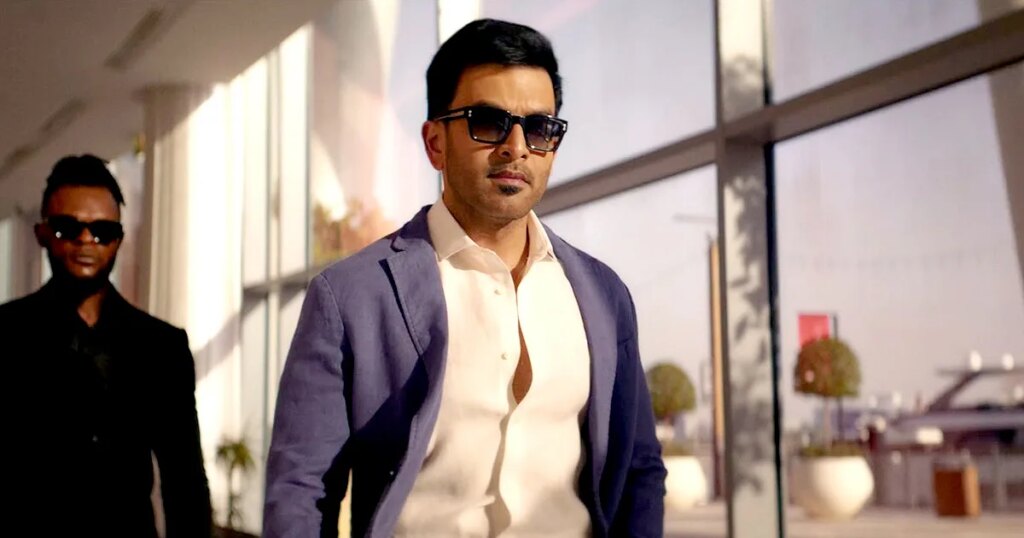
IMAGE: Prithviraj Sukumaran in Khalifa.
Key Points
- Prithviraj Sukumaran is the film’s biggest strength, effortlessly owning the action, dramatic moments and larger-than-life treatment.
- Khalifa‘s biggest weakness is its derivative screenplay, which borrows heavily from familiar Malayalam gangster dramas without bringing enough ingenuity of its own.
- The film’s weak villains, underwritten characters and excessive franchise-building leave the promised universe feeling more exciting than the actual movie.
I hope this message reaches out to all directors and producers out there: Do not promise a ‘universe’ to us when you cannot even get a cent of the plot right.
It is perfectly okay to have grand visions. But promising the next exciting chapter before the first one even releases is rarely a sign of confidence. It is usually just a sign of over-delivering on hype.
Lokah Chapter 1: Chandra was an exception that delivered. Khalifa (or Khalifa – The Ruler), unfortunately, is just another gasbag example of the norm.
A Promising Start Quickly Loses Steam
Directed by Vysakh, Khalifa kicks off with what feels like an extended wedding-themed commercial for Kalyan Jewellers. Once that sequence mercifully ends, the bride’s brother Samad (Sanju Sivaram) is suddenly arrested on a tip-off.
He is hauled in for questioning about the whereabouts of his best friend, Aamir Ali (Prithviraj Sukumaran), who is currently hiding out in London. A conniving politician named Punnavel Raghavan (Shammi Thilakan) orchestrated the arrest, hoping to use Samad as bait to drag Aamir back to Kerala.
Samad refuses to break. We are then immediately treated to a slick action set piece where Aamir casually dismantles an entire London hit squad sent to kill him. Only then is Samad told the shocking truth about his arrest.
Despite that awkwardly staged opening song, this entire prologue actually serves as an intriguing start for Khalifa. But what scenarist Jinu V Abraham has (under)cooked up from there on is a script radiating extremely strong déjà vu vibes.
We flash back to the early life of Aamir Ali in his native town. He is your typical happy-go-lucky youngster enjoying a content family life and courting the local town belle, Fiza (Malvika Sharma). Even their romance culminates in marriage without much fuss.
When his father (Renji Panicker) is falsely implicated in a gold smuggling case by Raghavan and Harris Bashir (Neil Nitin Mukesh), an evil businessman, the narrative predictably charts Aamir’s deep dive into the criminal underworld.
It does not take long for the screenplay to rush through him building his own empire, aided by his grandfather’s old business associate, Seth (Suresh Oberoi).
A Universe Teased In An Undercooked Film
Speaking of Aamir’s grandfather, the legend of Mambarakkal Ahmed Ali is tantalisingly teased throughout the runtime.
Even before the release, it was officially confirmed that Mohanlal would play the role and eventually lead the planned sequel, Khalifa 2: The Legacy. The movie concludes with his highly anticipated cameo, along with two other surprise appearances.
Honestly, that was easily the most exciting portion of the entire film, even if it carried a heavy Empuraan meets Marco vibe. The only problem is that by then, it is a classic case of too little, too late.
That is my main grudge with Khalifa. It is like a certain politician’s hollow promise of a glorious future that completely ignores a warped present. Whatever little tidbits the characters drop about Mambarakkal Ahmed Ali and his conquests sound infinitely more interesting than the actual movie we are watching.
Even before that epilogue, we keep hearing these anecdotes about the legend. We hear how he was the one don Indira Gandhi could not bring down, how he single-handedly forced the implementation of the COFEPOSA Act, and how he wiped out an entire gang all by himself.
Instead, we are stuck with the bland story of his grandson in a script that blindly relives past hits of Malayalam cinema like Parampara, Naduvazhikal, and Runway (among others) as he rises to the top and fights off generic threats.
Stylish Action Cannot Hide The Weak Writing
The heavily inspired screenplay is not even the main issue here. The real problem is a total lack of ingenuity in both the writing and Vysakh’s direction. Ideally, the best way to prove your protagonist is a criminal genius is to show exactly how he masterminds smuggling gold out of highly secure airports.
Khalifa desperately wants us to believe that Aamir’s sheer brilliance is an inherited legacy from his grandfather. The reality, however, is that the film struggles immensely to make that illusion convincing.
The scenes attempting to showcase this barely pass muster, completely lacking any whiff of brilliance. They rely entirely on convenient editing and lazy placement.
Some sequences are also painfully contrived in the edit. For instance, a character close to Aamir is killed off in the second half, but the script only bothers to show us how close they were after the death. The flashback is shot so awkwardly that I genuinely wondered if a secret romantic subplot was happening.
During the climactic fight, there is a moment that feels like a serious take on the famous Pokkiriraja rewind scene, where Mammootty’s character stands tall over defeated villains before we actually see the beatdown. While that older film (which was Vysakh’s directorial debut) played the trick for quirky laughs, doing it here completely kills the tension. It is exactly like knowing the final score of a match before watching it play out, stripping away any potential thrill.
What marginally saves Khalifa is its visual treatment and the execution of specific action blocks. Jomon T John’s cinematography lends a lush, rich and highly stylish feel to the proceedings, particularly during the foreign-locale shots.
As for the action, the opening London brawl, a tense bridge ambush and a brutal second-half attack on Aamir’s house stand out as clear highlights in an otherwise ordinary thriller. That last sequence is particularly engaging because it unfolds entirely without the hero present.
Jakes Bejoy’s background score elevates these moments with the necessary mass panache, even if his vocal tracks fall flat. However, in its desperate bid to look cool, Khalifa commits a cardinal cinematic sin: It pads the runtime with far too many slow-motion walking shots.
Prithviraj Carries The Film On His Lone Shoulders
The leading man, Prithviraj Sukumaran, is a massive asset as well and the primary reason Khalifa manages to feel a bit engaging. Looking effortlessly suave and convincingly youthful for a character trajectory beginning in his twenties, he completely owns the screen through heavy action beats, tense face-offs and quiet dramatic moments.
The tragic irony is that in its absolute obsession with making the lead star look cool, the movie completely forgets to flesh out the rest of the cast.
Malvika Sharma is simply there to look pretty in every frame. I genuinely cannot recall a single memorable line of dialogue she delivers. ‘
Sanju Sivaram gets some decent scope to perform when his commanding co-star is out of the frame, and that specific moment only happens during that prologue interrogation with Raghavan. After that, he is reduced to merely standing behind the hero. In the second half, his character takes a moral detour that feels so incredibly rushed that it exists purely to inject forced tension into the plot.
The villains are the weakest link, primarily because they never actually feel threatening. Neil Nitin Mukesh’s dubbing completely fails to match his physical performance. This is genuinely baffling, considering Prithviraj himself extracted a perfectly synced, menacing performance from Vivek Oberoi in his directorial venture, Lucifer.
Did he really have no tips for Vysakh on how to pull that off again?
NNM’s character ultimately feels entirely fangless, constantly hatching silly revenge schemes only to be easily bested. Shammi Thilakan and Shivajith are unfortunately saddled with the exact same predicament.
Indrans is strictly around to remind the hero about his grandfather’s towering legacy. Suresh Oberoi is adequate in his limited capacity. A genuinely good actor like Anand Manmadhan is completely wasted here, while Renji Panicker and Mohini are just about passable as the hero’s parents.
Khalifa wants to build a universe, but forgets to build a compelling film first. Despite Prithviraj Sukumaran’s commanding presence, stylish visuals and a few solid action stretches, the film’s derivative writing and archaic direction rob that universe of any good momentum even with those grand cameos in the end.
Khalifa Review Rediff Rating: