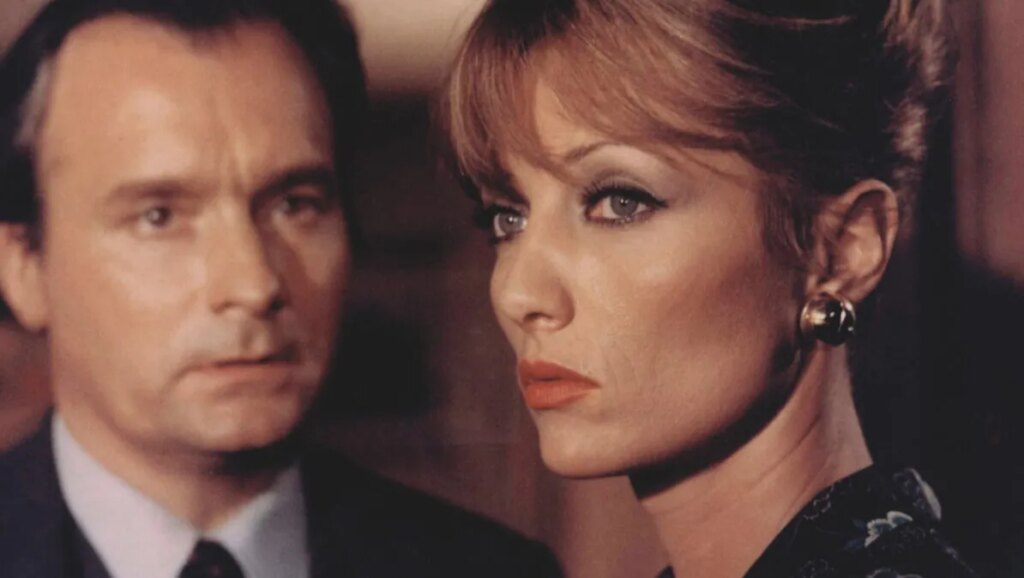

At times, The Unfaithful Wife (La Femme infidèle) feels like a Douglas Sirk classic, with its saturated colours and core melodramatic relationship. Suburbia has never been so perfect, but just like in a Sirk film, things are never quite as rosy as they first seem. Director-writer Claude Chabrol adds his own spin on things as well though, with La Femme infidèle being the first film in a successful run of psychological thrillers. Absurdity, comedy, romance, and pure unease coalesce into a film that is as distressing as it is riveting.
The titular wife is Hélène, played by a superb Stéphane Audran (Les Biches), who lives with her husband Charles (Michel Bouquet, Toto the Hero) and young son. Chabrol conducts the film’s opening scenes with a welcoming tone, inviting viewers into this seemingly perfect slice of domestic bliss. But peppered within this beginning are creeping zooms, overwhelming fades, and images blurring into one another. It is clear that things are not peachy, despite the couple’s polite way of speaking to each other. True to the title, Hélène is having an affair—something which Charles swiftly finds out through the help of a private investigator.
From here, the skin-crawling tone of La Femme infidèle comes to the fore even more, most notably in a pivotal scene between Charles and Victor Pégala (Maurice Ronet, Rendez-vous de Juillet), Hélène’s lover. That isn’t to say La Femme infidèle blows up into something overly loud or overt; Chabrol always keeps a firm handle on the tone, the violence, hatred, and malaise simmering beneath the surface and erupting only at very specific and brief flashpoints. Pierre Jansen and Dominique Zardi’s disconcerting original score further aids this evocative mood.
La Femme infidèle also invokes interesting questions about extramarital affairs. Sure, their marriage had become intertwined with deception, but when Charles does find out about Hélène’s lover, who does it actually help? What actually changes? More than anything for Charles, it’s the psychological effect of who it is that Hélène has chosen to be with. Vice versa, how did Hélène come to be in this position? Chabrol never offers easy answers—the characters’ mindsets and motives are too complex for this—but an air of indifference is instilled in every frame. It produces a cold, calculated nature to La Femme infidèle that is vital in reflecting the central duo’s ailing marriage.
All three main characters shine in their differing roles. Audran is consistently elusive and enigmatic; just when you think you have a handle on her, she flits off into another direction, motives and feelings recalculating. Bouquet complements her perfectly. A tightly controlled man in his facial expressions as much as his emotions, the flashes of rage he sometimes exhibits belie his meticulous and calm demeanour. Ronet is spot-on as the lover—a handsome and charming man caught up in a marriage that will cause him all sorts of issues.
Chabrol conducts all of these uneasy, superficial interactions like a master at work. The comedy is dry, the acts of love incredibly over the top, and the bursts of frustration often absurd but always terrifying. With an all-time great ending to boot, La Femme infidèle sits firmly as not just a highlight of 1960s cinema, but as a top-tier example of a psychological thriller.
La Femme Infidèle will be released by BFI on September 11.