
The scene in which Kerry declares her love for Hal amidst a restaurant full of angry neighbors highlights Chandler’s skill in the part. It could have been disastrous to make a character defined by his brashness sit there with a hangdog expression while someone else defends him. But Chandler seamlessly shifts from being properly embarrassed to returning the twinkle in Hal’s eye as he looks at Kerry with admiration. With that shift, we realize that this is still the same charming Hal Jordan we knew, but he’s finally matured, someone who has actually learned how to be afraid and got through it.
Which is, of course, the show’s primary theme. The series has been reminding us implicitly and explicitly that fearlessness equals brokenness, an (ironically) brave take on superheroes in general, let alone a superhero property built on the concept of rejecting fear. Yet, creators Lindelof, Chris Mundy, and Tom King—all of whom share a writing credit on the finale, directed by Alik Sakharov—manage to hone tie the theme so tightly to John’s development that it manages to feel like a proper superhero origin story, even if the episode puts more weight on a high school football game than it does space battles.
Yes, Noah Macon, the main player in those football games, is a Manhunter, one who threatens to someday become president and control America’s nuclear arsenal. And Noah did free Sinestro from his sciencell and bring him to the yellow planet (which, it turns out, is just Antaan’s unnamed home planet, not Qward) to forge a lantern and ring. Sinestro does try to manipulate John and the Hal-o-Gram by extolling the virtues of fear, and the lantern that he creates does have cracks of yellow in it, indicting the presence of fear.
But when John leaves the planet with Sinestro’s lantern to return to Rushville and face down Noah, the two don’t have a big sci-fi fight. Instead, they have a long, tearful conversation. In a car. Outside of a high school football field.
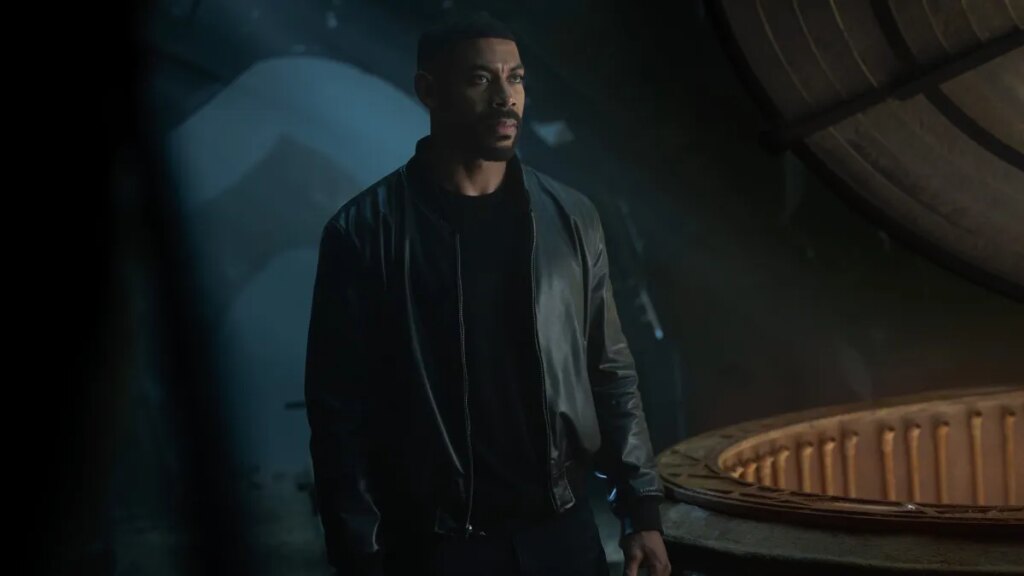
The fact that I—who has not only been reading Green Lantern comics for decades, but also regularly chose to stay home and read those comics as a teen instead of going with my family to University of Michigan football games—am not bothered in the least by this decision is a testament to Lanterns‘ quality. Shea Pritchard acquits himself well as Noah tries to maintain his composure while admitting that his Manhunter programming fills him with murderous thoughts, despite his basic human desires. But the scene truly works because of Aaron Pierre and the mature John Stewart the show has been constructing.
Make no mistake: John Stewart saves the day in that final scene. But he does so by relating to Noah, telling the boy that he understands carrying cosmic pressure since childhood. The 2016 story had tasked Pierre with playing a John Stewart who cannot have feelings, who must relate his thoughts only through quick glances and occasional lapses in body language. Up until this point, the 2026 story has asked Pierre to go too big, playing a John who embraces his feelings in rejection of his destiny as a GL.