
James Gray is undeniably one of the most underappreciated contemporary directors, considering the consistency of his films since his 1994 debut. His work has always been stylistically engaging and distinctive at the same time as borrowing elements from a number of great directors and taking inspiration from the classic Russian literature of Dostoevsky and Turgenev. Gray began his career at the incredibly young age of 24 with Little Odessa, a staggeringly well-produced and intelligent film which could easily have been made by somebody triple his age.
Starring Tim Roth, Edward Furlong, Moira Kelly and Vanessa Redgrave, the film follows Joshua (Roth), a hitman who returns to his hometown pursuing his latest target for the Russian Mafia for the first time since effectively being exiled by his abusive father Arkady (Maximilian Schell) years before. As word of his return spreads around the neighbourhood, Joshua finds himself restarting a relationship with his younger brother Reuben (Furlong), encountering a lost lover in Alla (Kelly) and, after discovering that his mother Irina (Redgrave) has a terminal brain tumour, attempting to mend some of the broken bonds within his family.
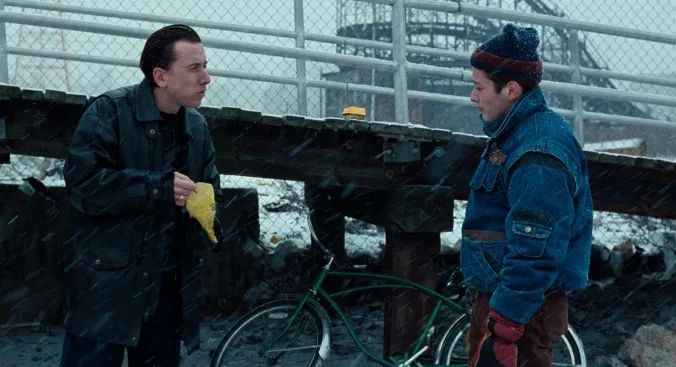
For an American crime film made by such a young director, the expectation is most likely that this is a lively, run-and-gun style mafia thriller with plenty of action and relatively minimal characters. But in reality, Little Odessa is the complete opposite. This is a classy, patient and character-driven film where the crime elements of the story are constantly secondary to the focus on the relationships between Joshua and those around him. The style of the film is wonderfully subtle throughout, shifting seamlessly between extremely grounded moments created by strong performances and on-location shooting and other moments which are ethereal because of the stunning cinematography (which looks unbelievable on this Criterion restoration).
First compelled by this very distinctive approach to telling the tale of a mob hitman, the viewer will likely soon find themselves emotionally involved in what is ultimately a story of two sons inheriting the sins of their domineering, ignorant father who is only too happy repeating those sins and failing to learn from the mistakes of his past. Little Odessa is able to generate shockingly strong emotions, considering how restrained so much of the filmmaking is, including Tim Roth’s performance, which he constantly holds back even during the most emotionally intense segments of the story.
There is a particular shot of a funeral towards the end of the film, when a large group of almost faceless mourners disperse through a heavily populated graveyard and, at some unseen point in the background, the graveyard ends, and the looming concrete labyrinth of New York begins. It makes sense that this point of change is almost impossible to make out in this brief shot, as this is a film in which the difference between life and death seems minimal. The characters who are alive are living either on the edge of death, in misery or in hiding, failing to live lives that are in any way full or joyful. Gray knows exactly how to capture that crushing emotion and express the true tragedy of this to his audience.
- New 4K digital restoration, supervised and approved by director James Gray, with 2.0 surround DTS-HD Master Audio soundtrack
- One 4K UHD disc of the film presented in Dolby Vision HDR and one Blu-ray with the film and special features
- Audio commentary from 2000 featuring Gray
- Once Upon a Time . . . “Little Odessa,” a making-of documentary by David Thompson produced for French television
- New conversation between Gray and critic and podcaster Sean Fennessey
- English subtitles for the deaf and hard of hearing
- An essay by film critic Glenn Kenny
- New cover by Michael Boland
Little Odessa will be released by the Criterion Collection on 4K UHD and Blu-ray on 7 September.