
Priceless artefacts looted from the museum after it was all but destroyed could still be found in Liverpool homes

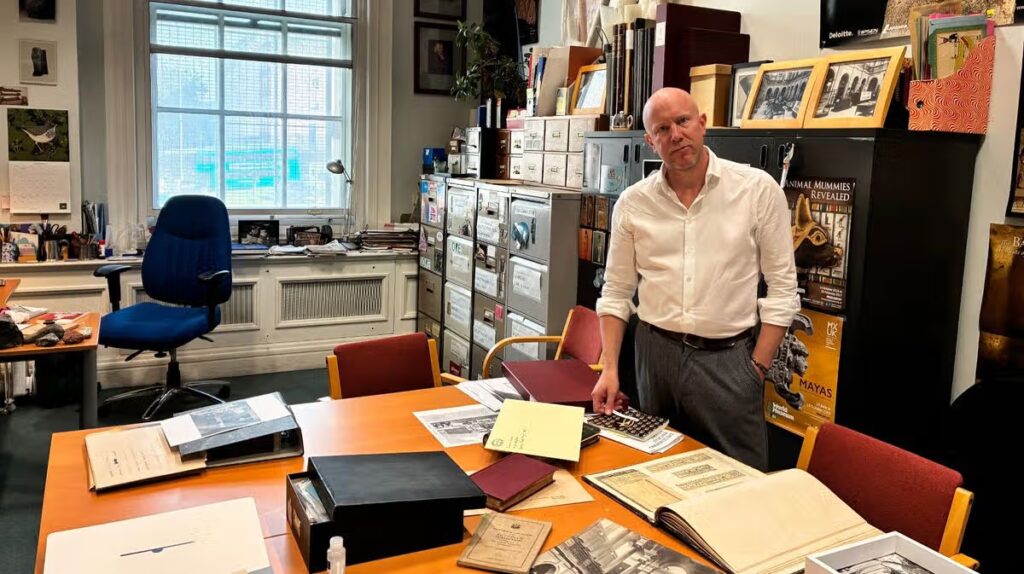
Dr Ashley Cooke, head of the World Museum, in his office(Image: Liverpool Echo)
Treasures lost when Liverpool’s World Museum was all but destroyed during the Blitz could still be found in city homes, according to the museum’s director.
Around 3,000 priceless artefacts were destroyed when a fire tore through the building after a bomb exploded on the roof of Central Library during the May Blitz of 1941. While 285 items from that time have been confirmed ‘lost’ in recent years, including a mummified body, others are marked ‘not located’ in the hope they may eventually show up.
The inferno ripped through the building from top to bottom, with burning timbers collapsing from the roof and the flames spreading quickly through air ducts. Among the living casualties was Sammy the Seal, who died in his aquarium tank.
Anglo-Saxon bronze bowls, Ancient Egyptian antiquities and items from the palaeontology gallery were lost, along with most of the taxidermy specimens.
Treasures found in Liverpool homes
Some items were looted from the museum after it was almost destroyed in the bombing. One such item was the bronze head of the goddess Isis, bent out of shape by war damage, which reappeared in 1961, 20 years after the Blitz.
The item, which once adorned the prow of an Egyptian boat used during ceremonies on the Nile, was returned to the museum by Major Dixon Nuttall of Huyton, who unwittingly acquired the priceless artefact and noticed the tiny museum stamp on the reverse.
In another instance, a local family returned mummified animal remains that had been kept inside a house in Liverpool for decades.
The Egyptian remains were borrowed decades earlier for early X-ray research and were discovered by the family after the researcher passed away.
Dr Ashley Cooke, head of the World Museum, said that less items are being found in recent years, but that it is still possible that ancient treasures taken from the museum after the bombing are languishing in homes on Merseyside and beyond.
‘Not located’
National Museums Liverpool (NML) holds an estimated four million artefacts, artworks and specimens, among the largest collections in the country. 285 items have been confirmed as lost during the past five years.
These include an Ancient Egyptian mummy and jars used to store organs in the embalming process, as well as ‘soul houses’, all used in Egyptian death rituals. The majority were lost in the blaze.
Since 2021, 210 items have been listed as ‘not located’ including the head of a Greek goddess, a gun and a pheasant.
NML insists these items are not lost, have not been stolen and are not loose. NML’s definition of ‘not located’ is that the object “still exists within the collection but we cannot currently find it”.
The museum said some of these items, including the early pinfire revolver, have since been relocated. The revolver, for instance, was marked ‘not located’ due to a duplicate index card.
This year, two swords, two knives and a dagger were marked ‘not located’ in May, and an automatic vending machine for Woodbine cigarettes—advertised at 2d per packet—which couldn’t be located in March.
Forty-five items previously listed as “lost” or “not located” have been recovered in the last 10 years.
‘It haunts me’
Dr Ashley Cooke, head of the World Museum, has spent two decades curating the museum’s Egyptian collection. In recent years he has been working to find the museum’s missing items. Tall, deep cabinets take up the wall behind his desk, each draw filled with hundreds of index cards relating to items in the Egyptian collection.
Two of these drawers are marked ‘unlocated’. Many of these index cards relate to items that vanished after the devastating fire, artefacts which Dr Cooke hopes to recover. He has already had some success, but said of the museum’s not located items: “It haunts me”.
‘I heard rumours things might come back’
The World Museum has held that name for 21 years, but the institution started out in 1852 as the Egyptian Museum on Colquitt Street, at an address now occupied by Brewdog, and the Egyptian gallery remains the second largest in the country.
But Dr Cooke said the “true scale” of Blitz damage to the Egyptian collection was “not immediately obvious” when he joined the museum in 2006.
The Blitz caused the closure of the Egyptian gallery for more than 30 years, and many of the items bear the scars of the bombing, including a ceramic coffin not previously displayed because of the damage it sustained in the fire.
Dr Cooke said: “I heard rumours that things might come back to us, and during my own time at the museum, they have.”
Another bomb damaged item was a 4,000-year-old statue shattered during the war. It was rediscovered by Dr Cooke after being categorised as “not located” for decades.
It was found in pieces in distant corners of the museum’s vast collection, pieced together with the help of a grainy pre-war photograph, and finally displayed in the Egyptian gallery.
A notable survivor of the bombing is the stone sarcophagus of Bakenkhonsu, an architect under Ramesses the Great. Originally acquired by Joseph Mayer from Arley Castle, it was intact until the Blitz shattered it. It was reassembled 30 years ago.
Mummified remains and delicate wooden coffins were moved to a former workhouse on Brownlow Hill, roughly where the Metropolitan Cathedral’s café now stands. One of the museum’s mummies bares the damage of rodents who gnawed the ancient bandages.
Ghost items
Other items remain what Dr Cooke calls “ghost” items, including a New Kingdom statue base believed to be destroyed in the bombing. It is thought to have held the name of an Egyptian ruler.
The statue base could have solved a long-running dispute over succession in the Kingdom, but it was destroyed in the bombing.
Like many of the artefacts lost during the war, the only thing that exists of it now is a line drawing which roughly copies out the inscriptions and shape of the item.